WGU C206 Course Roadmap: Ethical Leadership

WGU C206 Course Roadmap: Ethical Leadership
Two performance assessments. One core question underneath both: can you lead in a way that holds up under scrutiny, not just look good on paper?
Quick Facts
| Course | C206 — Ethical Leadership |
| Focus | Ethical decision-making, leadership responsibility, business communication, and corporate social responsibility |
| Format | Two written performance assessments — no exams |
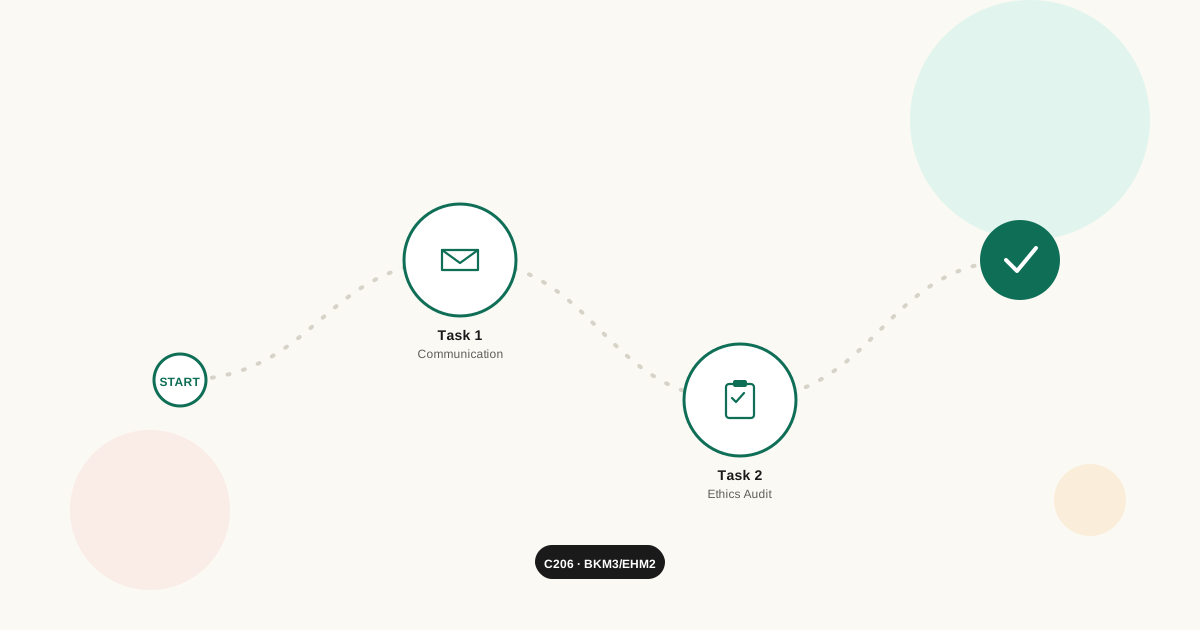
| Current assessments | BKM3 (Task 1) and EHM2 (Task 2) |
A Note on Course Structure
WGU periodically revises course structures, and C206 is a good example: older materials online reference a three-task version of this course (assessment codes EHM1 and KTP2 alongside EHM2), covering ethical theories and a personal ethics inventory as separate tasks. Based on direct review of the current task documents, C206 now runs as two tasks: BKM3, a business communication portfolio, and EHM2, an ethics audit and training program proposal. If your course materials reference a different task structure, you may be on an older or newer catalog version — check your own course page to confirm which tasks actually apply to you.
What This Course Actually Covers
C206 sits at the intersection of two skill sets that don’t always get taught together: communicating effectively across different audiences, and reasoning through genuine ethical tradeoffs as a leader. The course’s four underlying competencies — practical relevance of ethical theories, ethical leadership and codes of ethics, policy and program development, and legal/regulatory requirements — show up across both tasks, even though the tasks themselves look quite different on the surface (one is a writing-format exercise, the other is an ethics-audit report).
Task-by-Task Guides
- C206 Task 1 Guide: Building a Professional Communication Portfolio (BKM3) — six documents, five audiences, one underlying skill: adapting tone and structure correctly for whoever you’re writing to. → See also: Task 2 Guide
- C206 Task 2 Guide: Ethics Audit, Ethical Dilemmas, and Training Program Design (EHM2) — conducting an ethics audit, applying an ethical decision-making framework to a dilemma, and designing a training program that would actually work. → See also: Task 1 Guide
Both tasks draw on the same underlying leadership competencies, just applied differently — Task 1 tests whether you can communicate ethically-aware leadership decisions to different audiences; Task 2 tests whether you can actually make those decisions using a defensible framework. Reading both guides together reinforces that connection rather than treating them as unrelated assignments.
Key Concepts Worth Understanding Deeply
Supporting Task 1 (Communication Portfolio):
- Professional Email Writing
- Business Communication Fundamentals
- Executive Communication
- Persuasive Writing
- Stakeholder Analysis
- Customer Complaint Management
- Negotiation Skills
- Cross-Cultural Communication in Business
- Understanding Bias in the Workplace
Supporting Task 2 (Ethics Audit & Training):
Several of these — CSR, stakeholder theory, and the ethical-theories comparison — were originally built for a different course cluster and apply just as directly here, which is a genuine sign of how reusable these underlying business-ethics concepts are across a leadership curriculum, not a coincidence of site structure.
Templates and Study Aids
- Communication Tone Checklist (Task 1) — a quick-reference guide for matching tone to audience across all five portfolio documents
- Ethics Audit Worksheet (Task 2) — a fillable structure for organizing stakeholders, CSR responses, and training topics before drafting the full report
Disclaimer
This roadmap is an independent study aid based on C206’s publicly documented course structure and directly reviewed current task instructions. It’s not affiliated with or endorsed by WGU. Both linked task guides use entirely fictitious companies and scenarios to teach the underlying method — neither references the real Kamelon/Nasaquil/Sparkit communication scenarios or the real Paradigm Toys ethics scenario in any of their worked examples.
References & Further Reading
- Hu, Y., Yang, Y., & Lee, P. K. C. (2022). Effective Practices for Improving Service Professionals’ Ethical Behaviors: A Multiple Method Study. Frontiers in Psychology, 13. — A peer-reviewed study on practical approaches to improving ethical behavior in organizations, relevant background for this course’s leadership and ethics focus. See the Task 1 and Task 2 guides, and each linked concept explainer above, for topic-specific citations.
Need help across either C206 task?
Between the communication portfolio and the ethics audit, C206 asks for two genuinely different skill sets in one course. If you’re not sure where to start, an Assignment Clarity Session can cover either task — or both — in one conversation.