
What Is Stakeholder Theory?

What Is Stakeholder Theory?
Plain-Language Definition
Stakeholder theory says a company’s decisions should account for everyone affected by them — not just shareholders. That includes employees, customers, suppliers, the local community, and sometimes the environment itself. It’s a deliberate contrast to the older idea that a company’s only real obligation is maximizing shareholder profit, popularized in business scholarship by R. Edward Freeman’s foundational work reframing the corporation as a network of relationships rather than a single-purpose profit machine.
Why It Matters
Most business-ethics tasks ask you to identify stakeholders and describe how they’re impacted by a decision. The part students consistently lose points on isn’t identifying a stakeholder — it’s describing a specific, concrete impact rather than a vague label.
“Employees are affected” is not stakeholder analysis. “Employees lose eligibility for healthcare benefits when their hours drop below 30/week” is.
Beyond coursework, stakeholder theory matters because companies that only track shareholder interests tend to get blindsided by exactly the groups they weren’t watching — a community group organizing around an environmental concern, or a supplier relationship quietly deteriorating because it was never treated as worth managing carefully. The pattern shows up repeatedly in real corporate failures: the warning signs were rarely invisible, they were just coming from a stakeholder group leadership hadn’t been tracking closely enough to notice until the issue became public and costly.
Primary vs. Secondary Stakeholders
Stakeholder theory typically distinguishes between two categories:
- Primary stakeholders are directly and significantly affected by the organization’s decisions and essential to its ongoing operation — employees, customers, shareholders, key suppliers.
- Secondary stakeholders are affected by or interested in the organization’s actions but aren’t essential to its direct, day-to-day operation — the local community, advocacy groups, media, regulators.
This distinction matters practically: primary stakeholders often warrant direct operational responses (a policy change, a benefits adjustment), while secondary stakeholders often warrant communication and transparency (a public report, a disclosure) rather than an operational change. Neither category is “more important” in an absolute sense — the distinction is about directness of impact and operational necessity, and it shapes what kind of response actually fits.
The Stakeholder Salience Model: Prioritizing Who Matters Most Right Now
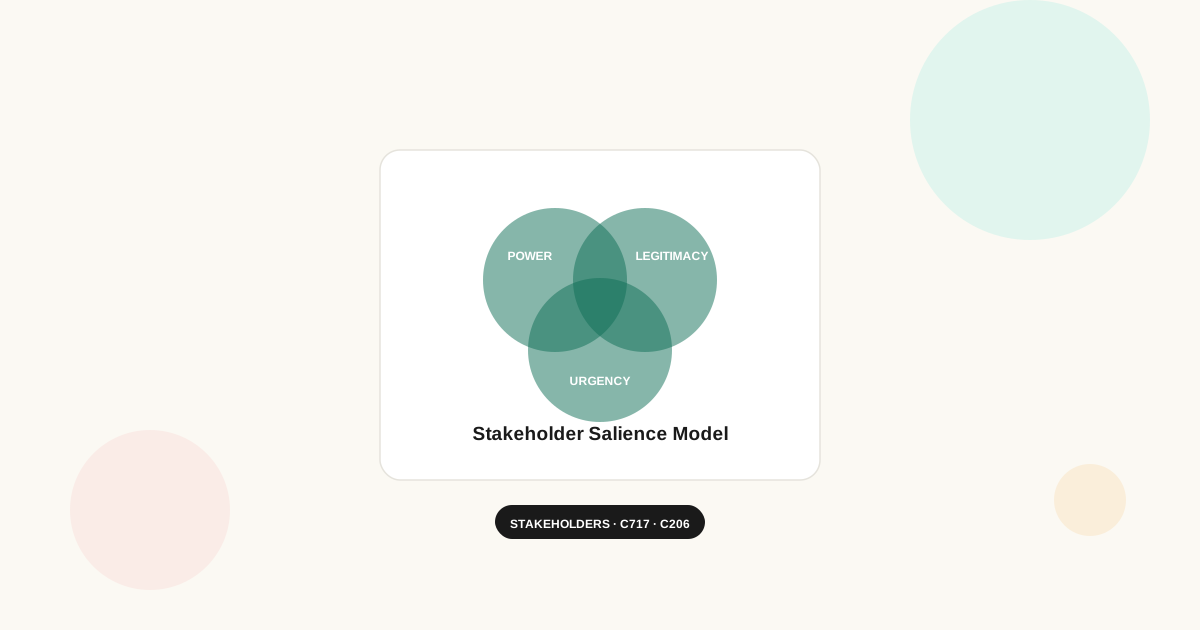
Once you’ve identified your stakeholders, a genuinely useful next step — one many students skip — is prioritizing them. The stakeholder salience model, developed by Mitchell, Agle, and Wood and still widely applied in current research, evaluates each stakeholder along three attributes:
- Power — their ability to influence the outcome (through resources, authority, or leverage)
- Legitimacy — whether their claim is perceived as appropriate or valid
- Urgency — how time-sensitive or critical their claim is right now
A stakeholder with all three attributes — power, legitimacy, and urgency — is highly salient and demands immediate managerial attention. A stakeholder with only one attribute (say, power but no legitimacy or urgency, like a large but currently disengaged investor) still matters, but requires monitoring rather than urgent action. Recent peer-reviewed research applying this model outside its original business context — including in healthcare priority-setting — has found it provides a more complete picture than power alone, precisely because it forces you to separately consider whether a claim is legitimate and how time-sensitive it is, not just who has leverage.
Why this matters for coursework: many assignments ask you to identify stakeholders without asking you to explicitly prioritize them, but demonstrating that you could rank their salience — even briefly — signals a more sophisticated understanding than a flat, unranked list, and it’s often the detail that separates a merely adequate stakeholder section from a genuinely strong one.
How to Do Stakeholder Analysis Well
- Name the group specifically. Not “the community” — which part of it? Local suppliers? Residents near a facility? Future customers?
- Describe the concrete change. What actually shifts for them — money, time, safety, trust, access?
- Explain why it matters to them, not the company. Stakeholder analysis is about impact on the stakeholder, not about how it makes the company look.
- Avoid double-counting. Two stakeholders should be affected differently — if your two stakeholders both experience the same generic harm, you likely haven’t found two distinct impacts.
- Consider salience, even briefly. Which stakeholder’s claim is most urgent right now, and does that change how you’d sequence your response?
Worked Example (Fictitious Company)
Bellhaven Foods’ misleading “locally sourced” claim affects:
- Customers — who pay a premium price based on a sourcing claim they reasonably relied on, receiving less value than the price implied.
- Regional farmers — who lose shelf space and revenue to an undisclosed distributor relationship, even though the company’s marketing implies it prioritizes their partnership.
Notice these are two different kinds of harm — financial deception for one group, lost business opportunity for another — not the same complaint said twice.
Applying salience: Customers have high power (collective purchasing decisions, social media visibility) and high urgency (an active, spreading complaint) but debatable legitimacy until the facts are confirmed. Regional farmers have high legitimacy (a genuine, verifiable business harm) but lower immediate power and urgency unless they organize collectively. This suggests Bellhaven’s most urgent response is customer-facing transparency, with a farmer-facing resolution following closely behind rather than being deprioritized entirely.
A Second Example: Prioritizing Under Time Pressure
Northfield Ergonomics, a fictitious office furniture manufacturer, discovers a safety issue with a manufacturing line at the same time a long-time supplier is threatening to end the relationship over a payment dispute.
- Manufacturing employees (safety issue): High power (unionized workforce, ability to halt production), high legitimacy (a genuine safety concern), high urgency (immediate physical risk). This stakeholder group is maximally salient — it demands immediate action ahead of anything else.
- The supplier (payment dispute): Moderate power (they could end the relationship, but Northfield has backup suppliers), high legitimacy (a legitimate contractual dispute), moderate urgency (damaging but not immediately dangerous). This stakeholder still matters, but the salience model makes clear it doesn’t require the same immediate response as the safety issue.
This is the practical value of thinking in terms of salience rather than a flat list: it gives you a defensible reason for sequencing your response, which is often exactly what a well-reasoned business recommendation needs to demonstrate.
Common Mistakes
- Naming a stakeholder group without describing a specific, concrete consequence
- Treating “the community” or “employees” as a single undifferentiated block rather than naming the specific subgroup actually affected
- Listing stakeholders without any sense of priority, when a brief salience assessment would strengthen the analysis
- Choosing two stakeholders who experience essentially the same kind of harm, rather than two genuinely distinct impacts
- Confusing a stakeholder’s loudness with their legitimacy — a vocal complaint isn’t automatically a legitimate one, and a quiet stakeholder isn’t automatically a low-priority one
Self-Assessment Questions
- Have I named a specific subgroup, not a generic category like “the public” or “employees”?
- Does each stakeholder I’ve identified experience a genuinely different kind of impact?
- Could I rank my stakeholders by power, legitimacy, and urgency if asked to?
- Have I explained the impact from the stakeholder’s perspective, not the company’s reputational concern?
Key Takeaways
- Stakeholder theory expands “who matters” beyond shareholders to anyone materially affected by a decision
- Primary stakeholders are directly affected and essential to operations; secondary stakeholders are affected or interested but not operationally essential — and each often warrants a different type of response
- The stakeholder salience model (power, legitimacy, urgency) offers a practical way to prioritize among identified stakeholders, not just list them
- Good stakeholder analysis names a specific group and a specific, concrete consequence
- Two stakeholders in an analysis should experience genuinely different impacts, not variations on the same one
Related Content
- C717 Task 1 Guide: Ethics Theory & Stakeholder Analysis
- WGU C206 Task 2 Guide: Ethics Audit, Ethical Dilemmas, and Training Program Design
- Understanding Corporate Social Responsibility (CSR)
- Virtue Ethics vs. Utilitarianism vs. Principle-Based Ethics
- Stakeholder Analysis
References & Further Reading
- Valentinov, V. (2023). Stakeholder Theory: Toward a Classical Institutional Economics Perspective. Journal of Business Ethics, 188(1), 75–88. — A recent peer-reviewed paper examining stakeholder theory’s foundations, published in one of management research’s top-ranked journals.
- Kapiriri, L., & Razavi, S. D. (2021). Salient Stakeholders: Using the Salience Stakeholder Model to Assess Stakeholders’ Influence in Healthcare Priority Setting. Health Policy OPEN. — A peer-reviewed application of the power/legitimacy/urgency salience model outside its original business context, demonstrating its continued relevance as a prioritization tool — the basis for this page’s salience-model section.