
WGU C717 Task 1 Guide: Applying Ethical Theory to a Real Scenario

WGU C717 Task 1 Guide
Written by EmployedScholar Editorial Team · Reviewed July 17, 2026
TechFite isn’t asking whether you know what utilitarianism means. It’s asking whether you can point it at a messy situation and get somewhere useful.
What This Task Actually Tests
Here’s the trap: Task 1 looks like a knowledge check. Define a theory, spot an issue, name a stakeholder, done. It isn’t. WGU already knows you can look up what utilitarianism means. What they’re checking is whether you can hold a real, contradictory business situation — good PR promises, bad internal practices — and reason through it out loud, using a theory as your lens instead of your gut.
That distinction changes how you write the whole task. A definition-and-vibes answer gets partial credit at best. An answer that traces cause and effect through the theory gets full marks.
What Evaluators Are Looking For
- A1: A clean, accurate description of one theory — not a Wikipedia paraphrase, an actual explanation of how it evaluates right and wrong.
- A2 / A3: Two genuinely different ethical issues. Not two symptoms of the same root problem restated — evaluators can tell when “unfair labor practices” and “unfair scheduling” are the same issue wearing two hats.
- A2b / A3b: Two stakeholders per issue, described with an actual consequence, not a label. “Employees are affected” isn’t an answer. “Employees lose benefits eligibility when hours drop below 30/week” is.
- A2c / A3c: The theory applied to the specific facts, reaching somewhere. If your theory paragraph would work unchanged for a completely different scenario, it’s not applied — it’s decoration.
- B1: One alignment and one conflict per policy — both required, not just the criticism.
- C1–C3: Three CSR strategies that are actually different from each other, each tied to why it would move the needle on TechFite’s reputation, not just why it sounds nice.

The Three Theories, Without the Fog
- Virtue ethics asks: what would a person of good character do here? It’s less about rules and outcomes, more about the kind of decision-maker the company is choosing to be.
- Utilitarianism asks: which choice produces the best overall outcome across everyone affected? It’s a weighing exercise — benefits and harms, tallied.
- Principle-based ethics asks: what rule or duty applies here, regardless of outcome? If a promise was made, principle-based reasoning says keep it — full stop, consequences aside.
Picking a theory isn’t about which one you like — it’s about which one gives you the clearest argument for the specific issue you’re analyzing. A broken public promise fits principle-based ethics almost too well; a resource-allocation tradeoff often fits utilitarianism better.
Spotting an Ethical Issue — A Repeatable Test
Scenarios like this one are built around gaps. Run this test on any claim in the case:
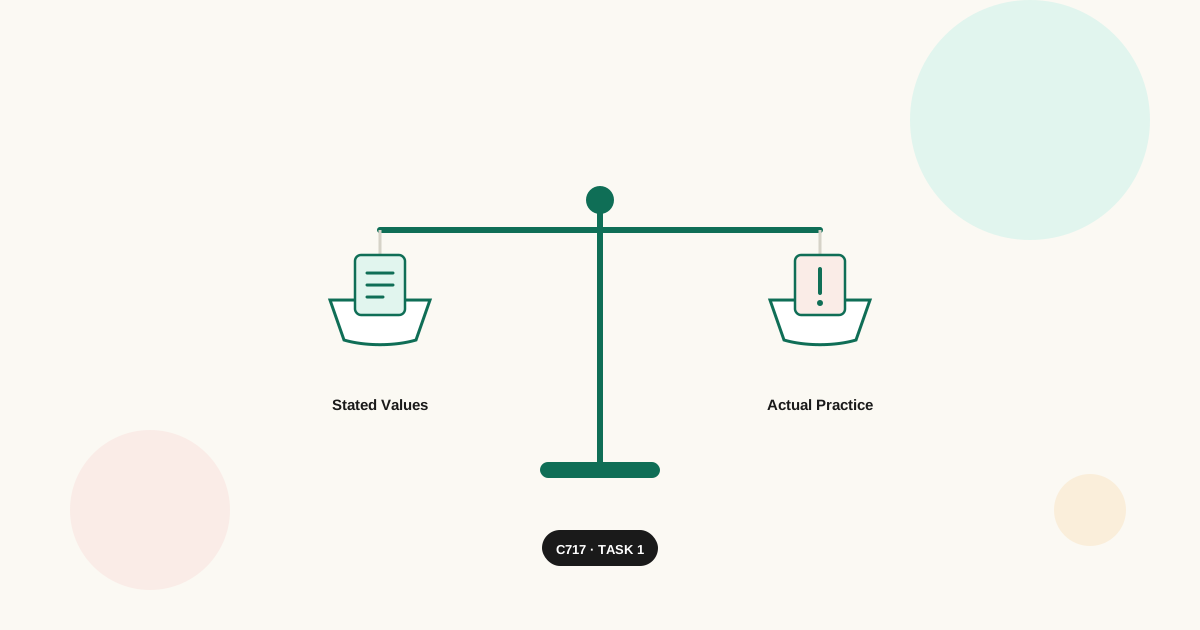
Does the company’s stated value or public commitment contradict what it’s actually doing?
That gap — promise vs. practice — is where ethical issues live. It’s rarely subtle once you’re looking for the specific pattern instead of a general “something feels off.”
Stakeholder Analysis Without Hand-Waving
For each issue, pick two stakeholder groups who are affected differently — not two groups who feel the same generic impact. Good stakeholder analysis names:
- Who specifically is affected (not “the community” — which part of it?)
- What concretely changes for them (money, time, trust, safety)
- Why that impact matters to them specifically, not to the company’s reputation in the abstract
Applying a Theory So It Actually Argues Something
A weak application: “Utilitarianism says we should maximize good outcomes, so the company should do the right thing.”
A strong application traces the logic: state the theory’s core test, apply it directly to the facts of this issue, and land on what the theory recommends — specifically because of those facts, not in general.
Analyzing a Policy for Alignment and Conflict
Every policy in a case like this is usually written in corporate hedge-language — it promises something in one sentence and reserves the right to not do it in the next. Your job is to find both halves:
- Alignment: which sentence or clause reflects the company’s stated ethical commitments?
- Conflict: which sentence undercuts it — usually a discretionary clause, a “subject to” qualifier, or a vague threshold?
Policies like this are almost always internally contradictory by design. Finding both halves is usually easier than it looks once you know to expect it.
Corporate Social Responsibility — Three Angles, Not One Vague Concept
CSR strategies in this task need to hit three genuinely distinct areas — mirroring the framework in ISO 26000, the widely used international guidance on social responsibility:
- Employee-focused — how the company treats the people who work for it
- Community-focused — how it engages the place it operates in
- Environmental — how it manages its physical footprint
A strategy only counts if it’s actionable — something the company could actually implement — not an aspiration restated as a plan.
Worked Example — Different Company, Same Method
To demonstrate the reasoning pattern without mapping onto TechFite’s actual facts, here’s a walkthrough using a fictitious company: Bellhaven Foods, a regional grocery chain.
Scenario (fictitious): Bellhaven’s marketing claims all produce is “locally sourced within 100 miles,” a claim featured heavily in store signage and its sustainability report. Internal sourcing data (fictitious) shows only 40% of produce actually meets that threshold — the rest is relabeled after being sourced from a national distributor.
Ethical issue: A gap between a public sustainability claim and actual sourcing practice — consumers are being misled about what they’re paying a premium for.
Two stakeholders:
- Customers, who pay a “local” premium for produce that isn’t local, based on a claim they reasonably relied on.
- Regional farmers, who lose shelf space and revenue to a distributor relationship the company doesn’t disclose.
Applying principle-based ethics: The core question is whether Bellhaven is honoring a duty of honest representation, independent of the financial outcome. A public sustainability claim functions as a promise to the customer; principle-based ethics says that promise creates an obligation to either meet the 100-mile standard or stop making the claim — regardless of whether the mislabeling is more profitable.
Policy alignment/conflict (fictitious sourcing policy): Bellhaven’s sourcing policy states a commitment to “prioritizing regional partnerships” (alignment) while also stating produce may be sourced “based on cost and availability at the company’s discretion” (conflict) — the same hedge-clause pattern you’ll likely find in the TechFite policies.
This is the shape your own A2/A3 and B1 answers need — issue, stakeholders with concrete impact, theory applied to the specific facts, and a policy read for both halves — built from TechFite’s actual scenario and policy documents rather than these fictitious ones.
Still not sure your two ethical issues are different enough from each other? An Assignment Clarity Session walks through your specific issues with you; not a hypothetical.
Common Mistakes to Avoid
- Restating the same ethical issue twice with different wording for A2 and A3
- Naming a stakeholder without describing a concrete, specific impact
- Defining a theory accurately but never actually applying it to the facts
- Only finding the conflict in a policy and skipping the alignment (or vice versa)
- Writing CSR strategies that are aspirational statements, not actions
Self-Assessment Checklist
- Are my two ethical issues genuinely distinct, not the same problem restated?
- Did I name a specific consequence for each stakeholder, not a vague label?
- Does my theory application only make sense for this specific issue — or would it work for any scenario unchanged?
- Did I find both an alignment and a conflict in each policy?
- Is each CSR strategy something TechFite could actually do next quarter, not just believe in?
References & Further Reading
- Stanford Encyclopedia of Philosophy — authoritative academic overviews of virtue ethics and the history and reasoning behind utilitarianism, useful for going deeper than a textbook summary.
- ISO 26000 — the international guidance standard on social responsibility, which frames CSR around governance, human rights, labor practices, environment, fair operating practices, and community involvement — the same structure this task’s CSR section draws from.
- ASQ’s overview of ISO 26000 — a more digestible plain-language summary of the same standard, useful if the official ISO documentation feels dense.
Frequently Asked Questions
Is TechFite a real company?
No. TechFite is a teaching scenario WGU uses across its business courses — it’s not a real corporation, and none of the events, policies, or figures in the case are drawn from an actual company.
Does this guide give me the answers to C717 Task 1?
No. This guide teaches the reasoning method — how to spot an ethical issue, analyze stakeholders, apply a theory, and read a policy for alignment and conflict — using a fictitious company (Bellhaven Foods) as the worked example. Applying that method to TechFite’s actual scenario and policies is still your own work.
How long does C717 Task 1 typically take?
Most students report spending several hours across a few sittings — reading the scenario and policies closely, then drafting each part. Budgeting more time for A2/A3 and B1 (the sections requiring the most specific reasoning) tends to pay off more than rushing through a first draft.
Is getting help with this task against WGU’s academic integrity policy?
Tutoring, coaching, and editing support are a normal, accepted part of studying — most university policies explicitly support students getting this kind of help. Our role is to help you understand and strengthen your own work, which fits well within that.
Can I use the Bellhaven Foods example in my own submission?
No; it’s a different, fictitious company built specifically to demonstrate the method without overlapping with TechFite’s facts. Your submission needs to reason through TechFite’s actual scenario and policy documents.
Build Notes
- All figures, names, and scenario details in the worked example (Bellhaven Foods, the 100-mile claim, the 40% figure) are entirely fictitious — written specifically to avoid overlapping with TechFite’s actual facts, so this teaches the method without mapping onto the real assignment’s answers.
- This guide does not answer A1’s theory choice, A2/A3’s specific issues, B1’s specific policies, or C1–C3’s specific strategies for TechFite — those require the student’s own reading of the actual TechFite documents, which is the point.