
Understanding Corporate Social Responsibility (CSR)

Corporate Social Responsibility (CSR)
Plain-Language Definition
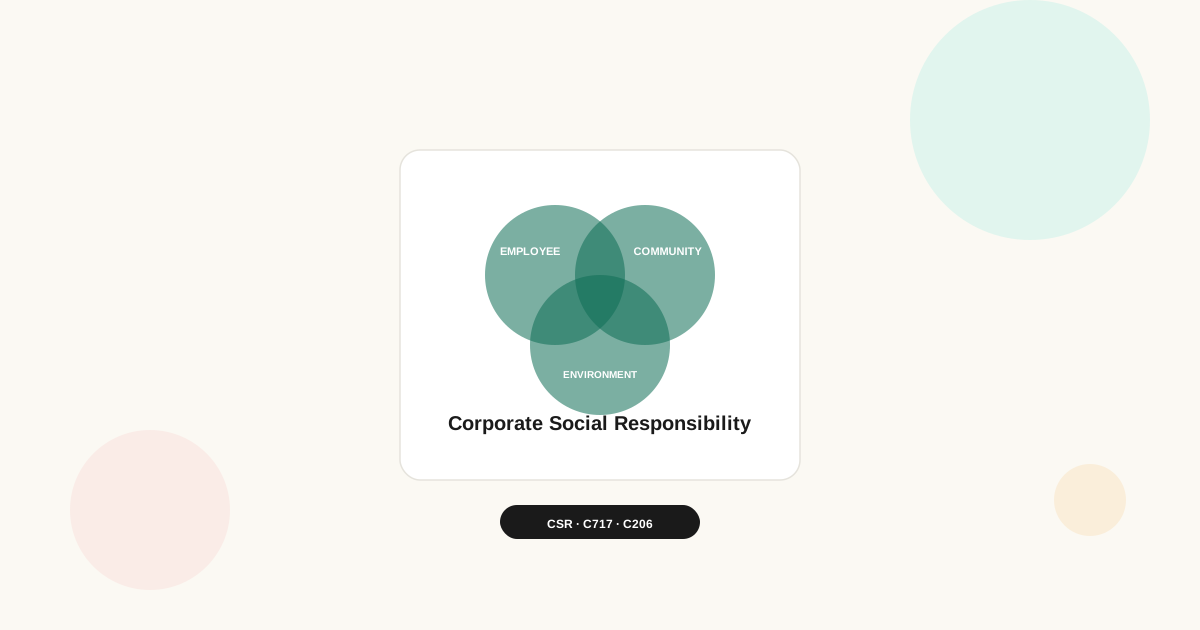
Corporate Social Responsibility is a company’s commitment to operating in a way that accounts for its impact on people and the environment — not just its financial return. It’s the practical application of stakeholder thinking: decisions get evaluated not only by “is this profitable” but “is this responsible.” CSR isn’t a single program or a single donation — it’s a lens applied across how a company treats its employees, engages the communities it operates in, and manages its environmental footprint, woven into ordinary business decisions rather than sitting off to the side as a charity initiative.
Why It Matters
Every WGU business course that touches ethics, leadership, or strategy eventually asks you to explain how a company should meet its CSR obligations to a specific stakeholder. The most common way students lose points isn’t misunderstanding what CSR is in the abstract — it’s failing to make the CSR response specific to the stakeholder and the company’s actual situation. A generic statement like “the company should be more socially responsible” says nothing an evaluator can assess. A statement like “the company should publish quarterly emissions data specific to its manufacturing facility, addressing the community’s concern about air quality” is something concrete enough to evaluate, defend, or challenge.
CSR also matters far beyond the classroom. Companies that treat CSR as a compliance checkbox — meeting the legal minimum and calling it done — tend to get caught flat-footed when a stakeholder group organizes around an issue the company never took seriously. Companies that treat CSR as embedded practice tend to have already built the trust and the internal processes that make a crisis smaller when it does happen.
CSR vs. Legal Compliance
A useful distinction: legal compliance is the floor — the minimum a company must do to avoid legal liability. CSR is a ceiling a company chooses to build above that floor, voluntarily, because it believes doing so is right, builds trust, or serves its long-term interest. A company can be fully legally compliant and still fail badly at CSR — meeting every regulation on workplace safety while still running a workplace culture that quietly punishes people who report near-misses, for example. Recognizing this distinction matters for coursework: a CSR analysis that only restates what the law already requires isn’t really analyzing CSR at all.
The Framework Most Tasks Actually Want
CSR assignments tend to expect strategies or analysis across three genuinely distinct angles, mirroring the structure used in ISO 26000, the widely referenced international guidance standard on social responsibility, and echoed in Carroll’s influential CSR pyramid model (economic, legal, ethical, and philanthropic responsibility):
- Employee-focused — how the company treats the people who work for it (compensation, benefits, working conditions, growth opportunities, safety, psychological wellbeing)
- Community-focused — how it engages the place it operates in (local investment, partnerships, transparency about commitments, addressing concerns raised by residents or local organizations)
- Environmental — how it manages its physical footprint (emissions, waste, resource use, supply chain sustainability)
Some frameworks add a fourth angle — economic responsibility to shareholders — but most WGU-style tasks focus specifically on the three above, since they’re the ones most directly tied to external stakeholder trust rather than pure financial performance.
Primary vs. Secondary Stakeholders in a CSR Context
CSR analysis usually asks you to distinguish between primary stakeholders (directly and significantly affected by the company, essential to its operation — employees, customers, shareholders) and secondary stakeholders (affected by or interested in the company’s actions, but not essential to daily operation — the local community, advocacy groups, regulators, media). This distinction matters because a strong CSR response often looks different for each: a primary stakeholder like employees might warrant a direct policy change (safer equipment, clearer promotion criteria), while a secondary stakeholder like the surrounding community might warrant transparency and communication (a public environmental report) rather than a direct operational change.
Why It Matters
The most common way students lose points on CSR tasks isn’t picking a bad strategy — it’s picking a response that’s all restatement and no substance, or picking two stakeholder responses that are really the same idea phrased twice. A CSR response only counts as a real answer when it answers: what would the company actually do, and how does that specific action address this specific stakeholder’s specific concern?
Worked Example (Fictitious Company)
For Bellhaven Foods, a fictitious regional grocery chain facing a mislabeled “locally sourced” claim scenario:
- Employee-focused: Train store staff to accurately label sourcing at the shelf level, with a reporting channel for flagging mislabeled products — turning frontline staff into an accountability layer rather than a source of the problem.
- Community-focused: Publish a quarterly, itemized sourcing report showing exactly which products meet the 100-mile claim and which don’t, rebuilding trust through transparency rather than a renewed marketing claim.
- Environmental: Since shorter supply chains reduce transportation emissions, actually increasing the real percentage of local sourcing (not just the claim) doubles as an environmental strategy — one action serving two CSR angles, worth pointing out explicitly when it genuinely applies.
A Second Example: Distinguishing Primary and Secondary Responses
Northfield Ergonomics, a fictitious office furniture manufacturer, is auditing its CSR practices after a supplier capacity issue exposed gaps in its safety-reporting culture.
- Primary stakeholder — employees: Their direct interest is safe working conditions and fair scheduling. The CSR response is operational: implement a transparent, anonymous safety-incident reporting process, and commit publicly to reviewing every report within 48 hours.
- Secondary stakeholder — the local community: Their interest is environmental impact from the manufacturing facility, but they aren’t part of daily operations. The CSR response is communicative rather than operational: publish an annual environmental impact report with specific emissions and waste figures, rather than a general sustainability statement no one can verify.
Notice the type of response differs based on the stakeholder type — a primary stakeholder often warrants a direct operational commitment, while a secondary stakeholder often warrants transparency and communication. This isn’t a rigid rule, but it’s a useful starting instinct when a CSR task asks for responses tailored to each stakeholder type.
Common Mistakes
- Writing one generic CSR statement and applying it to both a primary and secondary stakeholder, rather than tailoring the response to each
- Confusing legal compliance with CSR — restating what the law already requires isn’t a CSR analysis
- Proposing an aspirational statement (“the company should care more about the environment”) instead of an actionable, specific commitment
- Failing to connect the CSR response back to the specific concern the stakeholder actually has in the scenario
- Treating CSR as philanthropy alone (donations, sponsorships) while ignoring the employee, community, and environmental dimensions embedded in core operations
Self-Assessment Questions
- Does my CSR response for each stakeholder name a specific, concrete action — not just a value statement?
- Have I avoided restating the same response twice for two different stakeholders?
- Does each response address that stakeholder’s actual stated concern in the scenario, not a generic concern?
- Would a skeptical reader be able to tell the difference between my primary-stakeholder response and my secondary-stakeholder response?
Key Takeaways
- CSR is a company’s voluntary commitment to operate responsibly toward people and the environment, distinct from and beyond the legal minimum
- The three-pillar structure — employee, community, environmental — covers most of what CSR tasks expect, alongside economic responsibility to shareholders in some frameworks
- Primary and secondary stakeholders often warrant different types of CSR response — operational commitments for primary stakeholders, transparency and communication for secondary ones
- A CSR strategy only counts as a real answer when it names a specific action tied to a specific stakeholder concern
- Sometimes one action serves multiple CSR angles at once — worth noting explicitly when true, but don’t force the connection if it isn’t genuine
Related Content
References & Further Reading
- Silva Junior, A. D., Martins-Silva, P. D. O., Coelho, V. D., & Sousa, A. F. D. (2023). The Corporate Social Responsibility Pyramid: Its Evolution and the Proposal of the Spinner, a Theoretical Refinement. Social Responsibility Journal, 19(2), 358–376. — A recent peer-reviewed paper tracing the evolution of Carroll’s foundational CSR framework and proposing an updated model, useful for understanding how the economic/legal/ethical/philanthropic structure has developed.
- ISO 26000 — the currently active international guidance standard on social responsibility, reflected in the employee/community/environmental framing used above.