
WGU C208 Task 1 (JHM2): Change Strategy Guide with a Worked Example

One organization. Two fundamental problems. A change strategy leadership could actually act on. Here’s how to build all three pieces so they hold together.
Executive Summary
C208 Task 1 (assessment code JHM2) asks you to diagnose two genuine, evidenced problems inside an organization you have real experience with, then build a strategic plan to fix them; covering implementation, evaluation, sustainment, and how you’ll communicate the whole thing to the people it affects.
It looks like a writing exercise in five lettered sections. It’s actually testing something narrower and more practical: whether you can trace a straight line from specific evidence to a specific fix to a specific way of knowing it worked — the same reasoning a real change initiative lives or dies on.
What’s Covered in This Guide
- Why this task is graded on evidence and traceability, not on picking the “right” change theory
- What separates a Competent fundamental-problems section from one that reads as opinion
- A worked demonstration of Part A and Part B structure using a clearly fictional organization and narrator
- How the multimedia presentation should differ from the written report, not duplicate it
- Common mistakes, a self-assessment pass, and links to related MSML program guides
JHM2 Task 1 Assignment
Change Management and Innovation — C208
Introduction
An organization’s ability to survive depends on its leadership’s capacity to effectively lead innovation and planned change. Sustainable change depends on accurate diagnosis and effective intervention.
For this assessment, you will outline a change strategy for an organization of your choice. Your chosen organization must be one that you have experience with and one that has opportunities for you to develop a strategic plan. Your strategic planning should help the organization address its fundamental problems and help create sustained organizational change.
Note: Any information that would be considered confidential, proprietary, or personal in nature should not be included in the actual task submission to WGU. Do not include the actual names of people, suppliers, the organization(s), or other identifiable information. Fictional names should be used.
Also, organization-specific data, including financial information, should not be included but should be addressed in a general fashion as appropriate. Work performed for a client, or an employer is their property and should not be used without written permission.
Requirements
Your submission must represent your original work and understanding of the course material. Most performance assessment submissions are automatically scanned through the WGU similarity checker. Students are strongly encouraged to wait for the similarity report to generate after uploading their work and then review it to ensure Academic Authenticity guidelines are met before submitting the file for evaluation. See Understanding Similarity Reports for more information.
Understanding the Assignment
Five lettered parts, and they build on each other more than they first appear to.
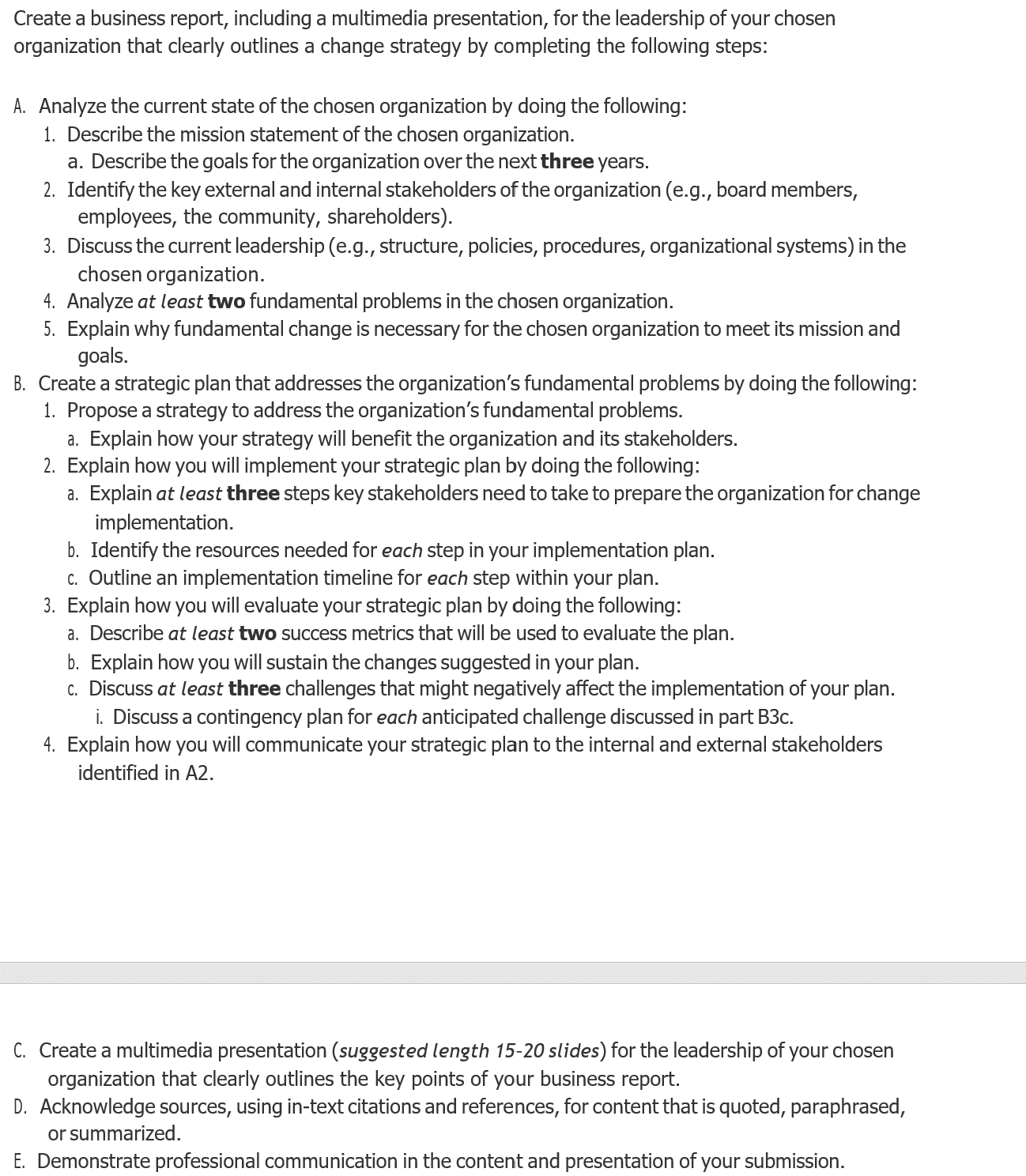
- Part A analyzes the organization’s current state — mission, stakeholders, leadership structure, and at least two fundamental problems with evidence behind them.
- Part B builds the strategic plan: the proposal itself, an implementation plan with steps/resources/timeline, an evaluation plan with metrics and contingencies, and a communication plan.
- Part C is a 15–20 slide presentation of the same material for a leadership audience.
- Parts D and E cover citations and professional communication. The two sections doing the heaviest lifting are A and B, and they’re connected the same way C210’s bibliography and application examples are: the problems you name in A only work if Part B’s strategy actually resolves them, point for point.
Why WGU Uses This Change Strategy Task
A task that just asked you to describe a change model would test recall. Asking you to diagnose real problems in an organization you actually know, then build a plan specific enough that leadership could act on it, tests something closer to what separates someone who can manage change from someone who can define it.
The evidence requirement in Part A exists for the same reason a real business case needs data before it gets funded; a plan built on an opinion (“morale is low”) is much easier to challenge, and much harder to evaluate, than one built on a pattern (“exit interviews over the past year cite the same two causes”).
Before You Begin
- Choose an organization you have personal, first-hand experience with — a current or former employer, a nonprofit, or an organization you’ve volunteered with. You need enough insider knowledge to name specific evidenced problems, not general industry ones.
- Fictionalize the organization’s name and any identifying or financial details before you start drafting — build the disguised version early so it stays consistent across the report and the deck.
- Confirm your current task instructions and rubric directly before you write — WGU periodically revises PA requirements, and some older example papers circulating online include a standalone SWOT section that isn’t part of every version of this task.
- Have your evidence ready before you draft Part A — a turnover rate, a complaint pattern, a missed-deadline pattern. Vague assertions are the single most common reason this section comes back below Competent.
Part A: Analyzing the Organization’s Current State
What each sub-part needs, per the rubric:
- A1 — Mission and three-year goals: the actual mission statement (or your best reconstruction of it), translated into specific goals leadership is realistically working toward.
- A2 — Stakeholders: internal and external groups, each with a sentence on why they have a stake in the outcome.
- A3 — Leadership structure: how decisions actually get made — org shape, policy process, how communication flows.
- A4 — Fundamental problems: at least two, each backed by specific, plausible evidence.
- A5 — Why change is necessary: each A4 problem connected explicitly back to the A1 mission and goals.
Where “Approaching Competence” papers fall short: the sections are all present, but A4 in particular tends to read as an opinion restated with more words — “communication is poor across departments” — rather than a pattern a reader could independently verify. The gap between Approaching Competence and Competent here is almost entirely about whether the evidence is specific enough to be checked, not about whether the problem is real.
Demonstrating a Strong Fundamental-Problems Section
To show what evidenced, traceable A4/A5 sections look like — not to hand you language to copy — here’s a fictional narrator, Jordan Ellery, applying this structure to a fictionalized mid-size outpatient clinic group, Meridian Health Partners:
A4, Problem 1: New-patient intake wait times have grown from an average of 12 days to 27 days over the past 18 months, driven by a scheduling system that can’t route referrals across locations.
A4, Problem 2: Clinical staff turnover reached 34% in the past year, concentrated among nurses with under two years of tenure, and exit-interview themes point to scheduling unpredictability and limited onboarding support.
A5: Meridian’s mission commits to “accessible, continuous care across every location it serves.” A 27-day intake wait directly contradicts “accessible,” and losing a third of its newest nurses annually undermines “continuous” — the same clinician rarely sees a patient through more than a few visits before turning over.
Notice both problems are specific enough that a reader could ask for the underlying data, and A5 doesn’t restate A4 — it draws a direct line from the evidence to the exact mission language it contradicts. That’s the traceability the rubric is checking for, independent of which organization or industry you’re writing about.

Part B: Building the Strategic Plan
What evaluators check across B1–B4: one coherent strategy that addresses both A4 problems (not a list of unrelated fixes), an implementation plan with specific steps/resources/timeline, an evaluation plan with measurable success metrics and a contingency for each anticipated challenge, and a communication plan matched to the stakeholders named in A2.
Demonstrating the Structure (Fictional Narrator — Not a Template to Copy)
Continuing Jordan’s fictionalized Meridian Health Partners example, to show what specific, traceable planning looks like:
Jordan proposes a shared, cross-location intake platform paired with a structured nurse-onboarding program that adds a peer-mentor check-in by day five — directly addressing both the scheduling bottleneck behind Problem 1 and the early-tenure turnover pattern behind Problem 2. For B2a, the first implementation step is a two-location pilot of the intake platform, resourced (B2b) with a defined IT budget line and a part-time project lead for the pilot quarter, running (B2c) over a 90-day window before wider rollout.
For B3a, Jordan tracks two metrics: average intake wait time and 90-day retention for newly onboarded nurses, both measured against the trailing 12 months. For B3c, Jordan names clinician resistance to the new platform as a likely challenge, with a contingency of running the pilot alongside the old system for the first 30 days rather than a hard cutover.
Notice every element traces back to a specific problem, a specific resource, or a specific number — the same step → resource → timeline → metric → contingency chain works regardless of which strategy or organization you’re building it around.

Part C: The Multimedia Presentation
The 15–20 slide deck summarizes the report for a leadership audience — it isn’t a slide-by-slide copy of the paper. A structure that consistently holds up:
- Title + mission (1–2 slides)
- Goals and stakeholders (2 slides)
- Leadership structure (1 slide)
- Fundamental problems + why change is needed (3–4 slides)
- Strategy proposal + benefits (2 slides)
- Implementation steps, resources, timeline (3–4 slides)
- Evaluation, sustainment, challenges/contingencies (3–4 slides)
- Communication plan + closing (1–2 slides)
Keep slide text to headlines and short bullets — the written report carries the supporting detail, the deck carries the narrative for someone reading it in a meeting, not at a desk.
Part D & E: Sources and Professional Communication
Part D requires in-text citations and a matching reference list for anything quoted, paraphrased, or summarized — typically your change-model source and anything you draw on for stakeholder or leadership-structure reasoning.
Part E is the standard Grammarly for Education gate: the overall submission won’t clear evaluation without it passing, so budget a full read-through after your last content edit specifically, since new errors introduced during a late revision are a common, avoidable reason this section comes back flagged.
Common Mistakes
- A4 problems stated as opinions (“communication is bad”) instead of evidenced, checkable patterns
- B1 strategy that clearly addresses one A4 problem but not the other
- B2b resources too vague to evaluate (“more training,” “more support”)
- B3c challenges without a distinct, specific contingency for each one
- A multimedia presentation that duplicates the report’s paragraphs as slide bullets instead of summarizing the narrative
- Citations present but a reference list entry missing a required field (date, source location)
Self-Assessment Checklist
- Could a reader independently verify both A4 problems from the evidence I’ve given, or would they have to take my word for it?
- Does my A5 explanation name the specific mission language each problem contradicts, rather than restating A4?
- Does my B1 strategy clearly resolve both A4 problems, not just one of them?
- Does every B2b resource name an actual budget line, role, or number of hours — not a vague category?
- Does every B3c challenge have its own distinct contingency?
- Have I cleared the Grammarly for Education review before submitting?
Frequently Asked Questions
Do I need a SWOT analysis for C208 Task 1? Not as a separate lettered section under the current task instructions — always confirm against your own rubric, since WGU updates PA requirements between terms, and some older example papers online reflect an earlier version that included one.
What organization should I use for my C208 change strategy? One you have direct, personal experience with — a current or former employer, a nonprofit, or an organization you’ve volunteered with — described under a fictional name with identifying and financial details disguised.
Does C208 Task 1 require a specific change management model? No specific model is mandated. Many students choose one (Kotter’s 8-step model is common) simply because it gives the B1–B4 sections a consistent throughline, not because the rubric requires it.
Is getting help with this task against WGU’s academic integrity policy? Tutoring, coaching, and editing support are a normal, accepted part of studying — most university policies explicitly support students getting this kind of help with structure and evidence strategy. The organization details, evidence, and final write-up still need to be genuinely yours.
Related Learning Resources
C208 is one of the nine courses required for the MSML capstone’s annotated bibliography — worth bookmarking if you’re working toward that requirement too:
- WGU C210 Task 1 Guide: MSML Annotated Bibliography (MKM1 Capstone)
- WGU C205 Task 1 Guide: Leading Teams
- WGU C206 Task 1 Guide: Ethical Leadership and C206 Task 2 Guide
- C208-Change-Strategy-Planning-Worksheet (free download) — a fillable outline covering every lettered rubric aspect, A1 through E

References & Further Reading
- Graves, L., Dalgarno, N., Hoorn, V. R., Hastings-Truelove, A., Mulder, J., Kolomitro, K., Kirby, F., & van Wylick, R. (2023). Creating change: Kotter’s Change Management Model in action. Canadian Medical Education Journal, 14(3), 136–139. — Used above as background for the B1–B4 structure; a clear, applied walkthrough of urgency-through-culture-change sequencing.
- Mastandrea, N., & Pruitt, Z. (2023). Using Kotter’s Change Management Framework to redesign departmental GME recruitment. Journal of Graduate Medical Education, 15(1), 98–104. — A real, recent example of the same framework applied to an organizational recruitment problem, relevant background for Part B strategy-building.
- Phillips, J., & Klein, J. D. (2023). Change management: From theory to practice. TechTrends, 67, 189–197. — Useful grounding for A5’s requirement to connect evidenced problems back to organizational goals.
This guide is an independent study resource produced by the Employed Scholar Team. It is not affiliated with, endorsed by, or reviewed by Western Governors University. Confirm current task instructions and rubric details in your own course before submitting.