
WGU C210 Task 1 Guide: MSML Capstone (Annotated Bibliography)


WGU C210 Task 1 Guide
Nine courses. Up to 45 articles. One document that’s supposed to prove your entire MSML program actually added up to something. Here’s how to build it right.
Executive Summary
C210 Task 1 (assessment code MKM1) is the first deliverable in the Management and Leadership Capstone, asking you to build an MSML annotated bibliography — 2 to 5 scholarly articles for each of nine MSML program courses — plus three detailed examples of how you’ll actually apply those concepts in your own management and leadership practice. It looks like a research-formatting exercise. It’s actually the program’s synthesis checkpoint: proof that nine separate courses added up to a coherent, personally-applicable body of knowledge, not nine disconnected transcripts.
What’s Covered in This Guide
- Why this task is graded on synthesis and application, not just correct citation formatting
- What actually makes a strong annotation, versus one that reads as a summary with no real insight
- A practical strategy for choosing the right articles across all nine courses without burning a week on research
- How to write the three application examples with genuine specificity, demonstrated with a clearly fictional narrator
- Common mistakes, a self-assessment pass, and links to in-depth guides already built for several of these nine courses
The Assignment
Introduction
Note: This task is designed to be taken after successful completion of all courses within the Master of Science, Management and Leadership (MSML) program. Before beginning this task, ensure all program courses are completed, or obtain permission from your program mentor and course instructor.
In your capstone project, you will apply competencies from throughout the MSML program. This course is designed for you to synthesize and reflect on key concepts learned within your MSML program.
In this task, you will create an annotated bibliography with references from each course in your MSML program. In creating each annotation, you will reflect on each course in your program and choose articles for each course that you find to be most important to your management and leadership practice. Next, you will reflect on the concepts presented in the articles and how you can apply them in your personal and team management and leadership practices. At the end of this task, you will have a robust portfolio of leadership concepts as you leave your program.
Requirements
Your submission must represent your original work and understanding of the course material. Most performance assessment submissions are automatically scanned through the WGU similarity checker. Students are strongly encouraged to wait for the similarity report to generate after uploading their work and then review it to ensure Academic Authenticity guidelines are met before submitting the file for evaluation. See Understanding Similarity Reports for more information.
Grammarly Note:
Professional Communication will be automatically assessed through Grammarly for Education in most performance assessments before a student submits work for evaluation. Students are strongly encouraged to review the Grammarly for Education feedback prior to submitting work for evaluation, as the overall submission will not pass without this aspect passing. See Use Grammarly for Education Effectively for more information.
Microsoft Files Note:
Write your paper in Microsoft Word (.doc or .docx) unless another Microsoft product, or pdf, is specified in the task directions. Tasks may notbe submitted as cloud links, such as links to Google Docs, Google Slides, OneDrive, etc. All supporting documentation, such as screenshots and proof of experience, should be collected in a pdf file and submitted separately from the main file. For more information, please see Computer System and Technology Requirements.
You must use the rubric to direct the creation of your submission because it provides detailed criteria that will be used to evaluate your work. Each requirement below may be evaluated by more than one rubric aspect. The rubric aspect titles may contain hyperlinks to relevant portions of the course.
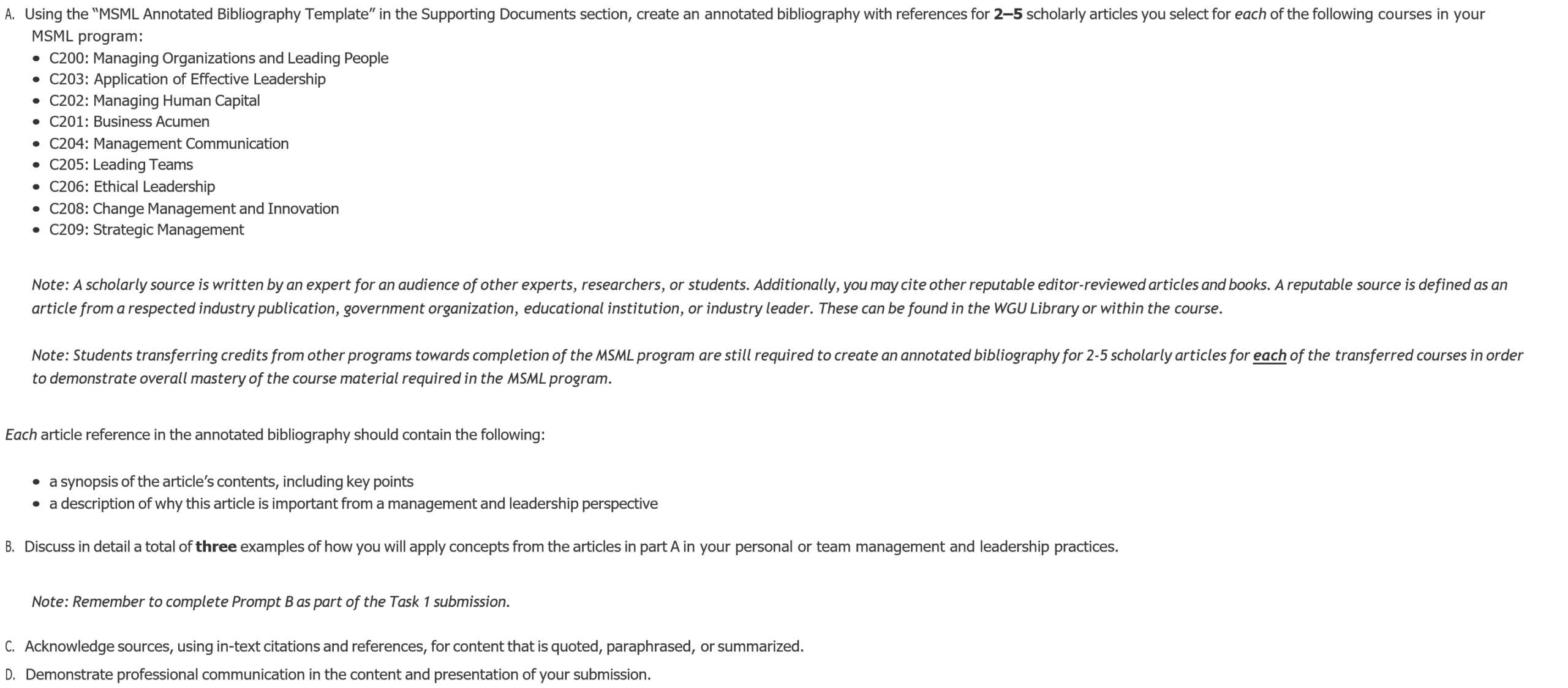
Understanding the Assignment
Four parts: an annotated bibliography spanning nine specific MSML courses (Part A), three detailed examples of applying those concepts in your own practice (Part B), proper source citation (Part C), and professional communication (Part D). The two courses doing the heaviest lifting are A and B — and they’re connected: the articles you choose in A should be ones you can genuinely speak to in B, not just ones that were easy to find.
Why WGU Uses This Capstone Annotated Bibliography
A management and leadership capstone that just asked you to summarize your program would test memory, not mastery. Asking you to select the articles you found most valuable, explain why each mattered from a management and leadership perspective, and then commit to specific ways you’ll apply them tests something much closer to what actually separates a credentialed manager from someone who just completed coursework: the ability to translate learning into practice.
Before You Begin
- Confirm you’ve completed all MSML program courses (or have mentor/instructor permission) before starting — this task assumes you have material to draw from across the full program
- Use the actual “MSML Annotated Bibliography Template” from the Supporting Documents section — don’t build your own format from scratch
- The nine required courses are: C200 (Managing Organizations and Leading People), C203 (Application of Effective Leadership), C202 (Managing Human Capital), C201 (Business Acumen), C204 (Management Communication), C205 (Leading Teams), C206 (Ethical Leadership), C208 (Change Management and Innovation), and C209 (Strategic Management)
- If you transferred credit for any of these courses from another program, you still need 2–5 annotated articles for that course — transfer credit doesn’t exempt you from this requirement
Part A: Building the MSML Annotated Bibliography
What counts as a scholarly source: written by an expert for other experts, researchers, or students — peer-reviewed journal articles are the clearest example. Reputable industry, government, or educational sources also qualify; general web content, opinion blogs, or non-expert-authored material doesn’t.
What each annotation needs, per the rubric:
- A synopsis of the article’s contents, including key points
- A description of why the article matters specifically from a management and leadership perspective
Where “Approaching Competence” papers fall short: they include both required elements, but thinly — a synopsis that just restates the abstract, and an importance statement that’s generic (“this article is important for leaders to know”) rather than specific to what the article actually argues. The gap between Approaching Competence and Competent here is entirely about specificity and depth, not about hitting the checklist.
A Practical Strategy for Choosing Articles Across Nine Courses
Don’t start by searching “best article for [course name].” Start by recalling which specific concept from each course actually changed how you think about management or leadership — then search for a scholarly source on that concept specifically. An article chosen because it resonated with something you already believe or experienced is dramatically easier to write a genuine, specific importance statement about than one chosen purely because it matched a course title in a database search.
Where to search: the WGU Library’s databases are the most efficient starting point, since they’re pre-filtered for scholarly quality. Google Scholar works well as a supplement, particularly for pinpointing a specific concept once you know what you’re looking for.

Demonstrating a Strong Annotation
To show what a genuinely strong annotation looks like — synopsis plus specific, non-generic importance — here’s an example using a real, publicly available peer-reviewed source relevant to C205 (Leading Teams), demonstrating the structure rather than telling you which article to choose for your own bibliography:
Wei, F., Hwang, B.-G., Zainal, N. S. B., & Zhu, H. (2024). Trust, Team Effectiveness, and Strategies: A Comparative Study between Virtual and Face-to-Face Teams. Journal of Construction Engineering and Management, 150(7).
Synopsis: This study compares how trust develops and affects team performance across virtual and face-to-face teams, finding that structural and environmental factors interact — meaning the same team structure can produce different effectiveness outcomes depending on whether the team is collocated or distributed.
Importance: This article matters to my management practice specifically because I lead a partially remote team, and it directly challenges an assumption I’d been operating on — that the same trust-building approach works regardless of whether a team meets in person. It gives me a concrete reason to build separate, deliberate trust-building practices for my remote team members rather than assuming my in-office habits transfer automatically.
Notice the importance statement doesn’t just say the article is “useful” — it names a specific assumption the article challenged and a specific practical consequence. That’s the depth difference the rubric is checking for across all nine courses, not just this one example.
Part B: Writing the Three Application Examples
What evaluators check: three examples, each supported by specific details, of how you’ll actually apply concepts from your Part A articles in your personal or team management and leadership practice. “Supported by specific details” is doing the same work here that it did in Part A — a generic statement of intent isn’t enough.
Demonstrating the Structure (Fictional Narrator — Not a Template to Copy)
To show what genuine specificity looks like without modeling a fabricated professional identity for you to copy, here’s a fictional narrator, Renata Cole, illustrating the pattern:
Drawing on a C202 (Managing Human Capital) article about structured onboarding’s effect on early retention, Renata plans to redesign her fictional team’s 30-day onboarding checklist to include a scheduled check-in with a peer mentor by day five, specifically because the article’s findings suggested early peer connection — not just manager check-ins — was the strongest predictor of six-month retention in the studied sample. Renata will track this by comparing 90-day retention for the next two cohorts onboarded under the new checklist against the prior two cohorts.
Notice this names the specific article’s finding, a specific concrete action, and a specific way of knowing whether it worked — the same three-part structure (concept → specific action → specific measure of success) works across all three required examples, regardless of which course or concept you’re drawing from.
Part C & D: Sources and Professional Communication
Part C requires both in-text citations and a reference list that accurately identifies author, date, title, and source location for every article across all nine courses — a genuinely large citation-management task worth tracking in a spreadsheet as you go, rather than assembling from memory at the end. Part D is the standard Grammarly for Education gate — review the feedback before submitting, since the overall submission won’t pass without it clearing.

Common Mistakes
- Choosing articles that topically match a course title but don’t connect to anything the student actually found valuable, producing thin, generic importance statements
- Writing a synopsis that restates the abstract without adding synthesis
- An importance statement that could apply to almost any leadership article, rather than naming what’s specific about this one
- Application examples that describe an intention (“I will try to communicate better”) without a specific action or a specific way of measuring whether it worked
- Inconsistent citation formatting across nine different courses’ worth of sources, since small errors compound at this scale
- Treating transferred courses as exempt from the bibliography requirement
Self-Assessment Checklist
- Does every course have 2–5 annotated articles, each with both a synopsis and a specific importance statement?
- Would a reader be able to tell my importance statements apart from each other, or do several of them sound interchangeable?
- Do all three Part B examples include a specific action and a specific way of measuring success, not just an intention?
- Is my citation formatting accurate and consistent across all nine courses’ sources?
- Have I cleared the Grammarly for Education review before submitting?
Frequently Asked Questions
Can I use the same article for more than one course? Generally no — each course needs its own 2–5 articles specific to that course’s concepts, since the point is demonstrating breadth across the full program, not depth in one area.
Do I need exactly the same number of articles for every course? No — the rubric allows 2 to 5 per course, so you can vary the count based on how many genuinely strong, personally relevant articles you find for each one.
What if I don’t remember much from a course I took early in the program? Revisit that course’s materials briefly to jog your memory before searching for articles — a concept you’d genuinely forgotten is harder to write a specific, honest importance statement about than one you recall clearly.
Is getting help with this task against WGU’s academic integrity policy? Tutoring, coaching, and editing support are a normal, accepted part of studying — most university policies explicitly support students getting this kind of help with structure and research strategy. The article selection, synopses, and personal application examples still need to be genuinely yours.
Related Learning Resources
Several of the nine required courses already have in-depth guides on this site — useful both for finding a genuine concept to build an annotation around and for cross-referencing your own coursework:
- C205 Leading Teams — Task 1 Guide
- C206 Ethical Leadership — Task 1 Guide and C206 Task 2 Guide
- C203 Personal Leadership Assessment Guide

References & Further Reading
- Wei, F., Hwang, B.-G., Zainal, N. S. B., & Zhu, H. (2024). Trust, Team Effectiveness, and Strategies: A Comparative Study between Virtual and Face-to-Face Teams. Journal of Construction Engineering and Management, 150(7). — The award-winning peer-reviewed source used above to demonstrate a strong C205 annotation’s structure; a genuine example of what a specific, well-supported synopsis and importance statement looks like.
- Yeh, H.-C., Yang, S.-H., Fu, J. S., & Shih, Y.-C. (2023). Developing College Students’ Critical Thinking Through Reflective Writing. Higher Education Research & Development, 42(1), 244–259. — A recent peer-reviewed study on how structured reflective writing builds critical thinking, directly relevant to Part B’s requirement that your three application examples be genuinely specific and analytical rather than a restated intention.