
WGU C210 Task 3 Guide: Management and Leadership Development Program Presentation (MKM1)

WGU C210 Task 3 Guide
Everything you built in Task 2, condensed into slides — then you have to stand in front of a camera and actually sell it. Here’s how to nail both halves.
Executive Summary
C210 Task 3 (assessment code MKM1) takes the management and leadership development program you designed in Task 2 and asks you to do two genuinely different things with it: build a persuasive multimedia presentation proposing it to organizational leadership, and deliver that presentation on camera via Panopto, in professional attire, for 15–20 minutes. This is the first task in the capstone that tests something beyond writing — it tests whether you can actually present like the leader the program you designed is supposed to develop.
What’s Covered in This Guide
- Why every single rubric aspect here requires presenter notes, and why that’s the most commonly missed requirement
- What the presentation actually needs to cover, condensed correctly from your full Task 2 submission
- How to approach the Panopto video recording — the genuinely new skill this task tests
- A full worked example continuing the same fictitious organization from the Task 2 guide
- Common mistakes, a self-assessment pass, and answers to the questions people actually ask
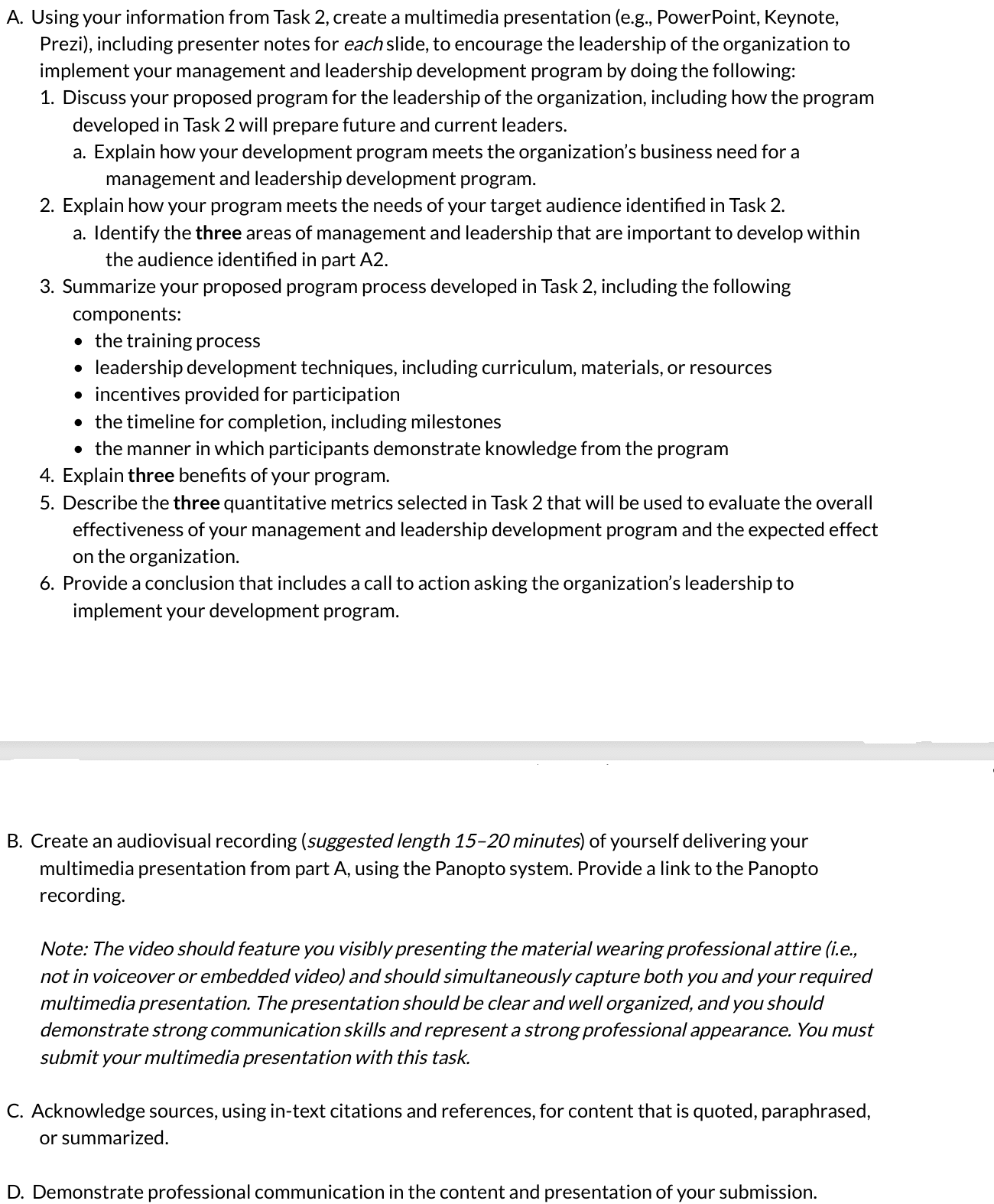
C210 MKM1 Task 3 Assignment
Management and Leadership Capstone — C210 PRFA — MKM1
Introduction
Note: Before starting this task, ensure that you have passed Task 2. If you have not yet passed Task 2, the Task 3 submission will be returned without evaluation.
For this task, you will use information from Task 2 to record yourself delivering a multimedia presentation (e.g., PowerPoint, Keynote, Prezi) using the Panopto video recording system. In your presentation, you will summarize your proposed management and leadership development program for the leadership of the organization with the intent to encourage them to implement your new program.
Note: The audiovisual recording should feature you visibly presenting the material (i.e., not in voiceover or embedded video) and should simultaneously capture both you and your multimedia presentation.
Note: For instructions on how to access and use Panopto, use the “Panopto How-To Videos” web link provided below. To access Panopto’s website, navigate to the web link titled “Panopto Access”, and then choose to log in using the “WGU” option. If prompted, log in using your WGU student portal credentials, and then it will forward you to Panopto’s website.
To submit your recording, upload it to the Panopto drop box titled “Management and Leadership Capstone.” Once the recording has been uploaded and processed in Panopto’s system, retrieve the URL of the recording from Panopto and copy and paste it into the Links option. Upload the remaining task requirements using the Attachments option.
Requirements
Your submission must represent your original work and understanding of the course material. Most performance assessment submissions are automatically scanned through the WGU similarity checker.
Students are strongly encouraged to wait for the similarity report to generate after uploading their work and then review it to ensure Academic Authenticity guidelines are met before submitting the file for evaluation. See Understanding Similarity Reports for more information.
Understanding the Assignment
Four parts: the multimedia presentation itself (Part A, with six required content sections), an audiovisual recording of you delivering it via Panopto (Part B), source citations (Part C), and professional communication (Part D). This task doesn’t ask for new content — everything in Part A comes directly from your approved Task 2 submission. The actual skill being tested is synthesis and delivery: can you take a document-length proposal and condense it into a presentation that would genuinely persuade a real leadership team, then deliver it with the presence of someone qualified to run the program they’re pitching.
Why WGU Uses This Capstone Presentation Task
A written proposal and a persuasive live pitch are different skills, and most management roles require both. Someone can write an excellent development program on paper and still fail to get leadership buy-in if they can’t present it compellingly — which is exactly the gap this task is designed to close before you finish the program.
Before You Begin
- Every single rubric aspect in Part A explicitly requires presenter notes — this is stated separately for A1 through A6, not once at the top. A presentation with strong slides but missing or thin presenter notes will read as Approaching Competence across the board, regardless of how good the slide content looks.
- Re-read your approved Task 2 submission closely before building slides — Part A is built entirely from that content, condensed and reframed for a presentation format, not new material.
- Set up Panopto access early, since WGU notes it can take up to two business days to receive recording permissions after being referred for the course — don’t wait until the day you plan to record.
- Plan for professional attire and a clean, distraction-free recording setup — the rubric explicitly requires the recording show you visibly presenting (not voiceover or an embedded video) while simultaneously capturing your presentation.
Part A: Building the Multimedia Presentation
A1 / A1a — Proposal and business need: discuss the program developed in Task 2, how it prepares future and current leaders, and explicitly explain how it meets the business need identified in your Task 2 Part B1 — condensed from a full paragraph into presentation-appropriate language, with the full explanation living in your presenter notes.
A2 / A2a — Target audience and three areas of development: restate your Task 2 target audience choice and the three areas of management and leadership you identified for that audience — this section should feel identical in substance to Task 2, just reformatted for a slide.
A3 — Program process summary: this needs to include all the given points from your Task 2 program design — training process, techniques, timeline, incentives, and demonstration of knowledge — summarized, not omitted for brevity. “Summarized” doesn’t mean “partial.”
A4 — Three benefits: distinct from the metrics in A5 — benefits describe what the organization gains, framed persuasively, while metrics describe how you’ll measure that gain. Keeping this distinction clear avoids the two sections blurring together.
A5 — Three metrics: restate the three quantitative metrics from your Task 2 C9 section, along with the expected effect on the organization.
A6 — Call to action: a genuine conclusion asking the organization’s leadership to actually implement the program — not a generic “thank you for watching” close. This needs to be appropriate for the specific audience you’re presenting to (executive leadership, typically) and supported by specific details tying back to everything presented before it.

Part B: The Panopto Recording
This is the part most students underprepare for, since nothing else in the MSML program requires an on-camera delivery. A few things worth knowing:
- The recording must show you visibly presenting — not a voiceover layered over slides, and not an embedded separate video. Panopto needs to capture both you and your presentation simultaneously, which typically means using its dual-capture recording mode (webcam plus screen share) rather than recording each piece separately and combining them after.
- Professional attire matters as a rubric-level requirement, not just good practice — dress as you would for an actual leadership presentation, not a casual video call.
- 15–20 minutes is a real constraint — six content sections plus an introduction and conclusion, in under 20 minutes, means roughly two to three minutes per section at most. Practice with a timer before your final recording, since running long is one of the most common reasons students need to re-record.
- Recorded, structured presentation practice measurably improves delivery — research on video-based presentation training has found that reviewing one’s own recorded delivery, even without formal coaching, builds noticeably more confident and polished performance over successive attempts. Recording a practice run first, watching it back critically, and then recording your final submission tends to produce a meaningfully stronger result than presenting cold on the first take.
Parts C & D: Sources and Professional Communication
Part C requires in-text citations and a reference list for any content quoted, paraphrased, or summarized — likely fewer new citations than Task 1 or Task 2 needed, since this task condenses existing work rather than introducing new research, but any external claim still needs proper attribution. Part D is the standard professional communication requirement, applied here to both your slide content and your spoken delivery.
A Full Worked Example (Continuing Brightwell Logistics)
Picking up directly from the Task 2 guide’s fictitious organization, here’s how the presentation condenses that work:
A1/A1a: “Brightwell Logistics has grown its warehouse footprint by nearly double in three years without a corresponding increase in formal leadership preparation. This program directly addresses that gap by adding a structured 12-week leadership development track for newly promoted supervisors.” (Presenter notes carry the full detail on the current informal shadowing process and why it’s insufficient at the company’s current scale.)
A2/A2a: “This program targets new and aspiring leaders, developing three critical areas: emotional intelligence in supervisory relationships, change management fundamentals given our growth phase, and performance feedback and coaching techniques.”
A3: A condensed summary covering the blended biweekly workshop and structured mentoring process, the 12-week timeline with its three milestones, the Supervisor Development Certificate incentive, and the final capstone project as the knowledge-demonstration component — all present, all brief.
A4: Three benefits: consistent, standardized leadership preparation across all three distribution centers; measurably improved new-supervisor retention; and a stronger internal promotion pipeline reducing external hiring costs for leadership roles.
A5: The same three Task 2 metrics — 90-day retention rate for newly promoted supervisors, pre/post leadership competency scores, and 18-month promotion rate for program graduates — restated with their expected organizational effect.
A6: “Implementing this program now positions Brightwell to support its continued growth with leaders who are prepared, not just promoted. I’m asking leadership to approve this program for rollout starting next quarter.”
This is the level of condensation the task expects — every section traceable directly back to Task 2, reframed for a live, persuasive delivery rather than a written document.
Common Mistakes
- Strong slides with thin or missing presenter notes, since every Part A rubric aspect requires them independently
- Introducing new content not actually covered in the approved Task 2 submission
- Blurring benefits (A4) and metrics (A5) into the same content instead of keeping them distinct
- A call to action that’s generic rather than specific to the organization and audience
- Recording via voiceover or an embedded separate video instead of Panopto’s simultaneous dual capture
- Running significantly over the 15–20 minute window without having timed a practice run first
Self-Assessment Checklist
- Does every one of the six Part A sections have supporting presenter notes, not just slide text?
- Does A3 include all the required program-process points, even if summarized briefly?
- Are my three benefits (A4) genuinely distinct from my three metrics (A5)?
- Is my call to action specific to my actual organization and audience, not generic?
- Have I timed a full practice run to confirm I land within 15–20 minutes?
- Does my Panopto recording show me visibly presenting while simultaneously capturing my slides?
Frequently Asked Questions
Can I add new content in Task 3 that wasn’t in my Task 2 submission? No — Part A should reflect your already-approved Task 2 program, condensed and reframed for presentation, not expanded with new material.
Do I need to memorize my presentation word-for-word? No, but you should be comfortable enough with the content that you’re not reading directly off slides — natural, confident delivery is part of what’s being assessed as professional communication.
What if my first Panopto recording goes over 20 minutes? Re-record after tightening your pacing — practicing with a timer before your final take is the most reliable way to avoid this, since cutting content after a recording is far harder than pacing correctly from the start.
Is getting help with this task against WGU’s academic integrity policy? Tutoring, coaching, and editing support are a normal, accepted part of studying — most university policies explicitly support students getting this kind of help with structure, pacing, and presentation delivery.
Related Learning Resources
- WGU C210 Task 2 Guide: Management and Leadership Development Program — this presentation is built directly from that submission
- WGU C210 Task 1 Guide: MSML Annotated Bibliography
- Executive Communication — directly relevant to delivering a persuasive proposal to leadership
References & Further Reading
- Robertson, C., & Mori, S. (2023). Student Reactions to Video Feedback Activities in Oral Communication and Presentation Courses. TEFL Praxis Journal, 2, 18–28. — A peer-reviewed study finding that reviewing one’s own recorded presentation delivery measurably improves confidence and performance across successive attempts, the basis for this guide’s recommendation to record and review a practice run before the final Panopto submission.