
WGU C210 Task 2 Guide: Management and Leadership Development Program (MKM1)

You picked a real organization. WGU wants you to anonymize it, then design something that would actually work there. Here’s how to do both without losing the specificity that gets you a Competent score.
Executive Summary
C210 Task 2 (assessment code MKM1) asks you to evaluate a real organization’s current management and leadership development program, then design a new one — covering everything from target audience and curriculum to incentives, timeline, and quantitative success metrics. Unlike almost every other WGU task, this one explicitly wants you to base it on something real: your current employer, a local business, a nonprofit, any operating organization you’re genuinely familiar with — while requiring you to anonymize every identifying detail. That combination (real-world grounding, fictional names) is exactly what makes this task simultaneously the most personally applicable and the easiest to get vague on, if you’re not careful about specificity.
What’s Covered in This Guide
- Why Task 1 has to be passed before you can even start this one, and why that matters for Part C2a specifically
- How to anonymize a real organization without losing the specific detail the rubric actually rewards
- Every required section (A through C9) broken down by what “Competent” actually requires
- A full worked example applying every section to one continuous fictitious organization
- Common mistakes and a self-assessment pass before you submit
MKM1 Task 2 Assignment: Management and Leadership Development Program
MKM1 Task 2: Management and Leadership Development Program
Introduction
Note: Before starting this task, ensure that you have passed Task 1. If you have not yet passed Task 1, the Task 2 submission will be returned without evaluation.
In this task, you will synthesize key concepts learned within your MSML program and then apply them by developing a management and leadership development program for a real-world business entity. You will first need to select an organization with which you are familiar. You may choose your current place of employment, a local business, a nonprofit organization, or any operating organization (e.g., government, school district, hospital, online business).
The management and leadership development program you design should include a process to foster the management and leadership skills of current and future leaders within an organization. These skills would be employed in formal and informal leadership positions throughout the company. The program should be targeted towards a specific leadership audience in the organization.
Note: Any information that would be considered confidential, proprietary, or personal in nature should not be included in the actual task submission to WGU. Do not include the actual names of people, suppliers, the company, or other identifiable information. Fictional names should be used. Also, company-specific data, including financial information, should not be included but should be addressed in a general fashion as appropriate
Requirements
Your submission must represent your original work and understanding of the course material. Most performance assessment submissions are automatically scanned through the WGU similarity checker. Students are strongly encouraged to wait for the similarity report to generate after uploading their work and then review it to ensure Academic Authenticity guidelines are met before submitting the file for evaluation. See Understanding Similarity Reports for more information.
Grammarly Note:
Professional Communication will be automatically assessed through Grammarly for Education in most performance assessments before a student submits work for evaluation. Students are strongly encouraged to review the Grammarly for Education feedback prior to submitting work for evaluation, as the overall submission will not pass without this aspect passing. See Use Grammarly for Education Effectively for more information.
Microsoft Files Note:
Write your paper in Microsoft Word (.doc or .docx) unless another Microsoft product, or pdf, is specified in the task directions. Tasks may notbe submitted as cloud links, such as links to Google Docs, Google Slides, OneDrive, etc. All supporting documentation, such as screenshots and proof of experience, should be collected in a pdf file and submitted separately from the main file. For more information, please see Computer System and Technology Requirements.
You must use the rubric to direct the creation of your submission because it provides detailed criteria that will be used to evaluate your work. Each requirement below may be evaluated by more than one rubric aspect. The rubric aspect titles may contain hyperlinks to relevant portions of the course.
Understanding the Assignment
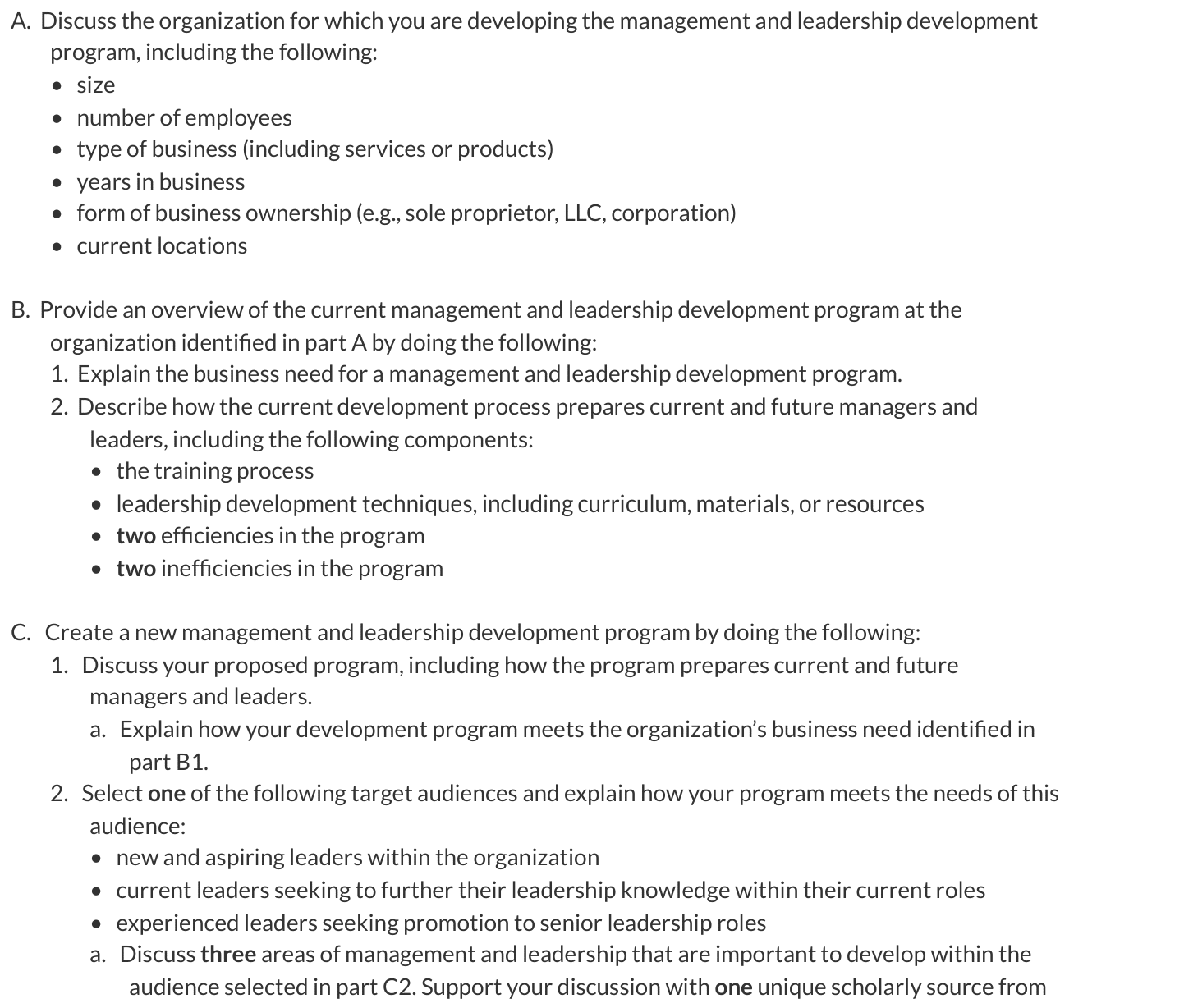
Five parts: describing your chosen organization (A), evaluating its current management and leadership development program (B), designing a new one (C — the largest section, with nine sub-parts), sources (D), and professional communication (E). The organization has to be real and one you’re genuinely familiar with — your current employer, a local business, a nonprofit, or any operating organization — but every identifying detail (names, company identity, financial specifics) needs to be replaced with fictional equivalents before submission.
Why WGU Uses This Capstone Task
A hypothetical, generic leadership development program is easy to design and easy to grade as thin. Grounding the task in a real organization you actually know forces genuine specificity — you can’t hand-wave “the current program has some gaps” when you actually know what those gaps are, and that specificity is precisely what separates Competent from Approaching Competence on nearly every rubric line here.
Before You Begin
- Confirm Task 1 is passed — Task 2 is returned without evaluation otherwise, and Part C2a specifically requires citing one unique scholarly source from your actual Task 1 bibliography for each of your three leadership development areas, so you need that bibliography finished and in hand
- Choose an organization you know well enough to describe specifically — a workplace you’ve only briefly worked at will make the “specific details” bar much harder to clear than one you know intimately
- Plan your anonymization before you start writing, not as a find-and-replace pass at the end — decide on your fictional organization name, industry framing, and any other identifying substitutions up front so they stay consistent throughout
- Re-read your own Task 1 annotations for the three you’ll cite in C2a — you’ll want the ones with the most specific, actionable importance statements, since C2a asks you to build directly on that earlier analysis
Part A: Organization Overview
Six required elements: size, number of employees, type of business (including services or products), years in business, form of business ownership, and current locations. This section is graded almost entirely on specificity — “a mid-sized company” fails where “approximately 340 employees across four regional offices” succeeds, even after anonymization.
Part B: Evaluating the Current Program
B1 — Business need: explain specifically why this organization needs a management and leadership development program — a generic “leadership development is important” statement won’t clear the bar; the need has to connect to something real about this organization (high manager turnover, a growth phase outpacing internal leadership pipeline, inconsistent management practices across locations).
B2 — Current process: describe the existing training process, the leadership development techniques currently used (curriculum, materials, resources), and — this is the part students most often shortchange — exactly two efficiencies and exactly two inefficiencies in the current program. Both counts matter precisely; more or fewer than two of each misses the rubric’s explicit ask.

Part C: Designing the New Program (Nine Sub-Parts)
C1 / C1a — Proposed program overview: discuss how your new program prepares current and future managers and leaders, and explicitly connect it back to the business need you identified in B1 — not just describe the program, but state the connection directly.
C2 / C2a — Target audience and three development areas: choose one of three audiences — new/aspiring leaders, current leaders deepening their existing role, or experienced leaders seeking promotion to senior roles — and explain how your program specifically serves that audience’s needs. Then discuss three areas of management and leadership important to develop for that audience (emotional intelligence, change management, strategic management, and similar areas are all fair game), each supported by one unique scholarly source pulled from your own Task 1 bibliography. This is the rubric’s most distinctive requirement — it’s testing whether your capstone actually connects to the coursework behind it, not whether you can find three new sources on the spot.
C3 — Training process: describe an appropriate training process, specific enough that a reader could picture how a session actually runs.
C4 — Leadership development techniques: curriculum, materials, or resources — again, specific enough to be implementable, not a generic list of formats (workshops, mentoring, e-learning) without detail on what each actually covers.
C5 — Capitalizing on efficiencies, overcoming inefficiencies: explicitly reference the two efficiencies and two inefficiencies from B2 and explain how your new program builds on the former and fixes the latter — this section fails most often when it addresses the inefficiencies generally without tying back to the specific ones already named in B2.
C6 — Incentives: describe what motivates participation — this needs to be appropriate to the organization and audience you’ve already established, not a generic list of possible incentives.
C7 — Timeline and milestones: a realistic completion timeline with defined milestones along the way, not just a start and end date.
C8 — Demonstration of knowledge: how participants will show they’ve actually learned the material — an assessment, a capstone project of their own, a practical application exercise.
C9 — Three quantitative metrics: this is worth extra care. The metrics need to be genuinely quantitative (a percentage, a rate, a count) and tied to an expected effect on the organization, not just “participant satisfaction was high.” Recent peer-reviewed research on leadership development evaluation specifically notes that self-reported satisfaction and even self-assessed learning gains are the weakest indicators of real impact — multi-source measures (supervisor ratings, retention data, promotion rates, performance metrics) tend to demonstrate genuine organizational effect more convincingly. Choosing metrics like manager retention rate, internal promotion rate for program graduates, or a pre/post leadership-competency assessment score gives your C9 section real teeth.
Parts D & E: Sources and Professional Communication
D requires both in-text citations and a complete, accurate reference list — remember that C2a’s three sources specifically need to trace back to your actual Task 1 bibliography, not new sources found for this task. E is the standard Grammarly for Education gate.
A Full Worked Example (Fictitious Organization)
Consistent with the task’s own anonymization requirement, here’s a demonstration using an entirely fictitious organization: Brightwell Logistics, a fictional regional freight and distribution company.
A: Brightwell Logistics — approximately 280 employees, freight transportation and warehousing services, founded 11 years ago, structured as an LLC, operating across three distribution centers in one U.S. region.
B1: The business need stems from rapid growth over the past three years — the company has nearly doubled its warehouse footprint without a corresponding increase in formal management preparation, resulting in several supervisors promoted from frontline roles with no structured leadership training.
B2: The current process consists of a single half-day orientation for new supervisors and informal shadowing with an existing manager. Efficiencies: the orientation covers company policy consistently, and the shadowing approach builds real operational familiarity quickly. Inefficiencies: there’s no standardized curriculum beyond orientation, and shadowing quality varies significantly depending on which manager a new supervisor is paired with.
C1/C1a: The proposed program adds a structured 12-week leadership development track following the existing orientation, directly addressing the B1 need by formalizing preparation for the growing number of newly promoted supervisors.
C2/C2a: Target audience: new and aspiring leaders. Three development areas, each grounded in a genuine Task 1 source: (1) emotional intelligence in supervisory relationships, (2) change management fundamentals given the company’s growth phase, (3) performance feedback and coaching techniques — each citing a specific, real scholarly source the student would pull from their own actual Task 1 bibliography for the corresponding course.
C3/C4: A blended training process combining biweekly in-person workshops with a structured mentoring pairing (replacing the inconsistent informal shadowing), using a defined curriculum covering the three C2a development areas plus situational leadership basics.
C5: The program capitalizes on the orientation’s policy consistency by keeping it as the foundation, while directly overcoming the shadowing inconsistency by replacing ad hoc pairing with a structured, curriculum-driven mentoring framework applied uniformly across all three distribution centers.
C6: Incentives include a formal “Supervisor Development Certificate” tied to eligibility for the next promotion cycle, plus protected paid time for workshop attendance rather than requiring it on top of existing workload.
C7: A 12-week timeline with milestones at week 4 (foundational curriculum complete), week 8 (mentoring midpoint check-in), and week 12 (final capstone project and certificate).
C8: Participants demonstrate knowledge through a final capstone project — a real process improvement proposal for their own distribution center, presented to their regional director.
C9: Three quantitative metrics: (1) 90-day retention rate for newly promoted supervisors, compared against the pre-program baseline; (2) pre/post self- and supervisor-rated leadership competency scores using a structured assessment; (3) percentage of program graduates promoted to senior supervisory roles within 18 months, compared against the historical promotion rate for supervisors who didn’t complete structured training.
Common Mistakes
- Choosing an organization the student doesn’t know well enough to describe with genuine specificity
- Naming exactly two efficiencies and two inefficiencies in B2, then not referencing them again explicitly in C5
- Using three new sources in C2a instead of three unique sources actually pulled from the Task 1 bibliography
- Quantitative metrics that are actually qualitative in disguise (“participants will feel more confident”) rather than genuinely measurable
- Inconsistent anonymization — a fictional company name that accidentally still references identifiable real details elsewhere in the paper
- A proposed program that doesn’t explicitly connect back to the B1 business need or the B2 efficiencies/inefficiencies
Self-Assessment Checklist
- Have I included all six required elements in Part A with specific figures, not vague ranges?
- Does B2 name exactly two efficiencies and two inefficiencies?
- Do my three C2a development areas each cite a genuine, unique source from my own Task 1 bibliography?
- Does C5 explicitly reference the same efficiencies and inefficiencies named in B2?
- Are all three C9 metrics genuinely quantitative and tied to an expected organizational effect?
- Have I anonymized consistently throughout, with no identifying details slipping through?
Frequently Asked Questions
Can I use my current employer for this task? Yes — that’s explicitly one of the suggested options, as long as you anonymize all identifying details, including the company name, real people’s names, suppliers, and any financial specifics.
Do the three C2a sources need to be completely new, or from my Task 1 bibliography? They must be unique sources specifically pulled from your own Task 1 submission — one source per development area, not newly found sources for Task 2.
What if my organization doesn’t have a formal current leadership development program at all? That’s a valid B2 answer — describe whatever informal process currently exists (even if it’s minimal), and frame the lack of formal structure itself as one of your two inefficiencies.
Is getting help with this task against WGU’s academic integrity policy? Tutoring, coaching, and editing support are a normal, accepted part of studying — most university policies explicitly support students getting this kind of help with structure and specificity. The organizational knowledge and program design still need to be genuinely yours.
Related Learning Resources
- WGU C210 Task 1 Guide: MSML Annotated Bibliography — your C2a sources come directly from this earlier work
- C205 Leading Teams — Task 1 Guide
- C206 Ethical Leadership Guides
- Strategic Planning Basics — relevant to program timeline and milestone design
- Business Decision Making Frameworks — relevant to evaluating current-program efficiencies and inefficiencies
References & Further Reading
- Seeg, B., Gauglitz, I. K., & Schütz, A. (2022). Explaining and Enhancing Training Transfer: A Consumer-Centric Evaluation of a Leadership Training. Human Resource Development International, 25(5), 506–526. — A peer-reviewed study on what actually determines whether leadership training transfers into real workplace behavior change, relevant background for designing a training process (C3) that goes beyond a one-time session.
- Emam, S. M., Fakhry, S. F., & Abdrabou, H. M. (2024). Leaders Development Program by 360 Degree Feedback: Reflection on Head Nurses’ Leadership Practices. BMC Nursing, 23, 772. — A recent peer-reviewed experimental study measuring a leadership development program’s effect using knowledge scores, self-assessment, and supervisor/staff ratings together — a genuine model for the kind of multi-source quantitative metrics this guide recommends for C9.