
C206 Task 1: Step-by-Step Guide to Completing EHM2 Successfully


Updated on: Aug 20, 2026
If you searched “C206 Task 1,” you’re probably staring at a suggested 6–8 page essay with seven lettered parts, a personality-style assessment to reflect on, and not much free time before bed. C206 Task 1 is the first performance assessment in WGU’s Ethical Leadership course, officially titled EHM2: Ethical Theories, Leadership, and the Ethical Lens Inventory. It’s a structured response to one scenario, graded against specific, nameable rubric criteria, not a generic “write about ethics” essay.
The question every student wants answered is: what exactly do I need to do to complete C206 Task 1 successfully? This guide covers the requirements, how to structure the paper, and the mistakes that most often send a submission back, without handing you a completed assignment to copy.
C206 EHM2 Task 1 Assignment: Ethical Theories, Leadership, And The Ethical Lens Inventory
Introduction
Leadership is often defined as the ability to influence people. An effective ethical leader guides an organization and its employees to accomplish organizational goals. In the same vein, an unethical leader can guide an organization and its employees to act unethically, harming both the organization and the stakeholders. Being a leader is an exploration, a reflection, and a test of your leadership values. Seeking understanding of how you resolve ethical dilemmas, taking inventory of where an ethical weakness may lie, and examining the traits of an ethical leader helps you define, shape, and apply an ethical decision-making framework, while also taking into consideration all stakeholders who may be affected by your decisions.
For this task, you will respond to an ethical situation as well as analyze the results of the Ethical Lens Inventory (ELI), which should be completed in the course. This task focuses on you as a leader by helping you to define, refine, and test your ethical boundaries through self-reflection and analysis.
Scenario
You are a sales representative for a medical device company that manufactures artificial joints. Your company has developed an artificial knee joint that is less expensive than the competition and will dramatically reduce healing time for patients. However, it is also known to produce a serious and potentially lethal infection in a small percentage of patients. The company refuses to disclose this potential side effect. You feel you have a duty to divulge this issue, but you signed a nondisclosure agreement when you were hired and worry about possible repercussions.
Requirements
Your submission must represent your original work and understanding of the course material. Most performance assessment submissions are automatically scanned through the WGU similarity checker.
Students are strongly encouraged to wait for the similarity report to generate after uploading their work and then review it to ensure Academic Authenticity guidelines are met before submitting the file for evaluation. See Understanding Similarity Reports for more information.
Grammarly Note:
Professional Communication will be automatically assessed through Grammarly for Education in most performance assessments before a student submits work for evaluation. Students are strongly encouraged to review the Grammarly for Education feedback prior to submitting work for evaluation, as the overall submission will not pass without this aspect passing. See Use Grammarly for Education Effectively for more information.
Microsoft Files Note:
Write your paper in Microsoft Word (.doc or .docx) unless another Microsoft product, or pdf, is specified in the task directions. Tasks may notbe submitted as cloud links, such as links to Google Docs, Google Slides, OneDrive, etc. All supporting documentation, such as screenshots and proof of experience, should be collected in a pdf file and submitted separately from the main file. For more information, please see Computer System and Technology Requirements.
You must use the rubric to direct the creation of your submission because it provides detailed criteria that will be used to evaluate your work. Each requirement below may be evaluated by more than one rubric aspect. The rubric aspect titles may contain hyperlinks to relevant portions of the course.
Write an essay (suggested length of 6–8 pages) in which you do the following:
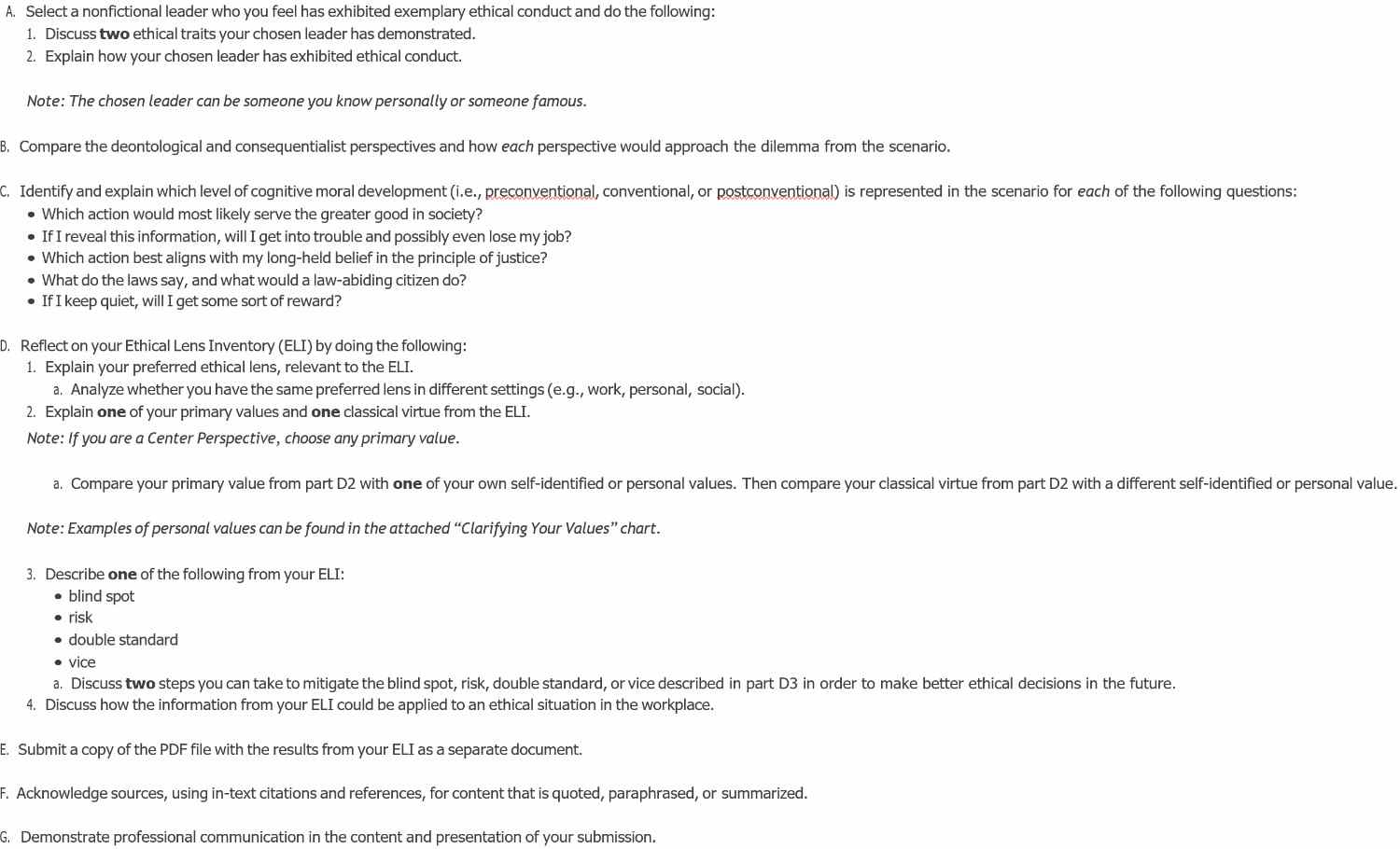
C206 Task 1 Questions: What Do You Actually Have to Answer?
The task gives you one scenario: you’re a medical device sales rep who discovers your company is hiding a serious side effect of an artificial knee joint, and you’re bound by a nondisclosure agreement. Every part of your response ties back to that scenario, broken into seven rubric aspects.
| Part | What it covers |
|---|---|
| A | Choose an ethical leader; discuss two traits and how they showed ethical conduct |
| B | Compare deontological and consequentialist perspectives on the scenario |
| C | Identify the level of cognitive moral development behind five specific questions |
| D | Reflect on your own Ethical Lens Inventory (ELI) results |
| E | Attach your ELI results as a separate PDF |
| F | Use in-text citations and a reference list |
| G | Demonstrate professional communication |
Treat A–G as a checklist, not a page-count target. WGU graders score each rubric aspect independently: a beautifully written paper that skips D2a or gives only one mitigation step in D3a will still come back as Approaching Competence on those specific aspects, regardless of how polished the rest of the writing is.
C206 Task 1 Example: How to Structure Your Paper
A clean structure is the easiest way to avoid missing a rubric aspect. Mirror the rubric order directly in your headings:
- A. Ethical Leader: A1. Two ethical traits, A2. Ethical conduct
- B. Ethical Dilemma Analysis: deontological vs. consequentialist
- C. Cognitive Moral Development: all five questions addressed
- D. Ethical Lens Inventory: D1 preferred lens, D1a different settings, D2 primary value and classical virtue, D2a comparison to personal values, D3 blind spot/risk/double standard/vice, D3a two mitigation steps, D4 workplace application
- References
If you take one idea from this article, make it this: build your headings before you draft a single sentence. It turns a vague “write 6-8 pages about ethics” task into a checklist you fill in one box at a time.
How to Handle A–G of C206 Task 1
A1 and A2: Choosing an Ethical Leader
Pick a real, nonfictional leader, someone you know personally or a public figure; the task allows either. The rubric wants analysis over biography, so skip the career summary:
- Name two specific ethical traits (e.g., transparency, accountability).
- Give a concrete example for each trait.
- Explain how the leader’s actions demonstrated ethical conduct, not just that they were “a good leader.”
The rubric asks for discussion that is logical and well supported, which means every claim needs a specific example attached.
B: Deontological vs. Consequentialist Perspectives
These two theories disagree about what makes an action right. A deontological perspective judges an action by whether it follows a duty or rule, regardless of outcome: the sales rep has a duty to disclose the defect because withholding safety information violates a moral rule, NDA or not (Stanford Encyclopedia of Philosophy, n.d.). A consequentialist perspective instead judges the action by its results, weighing patient harm against the financial and legal fallout of breaking the NDA.
A workable framework: theory, core principle, application to the scenario, comparison. Apply both theories to the same dilemma, then explicitly compare where they agree and disagree. The rubric wants both perspectives applied together, not two separate mini-essays.
C: Cognitive Moral Development
The task gives five specific questions tied to the scenario (e.g., “If I reveal this information, will I get into trouble?”). For each, identify whether it reflects preconventional, conventional, or postconventional reasoning, the three levels Lawrence Kohlberg used to describe moral reasoning (Britannica, n.d.).
- Preconventional: centers on personal consequences, avoiding punishment or gaining reward.
- Conventional: centers on social expectations, laws, and roles.
- Postconventional: centers on abstract principles like justice, even against self-interest.
Use this pattern for each question: level, reasoning, connection back to the question. Competent only requires four of the five to be well-reasoned, but attempt all five; a shaky answer beats a missing one.
D: Ethical Lens Inventory
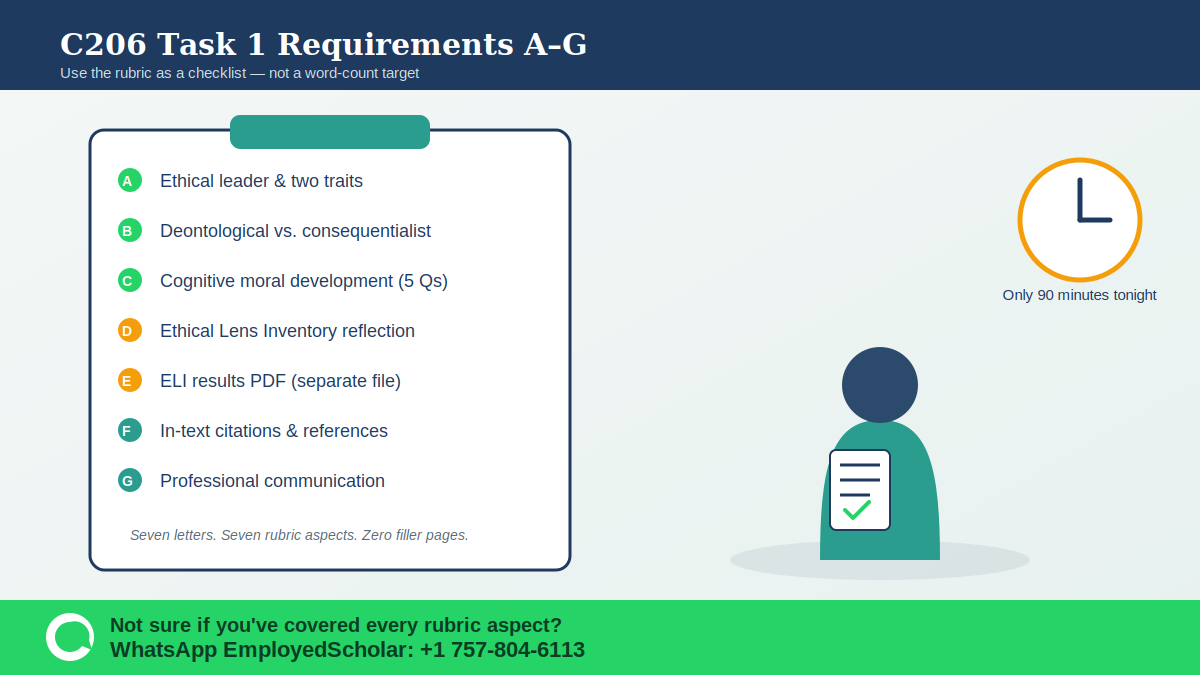
This is the most personalized part of the task, and where generic answers get caught fastest. The Ethical Lens Inventory (ELI) is an assessment developed by Catharyn Baird and distributed through EthicsGame; it sorts respondents into one of four “lenses” based on how they prioritize values like rationality, sensibility, autonomy, and equality (EthicsGame, n.d.). You must complete the ELI yourself in the course first; Part D has to be based on your actual results.
Cover, in order: your preferred lens and whether it holds steady across work, personal, and social settings (D1, D1a); one primary value and one classical virtue (D2), each compared to a personal value you hold independent of the ELI (D2a); one blind spot, risk, double standard, or vice (D3), plus two concrete mitigation steps (D3a); and how this self-knowledge applies to a workplace situation (D4).
Never copy another student’s ELI results or a generic lens description; the grader checks that D1–D4 are “relevant to the ELI results,” and mismatched details are an easy flag.
C206 Task 1 PDF: Don’t Forget the ELI Results
Part E is easy to lose points on by simply forgetting it; it’s a separate file, not a section of your essay:
- Complete the ELI in the course and save your results.
- Confirm the PDF opens and is fully readable.
- Upload it as its own attachment, separate from your main essay file.
- Double-check you attached the correct, current file.
C206 Task 1 Answers: What Students Should Actually Look For
If you’re searching “C206 Task 1 answers,” what helps isn’t a copy-paste script; it’s a model of the thinking. A genuinely useful example shows:
- Clear alignment with each rubric aspect
- Logical reasoning that connects claims to evidence
- Organization that mirrors A–G
- Both ethical theories applied to the same scenario
- Personalized, not generic, ELI analysis
- Proper in-text citations and a matching reference list
Use examples to understand how to approach the task, never to copy sentences into your own submission.
C206 Task 1 Reddit and Studocu: Are Shared Examples Reliable?
Searches like c206 task 1 reddit and studocu c206 task 1 turn up real student experiences worth skimming for common sticking points, but treat them as color commentary, not source material:
- Shared write-ups can be outdated if the rubric or scenario has changed.
- Another student’s ELI results are not your results; copying them defeats the purpose of Part D and is easy for a grader to spot.
- Your course’s official task instructions and rubric always take priority over anything posted publicly.
- Never submit, or lightly reword, another student’s paper. WGU runs submissions through a similarity checker before evaluation.
C206 Task 1 Perfect Score Strategy: Final Rubric Audit
There’s no such thing as a guaranteed perfect score, but you can maximize your chances of meeting every Competent criterion with one final pass through this list before you submit:
- Two ethical traits discussed with evidence
- Ethical conduct explained, not just described
- Both ethical theories compared and applied to the scenario
- At least four of five cognitive moral-development questions reasoned well
- Preferred ethical lens explained and tied to your ELI results
- Different settings analyzed (D1a)
- Primary value explained
- Classical virtue explained
- Both personal-value comparisons completed (D2a)
- Blind spot, risk, double standard, or vice addressed
- Two mitigation steps provided (D3a)
- Workplace application discussed (D4)
- ELI results PDF attached as a separate file
- In-text citations included throughout
- Reference list included and matches citations
- Grammar and professional communication reviewed (Grammarly for Education must pass before submission)
C206 Task 1 Common Mistakes
- Writing a generic ethics essay instead of responding to the scenario.
- Ignoring the rubric and writing to a page count instead.
- Describing instead of analyzing the scenario.
- Explaining theories without applying them to the dilemma.
- One-line answers in Part C with no level, reasoning, connection.
- Using generic ELI information instead of your actual results.
- Forgetting the D2a comparisons to personal values.
- Providing only one mitigation step in D3a when two are required.
- Forgetting the separate ELI PDF (Part E).
- Missing or inconsistent citations and references.
- Skipping the Grammarly for Education review: Professional Communication won’t pass without it.
C206 Task 1 for Busy WGU MBA Students: A Faster Workflow
You don’t need a free weekend to finish this task well. A realistic, full-time-job-and-family workflow looks like this:
Step 1 (20–30 min): Read the task instructions and rubric end to end.
Step 2 (20–30 min): Build your document headings to match A–G before writing anything.
Step 3 (30–45 min): Draft the analytical sections: A, B, and C.
Step 4 (20–30 min): Complete the ELI-based sections using your own results.
Step 5 (15 min): Run the final rubric audit above before you submit.
Spread across a few evenings, that’s under three hours, far less than writing the whole thing in one sitting after a full workday.
C206 Task 2 and C206 Task 3: What Comes Next?
Once Task 1 is submitted, C206 continues with C206 Task 2 and C206 Task 3. Course requirements and rubrics can change between terms, so rather than guess at what those tasks involve, check your current course materials in the WGU course portal for the live instructions once you reach that point.
C206 Task 1 FAQs
- What is C206 Task 1? The first performance assessment in WGU’s Ethical Leadership (C206) course, requiring a 6–8 page essay that analyzes an ethical dilemma through leadership traits, ethical theory, cognitive moral development, and your own ELI results.
- What is WGU C206 Task 1 EHM2? EHM2 is the official assessment code for C206 Task 1: “Ethical Theories, Leadership, and the Ethical Lens Inventory.” You’ll see it referenced in your course portal and evaluation report.
- What are the C206 Task 1 questions? Seven lettered requirements (A–G): ethical leader, ethical theory comparison, cognitive moral development, ELI reflection, the ELI PDF, sources, and professional communication.
- How long should C206 Task 1 be? 6–8 pages is suggested, but length is secondary to addressing every rubric aspect; a tight, well-organized paper beats a padded longer one.
- What is the Ethical Lens Inventory in C206? A self-assessment that identifies your preferred ethical decision-making lens, based on how you prioritize values like rationality, sensibility, autonomy, and equality.
- Do I need to submit the C206 Task 1 ELI PDF? Yes. Part E requires your ELI results as a separate PDF, apart from your main essay file.
- What is the difference between deontological and consequentialist ethics? Deontological ethics judges actions by whether they follow a duty or rule; consequentialist ethics judges actions by their outcomes. Part B applies both to the scenario.
- How can I avoid having C206 Task 1 returned? Address every rubric aspect specifically, base Part D on your actual ELI results, cite sources properly, and clear Grammarly for Education before submitting.
- Can I use a C206 Task 1 example? Yes, to understand structure and approach, never to copy language or ELI results from someone else’s submission.
- Should I copy C206 Task 1 answers from Reddit or Studocu? No. Use those threads only to spot common sticking points; your course instructions and rubric are authoritative, and Part D must reflect your own ELI results.
Working Full-Time and Short on Hours for C206 Task 1?
Between a full-time job, family, and a seven-part ethics essay, it’s easy to lose track of what’s actually required. If you’d rather have someone double-check your draft than guess whether you’ve covered every rubric aspect, EmployedScholar offers academic support for WGU MBA students: task and rubric clarification, draft review, citation checks, missing-rubric-item identification, and a final pre-submission review.
This is coaching and review support, not a completed assignment. We don’t guarantee a passing or perfect score, and we won’t write or submit work on your behalf.
WhatsApp EmployedScholar: +1 757-804-6113
Related WGU Guides and Examples
D473 Task 1 Example and Guide: How to Identify Root Cause Variables Using Data Analysis
C207 Task 2 Example: How to Nail Every Rubric Line on Your Decision Tree Analysis (QUM3)
C207 QUM3 Task 1 Example and Guide: Regression Analysis – Data-Driven Decision Making C207 PRFA
WGU D361 Task 2 Example and Guide: Competitive Analysis (SWOT, Strategic Graphs, SMART Goals)
D361 Task 2: WGU Business Simulation and Competitive Analysis Explained
References
Britannica. (n.d.). Lawrence Kohlberg’s stages of moral development. Encyclopædia Britannica. https://www.britannica.com/science/Lawrence-Kohlbergs-stages-of-moral-development
EthicsGame. (n.d.). Ethical Lens Inventory. https://www.ethicsgame.com/exec/site/eli.html
Nature Humanities and Social Sciences Communications. (2025). Ethical leadership and organizational excellence: The mediating role of citizenship behavior in healthcare. https://www.nature.com/articles/s41599-025-05743-6
Stanford Encyclopedia of Philosophy. (n.d.). Deontological ethics. https://plato.stanford.edu/entries/ethics-deontological/