
WGU D472 Task 1 Guide: Operations and Supply Chain Disruption Presentation

WGU D472 Task 1 Guide
A supplier fire, a leadership team caught flat-footed, and fifteen slides to prove you understand exactly why. Here’s how to build it right.
Executive Summary
D472 Task 1 asks you to build a multimedia presentation analyzing a real operational disruption; risk classification, external and internal risk identification, resilience and recovery, and a evaluated recommendation across three competing long-term solutions. It looks like a slide-deck exercise. It’s actually a test of whether you can do what a real operations consultant does: separate what happened from why it happened, and turn that analysis into a defensible recommendation a senior leadership team would actually act on.
The Assignment: D472 Task 1
Introduction
Even in its simplest form, supply chain management is a complex process with many moving parts. However, over the past several years, supply chain management has been undergoing an evolution fueled by complex and intertwined domestic and global factors, such as political upheaval, economic stresses, legislative changes, changing technology, natural disasters, and health crises. These factors pose risks to a business’s supply chain resilience, increasing the potential for significant disruptions to its business operations.
Scenario
You are a consultant for a company that recently experienced an operation and supply chain disruption. You are tasked with analyzing relevant qualitative and quantitative data related to the company’s operation and supply chain disruption and evaluating possible solutions to the problem. You will also recommend a solution for long-term risk mitigation and supply chain viability to the senior leadership team.
See the attached “D472 Task 1 Case Study” and “D472 Task 1 Supporting Data” in the Supporting Documents section for additional information and data.
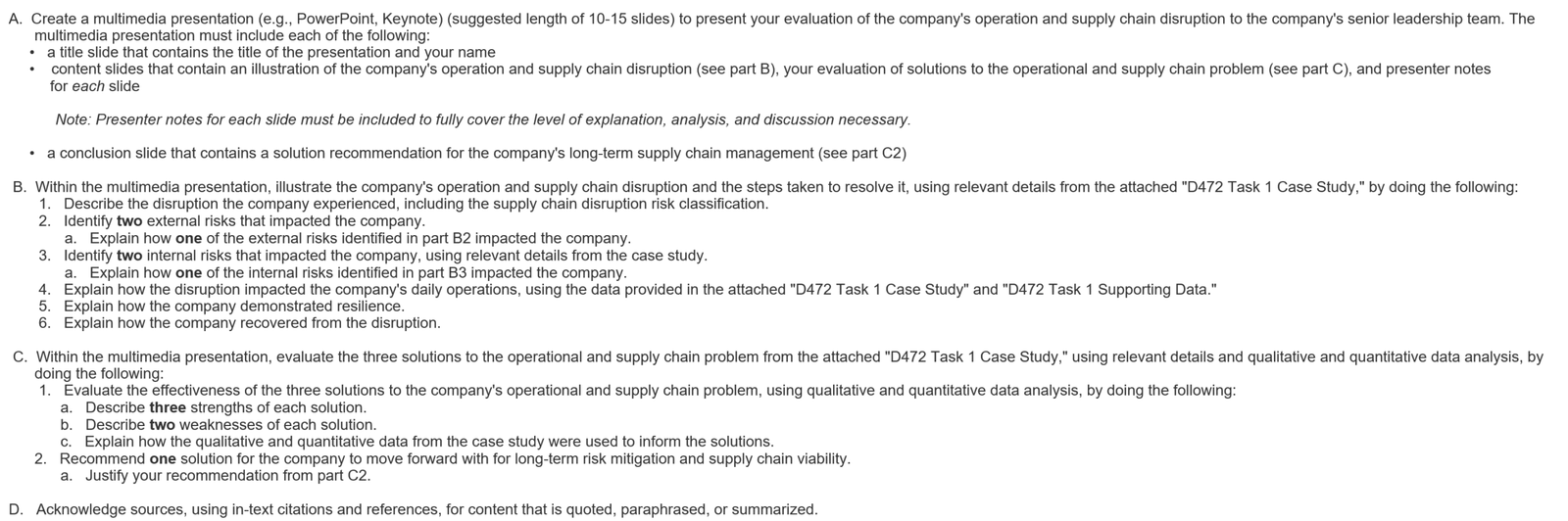
Understanding the Assignment
You’re acting as a consultant hired after the fact; the disruption already happened, the company already responded, and your job is to analyze the response and recommend what should change going forward. That framing matters: you’re not designing a crisis response from scratch, you’re evaluating one that already occurred, using the case study’s own qualitative narrative and quantitative data as your evidence base.
Why WGU Uses This Assignment
Supply chain disruptions rarely fail companies because leadership didn’t care; they fail because leadership hadn’t distinguished between the risks they could control and the risks they couldn’t, and hadn’t built the organizational capacity (clear ownership, diversified sourcing, adequate data visibility) to respond fast when the inevitable disruption hit. This task tests whether you can make that distinction clearly and recommend a genuinely defensible fix, not just describe what happened.
Before You Begin
- Read the full case study and data twice before drafting slide one — the qualitative narrative and the quantitative data are meant to be read together, not separately
- Identify your risk classification early, since it frames how the rest of the analysis reads
- Note the specific counts required throughout: two external risks, two internal risks, three strengths and two weaknesses per solution (nine strengths, six weaknesses total across three solutions)
- Plan presenter notes as you build each slide, not as a final pass — notes written last tend to read as an afterthought rather than genuine analysis
Part A: Presentation Structure
- Title slide: presentation title and your name — simple, easy to overlook, costly to skip
- Content slides: each needs presenter notes carrying the actual depth of analysis — the slide itself should be visually clean, with the explanation living in the notes, not crammed onto the slide as dense text
- Conclusion slide: your final solution recommendation specifically — this should feel like the natural endpoint of everything before it, not a new idea introduced at the end
A consistent mistake worth naming here: treating slides as a place to write full paragraphs and the presenter notes as an afterthought. Reverse that instinct — slides should be scannable, presenter notes should carry the depth.
Part B: Illustrating the Disruption
Risk Classification
Supply chain risk management literature generally distinguishes between disruption risk — risk from an unexpected disturbance to normal operations, like a supplier’s plant becoming inoperable — and recurrent risk, which comes from ordinary coordination problems between supply and demand even without any disruption occurring. A single-supplier fire or facility shutdown is a textbook disruption risk. Naming this classification explicitly, rather than just describing “a bad thing that happened,” is what part B1 is actually testing.
External vs. Internal Risks
External risks originate outside the organization’s direct control — natural disasters, supplier failures, geopolitical events, market volatility, even public/media speculation during a crisis. Internal risks originate from the organization’s own structure, processes, or decisions — a lack of clear incident ownership, an overly concentrated procurement strategy, insufficient contingency planning.
The case study data typically contains both types woven together, and separating them cleanly is the actual skill: a supplier’s facility fire is external; the company having zero backup suppliers for that same component is internal. Both contributed to the same disruption, but they call for genuinely different fixes.

Using the Quantitative Data
Part B4 specifically wants the case’s data connected to the operational narrative — not narrated separately from it. If a data table shows production capacity dropping over a specific timeframe, or inventory levels for a specific customer segment declining faster than others, name the specific figures, not just “production was impacted.”
Part C: Evaluating the Three Solutions
The core skill here is genuine, balanced evaluation — three real strengths and two real weaknesses for each solution, not a stacked deck where your eventual recommendation gets three glowing strengths and the other two get thin, generic weaknesses. Evaluators can tell when an analysis was reverse-engineered from a predetermined conclusion.
C1c specifically wants you to show how the case’s qualitative narrative and quantitative data informed each solution’s evaluation — not just cited once in passing. If a solution involves a capital investment, its payback period and cost figures should directly inform your assessment of its strengths and weaknesses, not sit disconnected from your written analysis.
C2 and C2a — your recommendation needs to follow logically from the strengths and weaknesses you just laid out, referencing them explicitly rather than introducing new justification that wasn’t part of your C1 evaluation.

A Full Walkthrough (Fictitious Company)
To demonstrate the method without touching the real case’s company, customers, or figures, here’s a walkthrough using an entirely fictitious manufacturer: Cascade Sensor Works, a producer of industrial pressure sensors for equipment manufacturers.
Disruption and risk classification: Cascade’s sole-source supplier of a specialized polymer housing component experienced a flood at its only production facility, halting shipments for an extended period. This is a disruption risk; an unexpected disturbance to normal supply, not a recurrent coordination problem.
External risks:
- The supplier facility flood itself; an environmental/natural event outside Cascade’s control.
- Regional media coverage speculating about Cascade’s ability to fulfill orders, amplifying customer anxiety beyond what the actual production data justified; (explained further: this speculation pressured Cascade’s sales team into premature customer commitments before the actual recovery timeline was confirmed, an external reputational risk distinct from the physical supply disruption).
Internal risks:
- No predefined incident-response owner — it took Cascade’s leadership three days to formally convene a cross-functional response team.
- A single-supplier procurement policy for the affected component, with no qualified backup vendor pre-identified — (explained further: this meant Cascade’s first actionable step wasn’t executing a contingency plan, but starting vendor qualification from scratch, adding weeks to the response).
Operational impact (fictitious data): Production volume for the affected sensor line dropped by roughly 60% over three weeks following the flood, with finished-goods inventory for Cascade’s largest customer segment falling from an average of 8,000 units on hand to under 1,500 before recovering.
Resilience: Cascade immediately contacted two alternate polymer suppliers, arranged expedited freight for the limited available stock, and proactively communicated revised timelines to its three largest customers rather than waiting for them to ask.
Recovery: Full production resumed within seven weeks, aided by a temporary substitute component approved through an accelerated quality review process.
Solution evaluation (abbreviated):
- Multisourcing: Strengths — reduces single-point-of-failure risk, increases negotiating leverage, improves responsiveness to demand spikes. Weaknesses — higher ongoing procurement complexity, potential quality inconsistency across vendors.
- In-house component production (capital investment): Strengths — full supply control, potential long-term cost savings, capacity for future product lines. Weaknesses — high upfront capital cost, multi-year payback period, requires new technical expertise Cascade doesn’t currently have in-house.
- Third-party inventory/logistics partnership: Strengths — improved supply chain visibility, professional inventory optimization, reduced warehousing overhead. Weaknesses — dependency on a new external partner’s own reliability, potential loss of direct operational control.
Recommendation: Multisourcing, justified as offering the strongest risk-reduction-to-cost ratio relative to the capital-intensive in-house option, while avoiding the third-party option’s introduction of a new external dependency during a period when reducing external dependency is the actual strategic goal.
Common Mistakes
- Describing the disruption without naming its risk classification explicitly
- Mixing external and internal risks together instead of cleanly separating them
- Writing three strengths for your eventual recommendation and vague, thin weaknesses for the alternatives
- Citing quantitative data once in passing rather than using it throughout the evaluation
- A recommendation that introduces new justification not actually covered in the C1 evaluation
- Overloading slides with dense text instead of carrying the depth in presenter notes
Self-Assessment Checklist
- Have I named my risk classification explicitly, not just described the event?
- Are my external and internal risks genuinely separated, not blended together?
- Does every solution get a fair, three-strength/two-weakness evaluation, including the one I don’t recommend?
- Have I used the case’s quantitative data throughout my evaluation, not just once?
- Does my final recommendation reference my own C1 evaluation, rather than introducing new reasoning?
- Do my presenter notes carry the real depth of analysis, with slides staying visually clean?
Frequently Asked Questions
How long should presenter notes be? Long enough to fully cover the explanation, analysis, and discussion the rubric requires for that slide — there’s no fixed word count, but a single sentence per slide is almost never enough for a B or C-section slide.
Do all three solutions need equal depth of evaluation? Yes — the rubric explicitly asks for three strengths and two weaknesses for each of the three solutions, regardless of which one you ultimately recommend.
Can my recommendation be a hybrid of two solutions? Check your specific task version, but the rubric as written asks for one recommended solution — if you want to note that elements of another solution could complement it, frame that as a secondary note, not as diluting your primary recommendation.
Is getting help with this task against WGU’s academic integrity policy? Tutoring, coaching, and editing support are a normal, accepted part of studying — most university policies explicitly support students getting this kind of help.
Related Learning Resources
- Understanding Working Capital — directly relevant to evaluating any solution involving inventory reduction or capital tied up in stock
- Managerial Accounting Concepts — relevant for evaluating a capital-investment solution’s payback period and cost structure
- Business Decision Making Frameworks — the structured evaluation process behind comparing three competing solutions fairly
- Strategic Planning Basics — relevant for framing a long-term risk mitigation recommendation
Need Help With D472 Task 1?
Separating external from internal risk, evaluating three solutions fairly, and building a presentation that carries real analytical depth is a lot to structure well. If you’re unsure whether your risk classification is right, or whether your solution evaluation reads as genuinely balanced, an Assignment Clarity Session walks through your actual case with you.

References & Further Reading
- Lücker, F., Timonina-Farkas, A., & Seifert, R. W. (2025). Balancing Resilience and Efficiency: A Literature Review on Overcoming Supply Chain Disruptions. Production and Operations Management, 34(6), 1495–1511. — A recent peer-reviewed literature review distinguishing disruption risk from recurrent risk and examining the resilience-efficiency tradeoff in supply chain strategy, the basis for this guide’s risk classification framework and its treatment of the tension between resilience investment and capital efficiency.