
WGU C203 Task 1 Guide: Personal Leadership Assessment and Profile

WGU C203 Task 1 Guide: Personal Leadership Assessment and Profile
Three assessments, one scholarly theory, and a profile with your actual name on it. This is the one WGU task that can’t be outsourced to a hypothetical company — here’s how to do it right.
Executive Summary
C203 Task 1 (assessment code MAM1) asks you to complete three self-assessments — the 360° Refined™ Leadership Test, the CQ Pro Assessment, and the VIA Character Strengths Survey — then write a scholarly paper explaining how your results align with a chosen leadership theory, and finally build a personal leadership profile. Unlike most WGU performance assessments, there’s no case study or fictional company standing between you and the assignment: every deliverable here is genuinely about you.
That changes what a study guide can responsibly do. This one teaches you how to read each assessment correctly, how to pick and apply a leadership theory, and gives you a real, fillable profile template — but the actual content describing your strengths, your results, and your leadership philosophy has to come from you.
A Note on How This Guide Is Built
Every other guide on this site uses a fictitious company to demonstrate a method without touching real assignment content. That approach doesn’t transfer cleanly here, because Task 1 doesn’t have a case study to substitute; it asks for your assessment results, your leadership philosophy, and your name and contact information. Inventing a fake “example person” with a complete fabricated leadership identity for you to lightly edit would create a worse problem than the one it’s meant to solve: it would model exactly the kind of shortcut this task is designed to prevent.
So this guide teaches the frameworks and the writing structure using a clearly labeled fictional narrator only where illustrating structure genuinely helps, and gives you a real fillable template for the profile — the content itself is yours to write.
Assignment C203 — MAM1 Task 1: Personal Leadership Assessment and Profile
Competencies
3005.1.1: Theories of Leadership and Personal Development Style
The graduate evaluates theories of leadership as they relate to personal leadership development and effectiveness.
Introduction
For this task, you will assess your personal leadership effectiveness using emotional intelligence, leadership skills, and character strengths. You will complete three self-assessments for this task: 360° Refined™ Leadership Test, CQ Pro Assessment, and VIA Character Strengths Survey. Additionally, you will write a paper assessing and explaining your results of the three assessments and your own leadership effectiveness using a scholarly leadership theory. Finally, to help you develop as a leader, you will create a personal leadership profile.
Requirements
Your submission must represent your original work and understanding of the course material. Most performance assessment submissions are automatically scanned through the WGU similarity checker. Students are strongly encouraged to wait for the similarity report to generate after uploading their work and then review it to ensure Academic Authenticity guidelines are met before submitting the file for evaluation. See Understanding Similarity Reports for more information.
Grammarly Note:
Professional Communication will be automatically assessed through Grammarly for Education in most performance assessments before a student submits work for evaluation. Students are strongly encouraged to review the Grammarly for Education feedback prior to submitting work for evaluation, as the overall submission will not pass without this aspect passing. See Use Grammarly for Education Effectively for more information.
Microsoft Files Note:
Write your paper in Microsoft Word (.doc or .docx) unless another Microsoft product, or pdf, is specified in the task directions. Tasks may not be submitted as cloud links, such as links to Google Docs, Google Slides, OneDrive, etc. All supporting documentation, such as screenshots and proof of experience, should be collected in a pdf file and submitted separately from the main file. For more information, please see Computer System and Technology Requirements.
You must use the rubric to direct the creation of your submission because it provides detailed criteria that will be used to evaluate your work. Each requirement below may be evaluated by more than one rubric aspect. The rubric aspect titles may contain hyperlinks to relevant portions of the course.
Understanding the Assignment
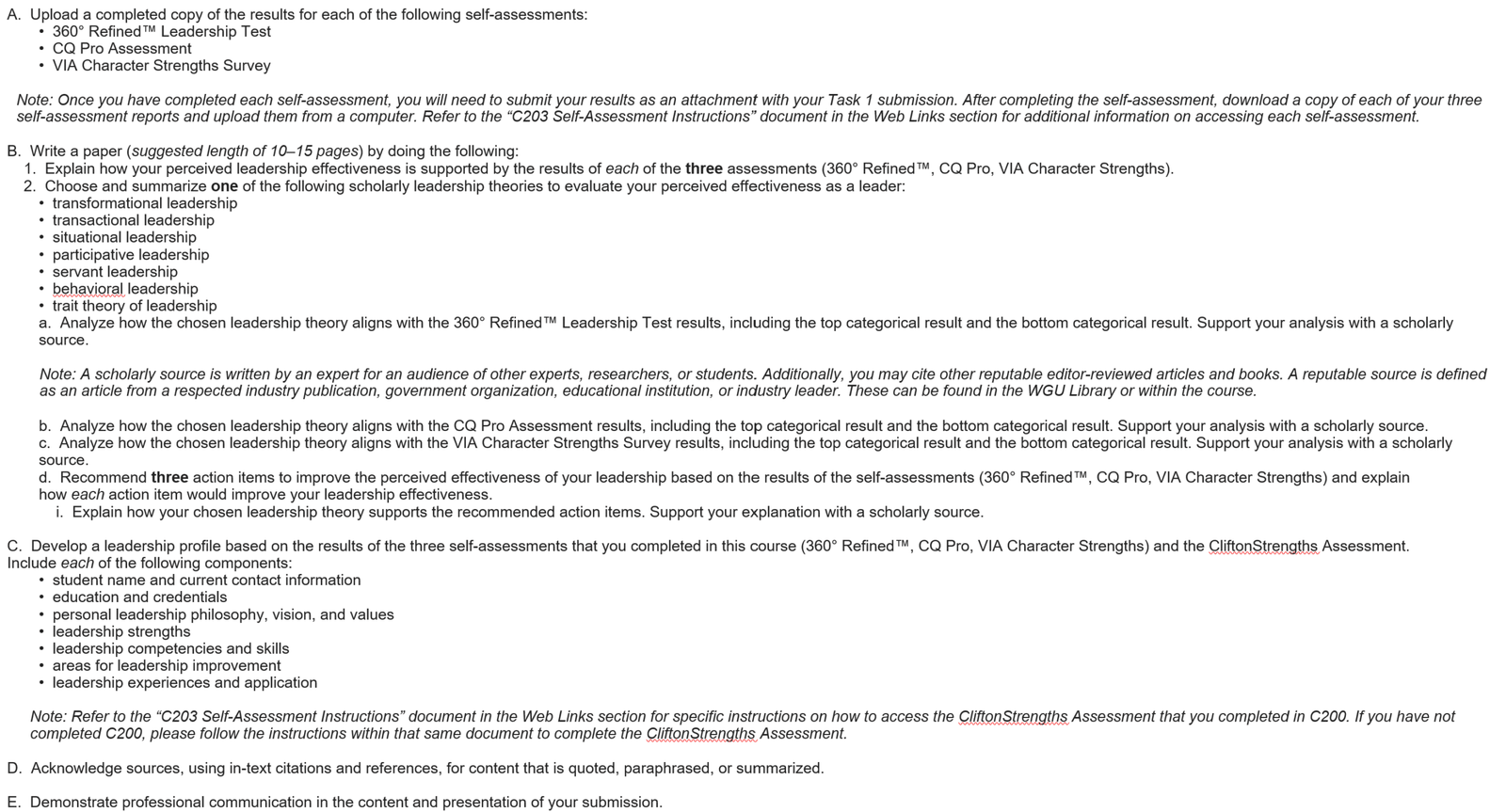
Three functional parts: uploading your three completed assessment reports (Part A), writing a scholarly analysis paper connecting those results to a chosen leadership theory (Part B), and building a leadership profile document (Part C). The paper is the analytical core — it’s not asking you to summarize what each assessment says about you, it’s asking you to explain why your results make sense through the lens of an established academic leadership theory.
Why WGU Uses This Assignment
Leadership development programs that skip self-assessment tend to produce leaders who can recite leadership theory without any real anchor to their own behavior. This task forces the connection: you can’t just describe transformational leadership in the abstract, you have to show how your own top and bottom assessment results either fit or complicate that theory. That’s a genuinely harder, more useful skill than memorizing a leadership framework.
Understanding the Three Assessments
360° Refined™ Leadership Test
This assessment measures 22 leadership skills across seven skill groups, split into two categories: Core Leadership (Strategy, Action, Results — “what you bring to the job”) and Adaptive Leadership (Emotional Intelligence, Organizational Justice, Character, Development — “who you are on the job”). The Self Edition specifically captures how you perceive your own behavior, rated on a 1–6 frequency scale.
A genuinely important caveat: self-report leadership data measures self-perception, not observed behavior. Research on 360-degree feedback consistently finds that self-ratings and other-ratings frequently diverge — leaders often rate themselves differently than peers, supervisors, or direct reports would. That’s not a flaw in the Self Edition specifically; it’s a documented pattern in leadership self-assessment generally, and it’s worth acknowledging directly in your paper rather than treating your self-report scores as objective fact. A stronger paper says “my self-perceived result suggests…” rather than “my result proves…”
CQ Pro Assessment
Cultural Intelligence (CQ) is academically modeled across four factors: CQ Drive (motivational — your interest in and confidence engaging cross-culturally), CQ Knowledge (cognitive — your understanding of cultural systems and differences), CQ Strategy (metacognitive — your awareness and planning around cross-cultural interactions), and CQ Action (behavioral — your ability to adapt your actual behavior across cultural contexts). Your top and bottom categorical results across these four factors are what Part B2b asks you to connect to your chosen leadership theory.
VIA Character Strengths Survey
24 character strengths organized under six virtue categories (Wisdom, Courage, Humanity, Justice, Temperance, Transcendence), ranked from your signature (top) strengths to your lesser-used ones. For a deeper breakdown of how to interpret signature versus lesser strengths, see our Virtue Ethics vs. Utilitarianism vs. Principle-Based Ethics and character-strengths-focused content elsewhere on this site — the same VIA framework shows up across multiple WGU courses.

Choosing Your Leadership Theory
You’re choosing one of seven: transformational, transactional, situational, participative, servant, behavioral, or trait theory. The right choice depends on which theory’s core claims actually fit the pattern across your three assessments — not which theory you find most personally appealing.
A practical way to narrow it down:
- High Vision/Acumen results, high CQ Drive, high strengths like Creativity or Hope → often aligns well with transformational leadership, which emphasizes vision, inspiration, and individualized development of others.
- High Decision Making/Acumen results with more moderate Emotional Intelligence scores → may align with transactional leadership, which emphasizes structured exchange, clear expectations, and performance-contingent reward.
- Results that vary significantly depending on context described in your own leadership experience → may fit situational leadership, which explicitly argues effective leadership style should change based on follower readiness and context.
- High Organizational Justice or Fairness-related strengths → often aligns with participative leadership (shared decision-making) or servant leadership (prioritizing others’ growth and needs).
- Strong, consistent core traits across all three assessments (e.g., high Integrity, high Honesty, high Credibility together) → may fit trait theory, which argues effective leadership stems from stable personal characteristics.
Recent peer-reviewed research on transformational and transactional leadership specifically has found that these styles are not simply “better or worse” in the abstract — their effectiveness depends heavily on organizational and cultural context, which is exactly why connecting your theory choice to your specific CQ Pro results (not just your 360° or VIA results) genuinely matters for this task, not just as a box to check.
Writing the Alignment Analysis (Part B2a, B2b, B2c)
What evaluators are checking: a logical, source-supported explanation connecting your chosen theory to your top and bottom categorical result for each assessment — not just your top result, and not a generic definition of the theory with your scores mentioned in passing.
The structure that works: state the specific result (top and bottom), state what the theory would predict or explain about that pattern, and support the connection with a scholarly source — not just cite a source near the paragraph, but actually use it to justify the specific claim you’re making.
Demonstrating the Structure (Fictional Narrator — Not a Template to Copy)
To show what this alignment actually looks like written out, here’s a fictional narrator, Dana Whitfield, illustrating the pattern using invented, fictional results. This is structure only — copying it with your own scores swapped in defeats the purpose of the assignment, and reads as exactly that to an evaluator.
Dana’s fictional 360° Refined top categorical result was Strategy (particularly Vision), with the fictional bottom categorical result in Organizational Justice. Applying transformational leadership theory, Dana’s high Vision score aligns with the theory’s central emphasis on articulating an inspiring future direction for followers — a defining behavior of transformational leaders (citing a scholarly source on transformational leadership’s vision component). The comparatively lower Organizational Justice result is also explainable through the theory: transformational leadership research has noted that a strong focus on future-oriented vision can sometimes come at the expense of the day-to-day fairness and consistency emphasized by other leadership approaches, suggesting a specific, theory-grounded area for Dana’s continued development rather than an unexplained weakness.
Notice this doesn’t just define transformational leadership — it uses the theory to explain both the strength and the weakness, with a source doing real justificatory work, not just sitting nearby.
Recommending Action Items (Part B2d)
Your three action items need to trace back to your actual assessment results, not read as generic leadership advice. “Improve communication” is not specific; “Complete structured feedback-seeking practice targeting the Organizational Justice gap identified in my 360° Refined results, consistent with [chosen theory]’s emphasis on X” is specific, evidenced, and theory-grounded — the same three-part structure (result → action → theory justification) the rubric is checking for throughout Part B.
Building the Leadership Profile (Part C)
This document needs seven components: your name and current contact information, education and credentials, your personal leadership philosophy/vision/values, leadership strengths, leadership competencies and skills, areas for improvement, and leadership experiences and application — all grounded in your three Task 1 assessments plus your CliftonStrengths results from C200.
Rather than a fabricated example profile, we’ve built an actual fillable template covering all seven required sections with guidance on what belongs in each — see the download below.
Common Mistakes
- Writing a generic definition of your chosen leadership theory without connecting it to your specific top and bottom results
- Only addressing your top result for each assessment and skipping the bottom one, which the rubric explicitly requires
- Citing a scholarly source near a claim without the source actually supporting that specific claim
- Treating self-report results as objective fact rather than self-perception, missing an easy opportunity to demonstrate more sophisticated understanding
- Action items that read as generic leadership advice rather than tracing back to a specific assessment result
- A leadership profile that restates the paper instead of standing as its own concise, forward-facing document
Self-Assessment Checklist
- Have I addressed both the top and bottom categorical result for all three assessments?
- Does my chosen theory genuinely explain my results pattern, or am I forcing a fit?
- Does every scholarly source actually justify the specific claim next to it?
- Have I acknowledged the self-report nature of these assessments anywhere in my analysis?
- Do my three action items each trace back to a specific result and a specific theory-based justification?
- Does my leadership profile include all seven required components?
Frequently Asked Questions
Can I choose a different leadership theory than the one my results seem to fit best? You can choose any of the seven, but your paper will be stronger and easier to write if the theory genuinely explains your results pattern rather than requiring you to force an unlikely connection.
Do I need a scholarly source for every single claim? The rubric specifically requires a scholarly source supporting your theory-to-assessment analysis in B2a, B2b, and B2c, and for your action items’ theory justification — build your source use around those specific points at minimum.
What counts as a scholarly source here? Something written by an expert for other experts, researchers, or students — peer-reviewed journal articles are the safest choice, alongside reputable industry, government, or educational sources. General web content or opinion blogs don’t qualify.
Is getting help with this task against WGU’s academic integrity policy? Tutoring, coaching, and editing support are a normal, accepted part of studying — most university policies explicitly support students getting this kind of help with structuring and understanding their own analysis. The assessment results, reflections, and profile content still need to be genuinely yours.
Related Learning Resources
- Understanding Bias in the Workplace — relevant background for interpreting the CQ Pro and 360° results honestly
- Executive Communication — relevant to the leadership profile’s competencies section
- Strategic Planning Basics — relevant to articulating your leadership vision and philosophy
References & Further Reading
- Klein, G. (2023). Transformational and Transactional Leadership, Organizational Support and Environmental Competition Intensity as Antecedents of Intrapreneurial Behaviors. European Research on Management and Business Economics, 29(2), 100215. — A peer-reviewed study on transformational and transactional leadership’s organizational effects, useful background for Part B’s theory analysis.
- Rockstuhl, T., Wu, D., Dulebohn, J. H., Liao, C., & Hoch, J. E. (2023). Cultural Congruence or Compensation? A Meta-Analytic Test of Transformational and Transactional Leadership Effects Across Cultures. Journal of International Business Studies, 54(3), 476–504. — A recent peer-reviewed meta-analysis on how cultural context shapes leadership effectiveness, directly relevant to connecting a leadership theory to your CQ Pro results specifically.
- Emam, S. M., Fakhry, S. F., & Abdrabou, H. M. (2024). Leaders Development Program by 360 Degree Feedback: Reflection on Head Nurses’ Leadership Practices. BMC Nursing, 23, 772. — A recent peer-reviewed study on 360-degree feedback in leadership development, relevant background for interpreting self-report leadership assessment data appropriately.