
WGU C205 Task 1 Guide: Leading Teams — Team Dynamics and Group Development (KUM1)

WGU C205 Task 1 Guide: Leading Teams
Seven discussion points, one underlying question every effective team leader eventually has to answer: what actually makes a group of individuals function as a team?
Executive Summary
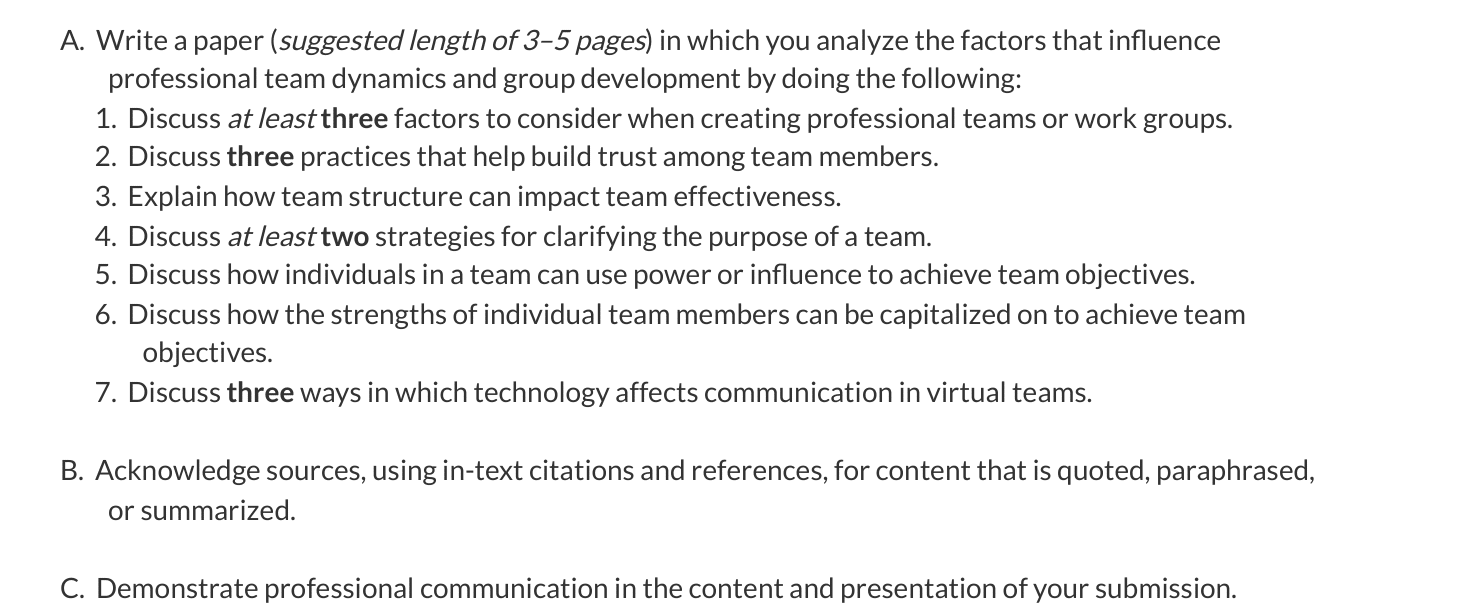
C205 Task 1 (assessment code KUM1) — sometimes referred to as “WGU C205 KUM1 Task 1” — asks you to write a 3–5 page paper covering seven distinct aspects of professional team dynamics and group development — from the factors to consider when creating professional teams or work groups, to trust, structure, purpose, power, individual strengths, and technology and communication in virtual teams.
Unlike most WGU performance assessments, there’s no case study or company scenario attached — this is a direct test of your grasp of effective team leadership strategies and communication, applied with enough specificity that it reads as understanding, not a definitions list. That distinction is what separates a Competent score from Approaching Competence on every single rubric line here.
What’s Covered in This Guide
- Why this task rewards specificity over breadth, given how many sub-topics it packs into 3–5 pages
- All seven required discussion points, broken down with the depth evaluators are actually checking for
- A full worked example applying every concept to one continuous team scenario
- Common mistakes and a self-assessment pass before you submit
The Assignment: WGU C205 Task 1
Introduction
Effective business leadership requires a mastery of group and team dynamics. In order to meet these needs, individuals must learn strategies for group communication, team building, and leadership to assist organizations in meeting goals. Organizational personnel must learn team strategies and appropriately apply them, as organizations increasingly operate with teams and work groups in both collocated and virtual settings.
In this task, you will write a paper that reviews key concepts related to team development, which will better prepare you for the teamwork required for Task 2.
Requirements
Your submission must represent your original work and understanding of the course material. Most performance assessment submissions are automatically scanned through the WGU similarity checker. Students are strongly encouraged to wait for the similarity report to generate after uploading their work and then review it to ensure Academic Authenticity guidelines are met before submitting the file for evaluation. See Understanding Similarity Reports for more information.
Grammarly Note:
Professional Communication will be automatically assessed through Grammarly for Education in most performance assessments before a student submits work for evaluation. Students are strongly encouraged to review the Grammarly for Education feedback prior to submitting work for evaluation, as the overall submission will not pass without this aspect passing. See Use Grammarly for Education Effectively for more information.
Microsoft Files Note:
Write your paper in Microsoft Word (.doc or .docx) unless another Microsoft product, or pdf, is specified in the task directions. Tasks may notbe submitted as cloud links, such as links to Google Docs, Google Slides, OneDrive, etc. All supporting documentation, such as screenshots and proof of experience, should be collected in a pdf file and submitted separately from the main file. For more information, please see Computer System and Technology Requirements.
You must use the rubric to direct the creation of your submission because it provides detailed criteria that will be used to evaluate your work. Each requirement below may be evaluated by more than one rubric aspect. The rubric aspect titles may contain hyperlinks to relevant portions of the course.
Understanding the Assignment
Seven rubric aspects (A1–A7), each independently scored, packed into a suggested 3–5 pages. That math matters: you don’t have room for long throat-clearing introductions before each section. The strongest papers get to the point fast, cover the required count precisely (three factors, three trust practices, two purpose strategies, three technology effects — not two, not four), and spend their limited space on depth rather than padding.
Why WGU Uses This Assignment
Team failures in real organizations rarely trace back to one dramatic cause — they trace back to a manager who skipped one of exactly these fundamentals: never clarified the team’s actual purpose, never built trust deliberately, or never adapted communication norms for a team that wasn’t sitting in the same room. This task is a checklist against exactly those failure points, which is also why Task 2 (the applied team project) builds directly on it.
Before You Begin
- Note the specific counts required for each section — losing points here is usually a counting error, not a knowledge gap
- Plan roughly equal space for each of the seven sections rather than over-writing the ones you find most interesting
- Identify your sources before you draft, since B (citations) is scored separately and needs to support specific claims, not just appear in a reference list
- Keep one continuous example in mind as you write — even though it’s not required, illustrating your points with one consistent scenario (real or hypothetical) makes abstract concepts concrete without inflating your page count
A1: Factors to Consider When Creating Professional Teams or Work Groups
A professional team and a work group aren’t identical — a team typically shares leadership and works toward a collective goal with mutual accountability, while a work group is more often individually accountable under a single supervisor. Keeping that distinction in mind sharpens your discussion of the factors themselves. Three factors worth discussing in real depth, not just naming:
- Skill and role diversity — a team assembled from people with overlapping skills duplicates effort and leaves gaps elsewhere; deliberately mapping required skills against available team members before assignment reduces this risk.
- Clarity of the team’s objective before formation — teams built before the objective is defined tend to be sized and skilled incorrectly for the actual task, since you can’t know what capabilities you need until you know what you’re solving for.
- Team size relative to task complexity — research on team effectiveness consistently finds that oversized teams suffer coordination costs that outweigh the added capacity, while undersized teams for complex tasks create bottlenecks; the right size depends on task interdependence, not a fixed number.
A2: Practices That Help Build Trust Among Team Members
- Consistent follow-through on commitments — trust erodes fastest not from big betrayals but from small, repeated gaps between what someone says and what they do; reliability compounds over time in a way charisma doesn’t.
- Transparent, proactive communication — sharing information before being asked, including uncomfortable information (a missed deadline, a mistake), signals that the team member values the relationship over self-protection.
- Vulnerability-based trust — team members who can admit uncertainty, ask for help, or acknowledge a mistake without fear of punishment build deeper trust than teams that reward only confident, polished performance; this is sometimes called psychological safety, and it’s a documented predictor of team performance, not just a “nice to have.”
A3: How Team Structure Impacts Effectiveness
Structure shapes what a team is actually capable of, independent of who’s on it:
- Functional structure (team members grouped by specialty, reporting through their own function) offers deep expertise but slower cross-functional coordination — good for tasks requiring specialized depth, weaker for tasks requiring fast integration across disciplines.
- Cross-functional structure (members from different specialties working together directly) improves integration speed and innovation but requires more deliberate coordination effort, since members don’t share a single reporting line.
- Self-managed/flat structure (minimal hierarchy, shared decision authority) increases member ownership and can speed up decisions for experienced teams, but struggles with unclear accountability if roles aren’t explicitly defined despite the flat hierarchy.
Recent peer-reviewed research comparing team trust and effectiveness across virtual and face-to-face settings found that structural and environmental factors interact — the same structural choice can produce different effectiveness outcomes depending on whether the team is collocated or distributed, which is worth acknowledging if your discussion touches virtual teams at all.
A4: Two Strategies for Clarifying the Purpose of a Team
- A team charter defining roles, goals, and decision-making policies — a written document defining the team’s objective, scope, decision-making process, and individual roles, created collaboratively at formation rather than assumed. A charter gives the team something concrete to refer back to when priorities blur mid-project.
- A structured kickoff session with explicit goal-setting — rather than assuming alignment, a kickoff that has every member state their understanding of the goal out loud surfaces misalignment immediately, before it costs the team weeks of work pointed in slightly different directions.
A5: Using Power and Influence to Achieve Team Objectives
The most useful framework here remains French and Raven’s five bases of power, originally identified in 1959 and still the standard reference point in leadership literature: legitimate power (formal position/authority), reward power (ability to grant desirable outcomes), coercive power (ability to impose penalties), expert power (recognized specialized knowledge), and referent power (influence through respect and personal rapport).
The practical insight worth including: legitimate and coercive power are the least effective for genuine team buy-in, since they produce compliance rather than commitment. Expert and referent power tend to produce more durable influence, especially in team settings where the influencer isn’t necessarily the formal team leader — a team member with deep technical expertise can shape a team’s direction through expert power alone, without holding any formal authority.
A6: Capitalizing on Individual Team Member Strengths
The core move is matching task assignment to demonstrated strength rather than defaulting to whoever’s available or whoever volunteers first. Practically, this means:
- Identifying each member’s strongest contribution area early — through direct conversation, past performance, or a formal strengths assessment
- Assigning stretch tasks that build on an existing strength rather than starting from a weakness, which builds both confidence and speed
- Deliberately pairing complementary strengths — someone strong in big-picture strategy paired with someone strong in execution detail, for example — rather than grouping similar strengths together
A7: Technology and Communication in Virtual Teams
At least three ways technology affects communication in virtual teams are worth discussing in depth:
- Loss of nonverbal and paraverbal cues — tone, facial expression, and body language carry meaning that text-based communication strips out, increasing the risk of misread intent and requiring more explicit, over-communicated context than a collocated team needs.
- Asynchronous coordination changes the pace of decision-making — virtual teams across time zones gain flexibility but lose the immediate back-and-forth of in-person discussion, meaning decisions that would take minutes in a room can take days over email or messaging threads.
- Relationship and trust-building require deliberate structure — the informal, unplanned interactions that build rapport in a physical office (hallway conversations, shared lunches) don’t happen automatically in virtual settings; research on virtual team trust specifically identifies structured, intentional relationship-building activity as necessary compensation for that missing informal contact, not something virtual teams can simply do without.

A Full Worked Example (Applying All Seven Concepts)
To show how these seven concepts connect rather than function as a checklist, here’s one continuous scenario: a cross-functional product launch team at a fictitious company.
Formation (A1): The team is built with deliberate skill diversity — one member each from engineering, marketing, and operations — sized at five people for a mid-complexity six-week launch, avoiding both the coordination drag of a larger team and the bottleneck risk of a smaller one.
Trust (A2): The team lead models transparent communication early by sharing a real budget constraint the team wasn’t expecting, rather than presenting the project as more resourced than it is — and follows through precisely on a promised decision timeline, establishing reliability from week one.
Structure (A3): The team operates as a cross-functional structure rather than routing decisions back through each member’s home department, prioritizing integration speed over functional depth given the tight timeline.
Purpose (A4): A one-page charter defines the launch date, decision rights, and each member’s specific deliverable, created collaboratively in a kickoff session where every member restates the goal in their own words before work begins.
Power (A5): The engineering lead, who holds no formal authority over the marketing or operations members, still shapes several key decisions through expert power — the team defers to her technical judgment on feasibility questions specifically because of her demonstrated expertise, not her title.
Strengths (A6): The operations member, whose strength is process documentation, is assigned the launch runbook rather than customer-facing tasks better suited to the marketing member’s communication strength — deliberate matching, not default assignment.
Virtual communication (A7): Because two team members work remotely, the team adopts an explicit norm of stating tone in writing (“flagging this as urgent, not upset”) to compensate for lost nonverbal cues, schedules a recurring synchronous check-in specifically to avoid the coordination lag asynchronous-only communication would create, and holds one deliberately informal virtual coffee chat per week to build the rapport that wouldn’t happen automatically.
This is the level of specific, connected application a strong paper demonstrates — not seven isolated definitions, but seven concepts working together on one coherent team.
Common Mistakes
- Providing exactly the required count with thin, one-sentence coverage instead of genuine detail — hitting “three factors” technically while failing the “sufficient detail” bar
- Defining a concept (like a base of power) without discussing how it’s actually used to achieve a team objective
- Treating the seven sections as fully independent, missing opportunities to show how they interact
- Citing a source without using it to support a specific claim
- Spending disproportionate space on one favorite topic and rushing the rest within the 3–5 page limit
Self-Assessment Checklist
- Have I hit the exact required count for each section (3 factors, 3 trust practices, 2 purpose strategies, 3 technology effects)?
- Does each point include real depth, not just a definition?
- Have I connected power/influence and individual strengths specifically to achieving team objectives, not just described them abstractly?
- Does every cited source actually support the specific claim next to it?
- Would a reader unfamiliar with team leadership theory understand each point without needing outside context?
Frequently Asked Questions
Does my paper need a real team example, or can everything stay theoretical? A real or hypothetical example isn’t explicitly required, but it strengthens the “sufficient detail” bar the rubric asks for — abstract discussion alone tends to read thinner than the same points illustrated concretely.
What’s the difference between a professional team and a work group? A team typically shares leadership responsibility and works toward a collective goal with mutual accountability across members. A work group is usually individually accountable to a single supervisor, with less shared ownership of the outcome. This distinction is worth naming explicitly in your A1 discussion.
How many sources do I need? The rubric doesn’t specify a number, but every major claim across the seven sections should be supported by at least one source, with accurate in-text citations and a matching reference list.
Can I discuss more than the required number of factors or strategies? You can, but given the 3–5 page suggested length across seven sections, exceeding the required count usually means less depth per point — sufficient detail on the required number typically scores better than thinner coverage of more.
Is getting help with this task against WGU’s academic integrity policy? Tutoring, coaching, and editing support are a normal, accepted part of studying — most university policies explicitly support students getting this kind of help.
Related Learning Resources
- Business Decision Making Frameworks — relevant background for the power/influence and structure discussions
- Executive Communication — relevant to the trust and virtual communication sections
- Understanding Bias in the Workplace — relevant to fair, strengths-based task assignment
References & Further Reading
- Wei, F., Hwang, B.-G., Zainal, N. S. B., & Zhu, H. (2024). Trust, Team Effectiveness, and Strategies: A Comparative Study between Virtual and Face-to-Face Teams. Journal of Construction Engineering and Management, 150(7). — An award-winning, recent peer-reviewed study comparing trust and effectiveness dynamics across virtual and face-to-face teams, the basis for this guide’s discussion of structure, trust, and virtual communication technology.
- French, J. R. P., & Raven, B. (1959). The Bases of Social Power. In D. Cartwright (Ed.), Studies in Social Power (pp. 150–167). University of Michigan Press. — The original primary source identifying the five bases of power still used as the standard framework in leadership and team-influence literature, cited directly here since it is the actual origin of the model this section applies.