
D361 Task 1 vs D361 Task 2: Key Differences, Expectations, and How to Pass Both


D361 Task 1 vs D361 Task 2
Introduction
If you’re staring at the D361 course overview wondering why there are two performance assessments instead of one, you’re not alone. Many students assume Task 1 and Task 2 are just “part A and part B” of the same assignment; and that assumption is where most early confusion (and most early revisions) starts.
D361, WGU’s Business Simulation course, builds around a single simulated company that you manage over several quarters. Task 1 and Task 2 both draw from that simulation, but they’re graded on different competencies and ask you to think in different ways. Task 1 is largely about reporting what happened and why it matters. Task 2 asks you to step back and evaluate where your company stands against the competition — and to justify a path forward.
In this guide, you’ll learn:
- What each task actually assesses
- How the two tasks differ in scope, deliverables, and difficulty
- Which task tends to be harder — and for whom
- The mistakes that most often trigger a revision
- How to prepare for each task before you start writing
This article is a planning and strategy resource. It won’t walk you through your specific scenario data or write your submission for you — that part has to be your own original work, evaluated against the rubric your instructor gives you.
Quick Answer
While D361 Task 1 and Task 2 are both performance assessments within the same Business Simulation course, they emphasize different competencies. Task 1 generally asks you to report and interpret the financial and operational results of your simulated company — think balance scorecards, income statements, and a business overview that explains what those numbers mean. Task 2 shifts the lens outward: it asks you to analyze your company’s competitive position, typically through a SWOT-style analysis and a justified recommendation for how the business should respond to market conditions.
In practice, Task 1 tends to reward clear, accurate reporting and sound business explanation, while Task 2 rewards deeper analysis, evidence-based judgment, and stronger justification. Neither task is “the easy one” — they simply test different muscles. Students who are comfortable with numbers and structured reporting often move through Task 1 faster, while students who enjoy strategic thinking sometimes find Task 2 more natural. Understanding this difference before you start can help you plan your time, choose the right order to tackle your work, and avoid the kind of scope confusion that leads to a returned submission.
Quick Comparison Table
| Feature | D361 Task 1 | D361 Task 2 |
|---|---|---|
| Objective | Report and explain your simulated company’s financial and operational performance | Analyze your company’s competitive position and justify a strategic direction |
| Skills Tested | Financial interpretation, business communication, structured reporting | Strategic analysis, critical thinking, evidence-based recommendation |
| Deliverables | Business performance report with supporting financial exports | Competitive analysis (commonly SWOT-based) with a recommendation |
| Expected Length | Concise, rubric-driven sections | Similar length, but more analytical depth per section |
| Critical Thinking | Moderate — explaining what happened and why | High — evaluating options and defending a what next |
| Research | Primarily simulation data and course materials | Simulation data plus market/competitive reasoning |
| APA Requirements | Required for supporting sources and citations | Required for supporting sources and citations |
| Time Commitment | Moderate; often faster once data exports are organized | Moderate to high; more time spent on analysis and justification |
| Common Challenges | Formatting exports correctly, aligning narrative to numbers | Avoiding surface-level analysis, weak justification |
What Is D361 Task 1?
D361 Task 1 is the performance-reporting assessment. After you’ve made a series of decisions for your simulated company across the course’s business quarters, Task 1 asks you to step back and report what happened: how the company performed financially, what decisions drove those results, and what the numbers mean for the business going forward.
What you’ll typically work with:
- Learning objectives centered on business performance reporting and financial literacy
- A written report structured around your simulation results (commonly including a business overview, financial summary, and interpretation of key metrics)
- Supporting exports from the simulation platform, such as financial statements or a scorecard
What evaluators generally look for, based on the published rubric and assignment instructions:
- A clear, accurate business overview that orients the reader to your company
- Correctly formatted and complete financial exports (not screenshots, when a proper export is required)
- Explanations that connect the numbers to business decisions — not just a restatement of the data
- Professional, well-organized writing that mirrors the rubric’s structure
Where students most often need revisions: Many students find that revision requests on Task 1 come from formatting issues (like submitting a screenshot instead of a proper spreadsheet export) or from a narrative that describes results without explaining the why behind them. Reviewing the rubric line by line before you draft — rather than after — tends to prevent both problems.
Read our complete D361 Task 1 Guide for a step-by-step walkthrough of each section.
What Is D361 Task 2?
D361 Task 2 shifts from reporting to strategy. Its purpose is to evaluate how well you can assess your company’s position in a competitive market and justify a direction forward using evidence from the simulation.
What it typically covers:
- Purpose: evaluating your simulated company against its competitive environment
- Required deliverables: a structured competitive analysis (often built around a SWOT framework) and a justified strategic recommendation
- Competencies assessed: strategic thinking, evidence-based reasoning, and business communication
What evaluators generally look for:
- A genuine analysis of strengths, weaknesses, opportunities, and threats — not a list of generic business terms
- A recommendation that’s clearly tied back to the analysis, not introduced out of nowhere in the final paragraph
- Use of simulation data and course concepts as evidence, rather than opinion alone
- Headings and structure that mirror the rubric, so every competency is easy for an evaluator to locate
Where students most often need revisions: Task 2 revisions tend to cluster around shallow analysis — for example, labeling something a “strength” without explaining why it matters competitively — or a recommendation that doesn’t clearly follow from the SWOT analysis above it. Many students find that outlining the connection between each SWOT point and the final recommendation before drafting solves this.
See our detailed D361 Task 2 Guide for examples and practical tips.
Major Differences Between D361 Task 1 and Task 2
| Area | Task 1 | Task 2 |
|---|---|---|
| Objective | Report and interpret business performance | Analyze competitive position and recommend strategy |
| Research Required | Simulation exports and course materials | Simulation data plus competitive/market reasoning |
| Critical Thinking | Explaining outcomes and their causes | Evaluating options and defending a recommendation |
| Writing Style | Descriptive, explanatory, data-anchored | Analytical, persuasive, evidence-driven |
| Data Analysis | Financial statement interpretation | Strategic/competitive interpretation (SWOT-style) |
| Business Application | Performance measurement and reporting | Strategic planning and decision justification |
| Length | Rubric-driven, moderate | Rubric-driven, similar length with denser analysis |
Why these differences matter: Task 1 is closer to what you’d do as an analyst summarizing quarterly results for a manager. Task 2 is closer to what you’d do as that manager deciding what to do next. Recognizing which mode you’re in before you start writing helps you match your tone, structure, and depth to what the rubric is actually measuring.
Which Task Is More Difficult?
There’s no universal answer here — and you should be skeptical of any guide that claims one task is objectively harder. What’s true is that the two tasks load differently on different skills:
- Critical thinking required: Task 2 generally asks for more open-ended evaluation, since you’re weighing options rather than reporting results.
- Amount of analysis: Task 1’s analysis is more contained (explain the numbers); Task 2’s analysis is more expansive (build and defend an argument).
- Research depth: Both require simulation data, but Task 2 asks you to reason about competitive context on top of that data.
- Writing complexity: Task 1 rewards clarity and precision; Task 2 rewards clarity plus persuasive structure.
- Evaluator expectations: Both are graded against explicit rubric criteria, but Task 2’s criteria tend to reward depth of justification more heavily.
Students who are comfortable with numbers and structured reporting often move through Task 1 more quickly. Students who enjoy synthesizing information into a recommendation sometimes find Task 2 more natural, even though it takes longer. If you’re unsure which will be harder for you, it’s worth reviewing both rubrics before you start either task.
Common Mistakes Students Make
Task 1
- Misunderstanding rubric requirements — starting the narrative before fully reading what each section needs to include.
- Missing supporting evidence — describing a result without the export or data point that backs it up.
- Weak explanations — restating a number (“revenue increased”) without explaining what drove the change or what it means for the business.
Task 2
- Superficial analysis — listing SWOT points as single words or phrases instead of explaining their competitive significance.
- Incomplete recommendations — proposing a direction without connecting it back to the strengths, weaknesses, opportunities, or threats identified earlier.
- Poor alignment with competencies — organizing the paper narratively instead of mirroring the rubric’s structure, which makes it harder for an evaluator to verify each requirement is met.
Rubric Alignment Checklist
Use this quick checklist before you submit either task:
- Every rubric criterion has a corresponding heading or clearly labeled section in your draft
- Each claim is backed by a simulation data point, export, or cited source
- Financial exports (Task 1) are submitted in the required format — not as screenshots
- Your SWOT points (Task 2) each explain why they matter, not just what they are
- Your recommendation (Task 2) is explicitly tied back to your analysis
- APA formatting is applied consistently to all in-text citations and references
- Headings mirror the rubric’s language so an evaluator can verify requirements quickly
Time Planning Guide
A rough planning breakdown many students find workable — adjust based on your own pace and familiarity with the simulation:
| Phase | Task 1 | Task 2 |
|---|---|---|
| Reviewing rubric and scenario | 30–45 minutes | 30–45 minutes |
| Gathering data/exports | 45–90 minutes | 45–90 minutes |
| Outlining | 30 minutes | 45–60 minutes |
| Writing | 2–3 hours | 3–4 hours |
| Proofreading and rubric check | 30–45 minutes | 45–60 minutes |
Breaking the work into separate planning, research, drafting, and proofreading sessions — rather than trying to complete everything in one sitting — tends to reduce both fatigue and revision requests.
Revision Insights
Across both tasks, the most common reasons submissions come back for revision tend to fall into a few categories:
- Formatting issues — the wrong export type, missing APA elements, or headings that don’t match rubric language.
- Evidence gaps — a claim made without the data, citation, or simulation result to support it.
- Shallow justification — especially on Task 2, where a recommendation isn’t clearly earned by the analysis above it.
If your task is returned for revision, treat the evaluator’s comments as a rubric map: address each point individually, and re-check the full rubric (not just the flagged section) before resubmitting, since revisions sometimes surface adjacent gaps.
Decision Guide: Where Should You Focus First?
If you’re planning your time across D361, a simple way to decide where to start:
- Are you more confident interpreting financial statements than building a strategic argument? Start with Task 1 to build momentum, then move to Task 2 while the simulation context is fresh.
- Are you more comfortable with strategic reasoning than financial reporting? Consider outlining Task 2’s SWOT framework early, even if you complete Task 1’s report first — the competitive thinking often benefits from marinating alongside the performance data.
- Are you unsure which is harder for you? Read both rubrics in full before starting either task. The rubric — not this guide or anyone else’s experience — is the real source of truth for what’s expected.
How to Prepare Before Starting Either Task
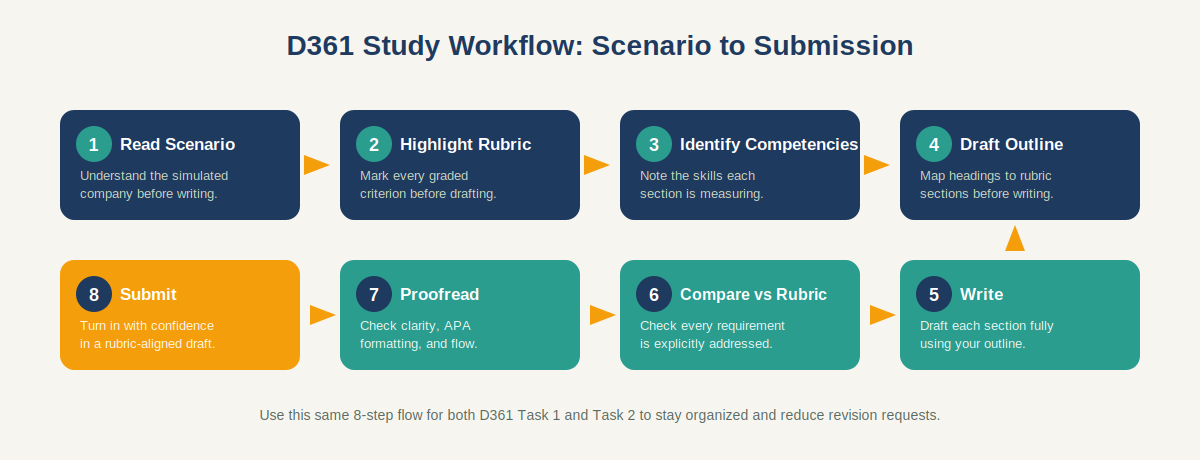
- Review the rubric first. Read it before the scenario, not after your first draft.
- Read the scenario carefully. Note every decision point and result that might be relevant.
- Outline your response before writing. Map your headings directly to rubric sections.
- Gather supporting sources early. Locate APA-formatted sources for concepts you’ll cite before you start drafting.
- Use evaluator feedback if revising. Treat prior feedback as a checklist for your next draft, not just a note to skim.
Tips to Pass Both Tasks on the First Submission
- Follow the rubric point by point — don’t rely on memory of what “usually” gets asked.
- Address every competency explicitly, even ones that feel obvious.
- Use clear headings that mirror rubric sections so an evaluator can verify requirements quickly.
- Support claims with credible, correctly cited evidence.
- Proofread for clarity and formatting before you submit — a second read after a break catches more than a read right after finishing.
Frequently Asked Questions
Is D361 Task 2 harder than Task 1? Not universally. Task 2 typically demands more open-ended strategic analysis, while Task 1 demands precise, well-supported reporting. Which one feels harder often depends on whether you’re more comfortable with financial interpretation or strategic argument-building.
Can I complete Task 2 before Task 1? Check your course sequencing in the WGU course overview, since this can vary. Even where the platform allows flexibility, most students find it easier to complete Task 1’s performance reporting first, since Task 2’s competitive analysis often benefits from a clear picture of how the company actually performed.
How long does each D361 task take? This varies by student, but many find Task 1 takes a bit less time once data exports are organized, while Task 2 takes longer because of the additional analytical depth required. See the Time Planning Guide above for a rough breakdown.
Do both tasks require APA citations? Yes. Both tasks generally require APA-formatted in-text citations and references for any outside sources you use to support your analysis.
What happens if my task is returned for revision? You’ll typically receive specific evaluator feedback tied to rubric criteria. Address each point directly, then re-check the entire rubric — not just the flagged section — before resubmitting.
Final Thoughts
D361 Task 1 and Task 2 test different sides of the same simulated business: Task 1 asks you to report and explain what happened, while Task 2 asks you to analyze what it means and recommend what comes next. Neither is inherently harder — they simply reward different strengths. Reviewing both rubrics before you start, outlining around rubric language, and working through a consistent study workflow are the habits that most reliably lead to a first-submission pass.
Before you begin, it’s worth reading through our individual D361 Task 1 Guide and D361 Task 2 Guide for a section-by-section walkthrough.
If you’d like a second set of eyes on your outline or draft before you submit, our coaches are available for personalized guidance and editing support on WhatsApp. The goal is always to help you understand the material and produce work that’s genuinely your own — not to complete the assessment for you.

References
Benzaghta, M. A., Elwalda, A., Mousa, M. M., Erkan, I., & Rahman, M. (2021). SWOT analysis applications: An integrative literature review. Journal of Global Business Insights, 6(1), 55–73. https://doi.org/10.5038/2640-6489.6.1.1148
Faisal, A., Ahmad Ludin, K., & Adin, M. (2022). Business simulation games in higher education: A systematic review of empirical research. Human Behavior and Emerging Technologies, 2022, Article 1578791. https://doi.org/10.1155/2022/1578791
Journal of International Education in Business. (2023). Assessing the impact of business simulation as a teaching method for developing 21st century future skills. Journal of International Education in Business, 16(3), 351–370. https://doi.org/10.1108/JIEB-11-2022-0085
Mrangu, L. (2022). Rubric as assessment tool for lecturers and students in higher education institution. Acta Pedagogia Asiana, 1(1), 26–33. https://doi.org/10.53623/apga.v1i1.98
Students’ perception of the use of a rubric and peer reviews in an online learning environment. (2022). Journal of Risk and Financial Management, 15(11), 503. https://doi.org/10.3390/jrfm15110503
Wolters, C. A., & Brady, A. C. (2021). College students’ time management: A self-regulated learning perspective. Educational Psychology Review, 33, 1319–1351. https://doi.org/10.1007/s10648-020-09519-z