
C210 Task 1 vs Task 2 vs Task 3: Key Differences, Expectations, and How to Succeed


C210 Task 1 vs Task 2 vs Task 3
Introduction
C210, the Management and Leadership Capstone, is the course where everything you’ve studied in the MSML program comes together. Instead of one big final project, it’s broken into three connected tasks; and that structure trips people up more often than the content itself does.
Students often assume the three tasks are just “parts” of one long paper. In practice, each task develops a different competency while still contributing to the same overall goal: showing that you can research, design, and communicate a leadership solution for a real or realistic organizational challenge. Task 1 builds your research foundation. Task 2 turns that research into a concrete program proposal. Task 3 synthesizes everything into a comprehensive, presentation-ready deliverable.
In this guide, you’ll learn:
- What each task focuses on and what it’s really assessing
- How the three tasks compare in critical thinking, research, and writing style
- Which task students tend to find most challenging — and why that varies
- The mistakes that most commonly trigger a revision, task by task
- A practical workflow you can reuse across all three tasks
This is a planning and strategy resource. It’s designed to help you understand what each task expects and how to prepare — not to complete the assignment for you or reproduce assignment-specific instructions.
Quick Comparison Table
| Feature | Task 1 | Task 2 | Task 3 |
|---|---|---|---|
| Purpose | Establish a research foundation on leadership theory and practice | Design a leadership development program proposal for an organization | Synthesize research and proposal into a comprehensive, presentation-ready program |
| Main Competency | Research literacy and critical evaluation of sources | Applied strategic analysis and program design | Integration, synthesis, and professional communication |
| Deliverable | Annotated bibliography of leadership sources | Written program proposal (often including a SWOT-style analysis) | Comprehensive program document and/or presentation |
| Analysis Required | Evaluative — assessing each source’s credibility and relevance | Applied — connecting theory to a specific organizational context | Integrative — pulling Tasks 1 and 2 into one coherent whole |
| Research Level | High — this task is the research | Moderate — targeted research to support design choices | Lower new research, higher synthesis of prior work |
| Writing Complexity | Concise, evaluative annotations per source | Structured, analytical narrative | Polished, audience-aware, often presentation-style |
| Estimated Time | Moderate; time-consuming mostly due to source selection | Moderate to high; more time in the analysis and design stages | High; assembling and refining prior work takes real time |
| Common Revision Issues | Weak or overly descriptive annotations, insufficient source quality | Shallow analysis, proposal not clearly tied to research | Weak synthesis, inconsistent alignment with Tasks 1 and 2 |
What Does Each Task Focus On?
C210 Task 1
Task 1’s primary objective is building a credible research base. You’re typically asked to compile and evaluate a set of scholarly sources on leadership theory and practice — the foundation everything else in the capstone will draw from.
Core skills assessed:
- Locating credible, peer-reviewed sources relevant to leadership and management
- Critically evaluating each source rather than simply summarizing it
- Writing clear, evaluative annotations in proper APA format
What you’re expected to demonstrate: that you can distinguish a genuinely useful source from one that merely mentions leadership in passing, and that you can articulate why a source matters to your eventual program design — not just what it says.
Common pitfalls: Many students find that early drafts read as descriptive rather than evaluative — summarizing an article’s content without assessing its credibility, relevance, or limitations. It’s also easy to select sources that are topically related but too general to meaningfully support a specific program proposal later.
Preparation tips: Start by skimming your rubric’s evaluation criteria for each annotation, then build a short source list before you commit to full annotations. It’s much easier to swap a weak source early than to discover it doesn’t hold up in Task 2.
Read our complete C210 Task 1 Guide for a step-by-step walkthrough.
C210 Task 2
Task 2 shifts from research to application. Building on the sources from Task 1, you design a leadership development program proposal for an organization — commonly supported by a SWOT-style analysis of the organization’s current leadership capacity.
What changes from Task 1: the work becomes applied rather than evaluative. Instead of assessing sources, you’re using them as evidence to justify specific design choices in your proposed program.
Core skills assessed:
- Applying leadership theory to a real or realistic organizational context
- Conducting a structured analysis (frequently SWOT-based) of leadership needs
- Designing a proposal that’s both theoretically grounded and practically feasible
Common pitfalls: A proposal that reads well on its own but doesn’t clearly draw on the Task 1 research is a frequent source of revisions. Another is an analysis that identifies issues without connecting them to specific, actionable program elements.
Preparation tips: Before drafting, map each major program element back to a specific source or concept from your Task 1 annotated bibliography. This keeps your proposal evidence-based rather than opinion-based.
See our detailed C210 Task 2 Guide for examples and practical tips.
C210 Task 3
Task 3 is the capstone’s synthesis point. It asks you to pull Task 1’s research and Task 2’s proposal into one comprehensive, polished deliverable — often a full program document, a presentation, or both, depending on how your course section is structured.
Unique focus: rather than introducing significant new research, Task 3 tests your ability to integrate everything into a single, coherent, professional-quality product that could plausibly be presented to real organizational stakeholders.
Core skills assessed:
- Synthesizing prior research and design work into one unified narrative
- Professional-level written and/or presentation communication
- Consistency — making sure Task 3 doesn’t contradict or drift from Tasks 1 and 2
Common pitfalls: The most frequent issue is inconsistency: details in Task 3 that don’t quite match the proposal from Task 2, or a presentation that reads like a summary rather than a genuinely integrated final product. Formatting and polish also matter more here, since this task is often evaluated as a finished, presentation-ready deliverable.
Preparation tips: Reread Tasks 1 and 2 in full before starting Task 3, and build an outline that explicitly maps each Task 3 section back to where it originated in your earlier work.

How the Three Tasks Compare
| Area | Task 1 | Task 2 | Task 3 |
|---|---|---|---|
| Critical Thinking | Evaluating source credibility and relevance | Applying theory to a specific context | Integrating and reconciling prior work |
| Research Expectations | Primary — finding and vetting sources | Secondary — targeted, supporting research | Minimal new research; mostly synthesis |
| Writing Style | Concise, evaluative annotations | Structured, analytical narrative | Polished, audience-facing, presentation-ready |
| Application of Concepts | Conceptual — understanding theory | Applied — designing a real program | Demonstrative — showing the finished result |
| Decision-Making | Which sources are worth including | What the program should actually include | How to present and frame the final product |
| Evidence Required | Peer-reviewed, properly cited sources | Data/evidence tied to the target organization | Consistency with evidence used in Tasks 1 and 2 |
The throughline across all three tasks is evidence discipline: Task 1 builds your evidence base, Task 2 applies it, and Task 3 demonstrates that you can carry it through to a finished, professional product without losing the thread.
See our detailed C210 Task 3 Guide for examples and practical tips.
Which Task Do Students Find Most Challenging?
There’s no single answer that holds for every student, and it’s worth being skeptical of any guide that ranks the tasks definitively. What varies is which factors weigh more heavily for a given person:
- Workload: Task 1 can feel heavier upfront because source selection is time-consuming; Task 3 can feel heavier at the end because it requires reconciling everything that came before.
- Complexity: Task 2 often introduces the most new complexity, since it’s the first point where you’re designing something rather than researching or synthesizing.
- Ambiguity: Students newer to graduate-level research sometimes find Task 1 more ambiguous (what actually counts as a strong source?), while students newer to strategic design find Task 2 more ambiguous (how specific should the program actually be?).
- Analysis required: Task 2’s applied analysis tends to demand the most sustained critical thinking in a single sitting.
- Confidence with the subject matter: Students with a research background often move through Task 1 fastest; students with program design or HR experience often find Task 2 more intuitive.
If you’re unsure where you’ll struggle most, a quick read of all three rubrics before you start any of them tends to be more useful than guessing based on task number alone.
Common Mistakes Across All Three Tasks
Task 1 — Typical planning or rubric alignment issues
- Starting to write annotations before confirming which rubric criteria each one needs to address
- Choosing sources for topical relevance alone, without checking they’re strong enough to support later design work
Task 2 — Common analysis or evidence-related issues
- A SWOT-style analysis that lists points without explaining their significance for leadership development specifically
- Program elements introduced without a clear link back to Task 1 research
Task 3 — Challenges with synthesis, recommendations, or final presentation
- Inconsistencies between Task 3 and the proposal established in Task 2
- Treating Task 3 as a summary rather than a fully integrated, standalone deliverable
- Under-polishing formatting or presentation quality on what’s meant to be the capstone’s finished product
A Suggested Workflow
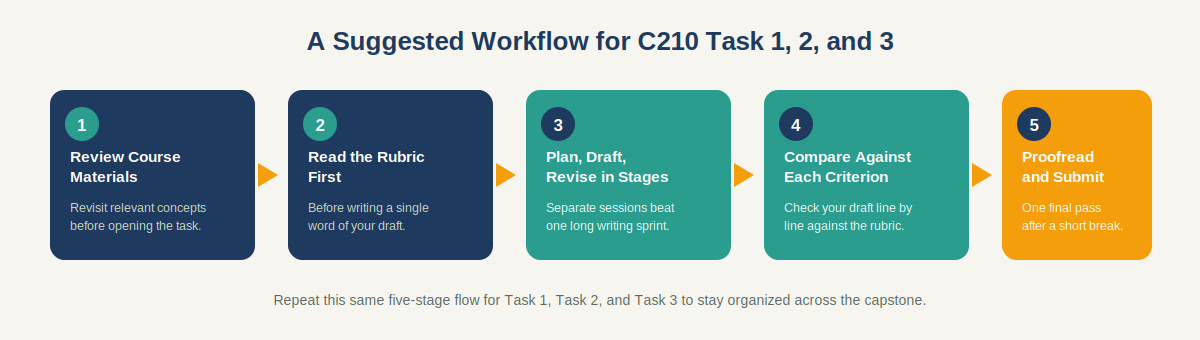
The same basic sequence works well across all three tasks — only the content changes:
- Review the course materials. Refresh your understanding of the relevant leadership concepts before opening the task.
- Read the rubric before writing. Know exactly what’s being evaluated before you draft a single sentence.
- Break the work into planning, drafting, and revision stages. Trying to do all three in one sitting is where quality tends to slip.
- Compare your draft against each rubric criterion. Go line by line rather than reading top to bottom for “flow” alone.
- Proofread before submission. A short break before your final read catches more than reviewing immediately after finishing.
Learning Progression Across the Capstone
It helps to see the three tasks as a single skill arc rather than three unrelated assignments:
- Task 1 builds your evidence base — the raw material everything else depends on.
- Task 2 builds your design and application skills — turning evidence into a concrete proposal.
- Task 3 builds your integration and communication skills — presenting that work as a finished, professional product.
Each task assumes the skills developed in the one before it, which is why gaps in Task 1’s source quality or Task 2’s program design tend to surface again in Task 3 if they aren’t addressed early.
Preparation Checklist
Before starting any C210 task:
- Read the full rubric for that specific task, not just the assignment overview
- Reread your prior task(s) if you’re on Task 2 or Task 3
- Confirm your sources are peer-reviewed and properly cited in APA format
- Draft an outline that maps directly to rubric headings
- Block separate time for planning, drafting, and revision rather than one long session
- Identify at least one specific link between this task and the task before it
Time Planning Guide
A rough planning breakdown many students find workable — adjust to your own pace and familiarity with the material:
| Phase | Task 1 | Task 2 | Task 3 |
|---|---|---|---|
| Reviewing rubric and materials | 30–45 min | 30–45 min | 45–60 min |
| Research / source gathering | 2–3 hours | 45–90 min | 30–45 min (mostly review) |
| Outlining | 30–45 min | 45–60 min | 45–60 min |
| Writing / building the deliverable | 2–3 hours | 3–4 hours | 3–5 hours |
| Proofreading and rubric check | 30–45 min | 45–60 min | 60–90 min |
Task 3 often takes the longest in total, largely because of the review and polish stages rather than the drafting itself.
Rubric Alignment Tips
- Organize your work around the published rubric from the start — don’t write first and check alignment later.
- Use headings that mirror the rubric’s own language wherever possible, so an evaluator can verify each requirement quickly.
- For Tasks 2 and 3, explicitly reference how each section connects to the task(s) before it; evaluators are often checking for that continuity.
- Keep a simple personal checklist of rubric criteria next to your draft and check items off as you write, rather than trying to verify everything at the end.
Decision Guide: Which Task Should You Focus on Next?
- Haven’t started the capstone yet? Begin with Task 1 — your annotated bibliography is the foundation Task 2 will draw from directly.
- Finished Task 1 but haven’t started Task 2? Revisit your strongest sources before drafting, and sketch how each one might support a specific program element.
- Finished Task 2 but feeling behind on Task 3? Reread Tasks 1 and 2 together first. Most Task 3 struggles come from jumping straight into the final deliverable without re-grounding in the earlier work.
- Task 3 was returned for revision? Check for consistency issues with Task 2 first — that’s the most common root cause — before assuming the problem is with Task 3’s content itself.
Frequently Asked Questions
- Can I complete C210 Task 2 before Task 1? Check your specific course sequencing, since this can vary. Even where the platform allows flexibility, Task 2’s program design typically depends on the source base you build in Task 1, so most students find it more effective to complete them in order.
- Do the three tasks build on each other? Yes, generally. Task 1’s research supports Task 2’s program design, and Task 3 synthesizes both into a final deliverable. Treating them as fully independent assignments is one of the more common sources of revision requests, especially at Task 3.
- Which task typically takes the longest? This varies by student, but many find Task 3 takes the most total time, largely due to the integration, formatting, and polish it requires — even though it introduces less new research than Task 1.
- Do all three tasks require APA citations? Yes. APA formatting is generally expected throughout the capstone, from Task 1’s annotated bibliography through any sources referenced in Tasks 2 and 3.
- What should I do if my submission is returned for revision? Address the evaluator’s specific feedback first, then re-check the entire rubric for that task — not just the flagged section. If the revision is on Task 2 or Task 3, also double-check consistency with the task(s) before it, since that’s a common underlying cause.
Final Thoughts
C210’s three tasks aren’t three separate hurdles — they’re one connected arc. Task 1 builds the research foundation, Task 2 turns that research into an applied program proposal, and Task 3 brings both together into a polished, professional final product. Understanding how the tasks build on each other — and reviewing each rubric before you start — is the most reliable way to move through the capstone without unnecessary revisions.
For a closer look at each task, read our individual C210 Task 1 Guide, C210 Task 2 Guide, and C210 Task 3 Guide.
If you’d like a second set of eyes on your outline, source list, or draft before you submit, our coaches are available for personalized guidance and editing support on WhatsApp. The goal is always to help you understand the material and produce work that’s genuinely your own — not to complete the assessment for you.

References
- Benzaghta, M. A., Elwalda, A., Mousa, M. M., Erkan, I., & Rahman, M. (2021). SWOT analysis applications: An integrative literature review. Journal of Global Business Insights, 6(1), 55–73. https://doi.org/10.5038/2640-6489.6.1.1148
- Merkle, B. G. (2022). Writing science: Leveraging the annotated bibliography as a writing tool. Bulletin of the Ecological Society of America, 103(1), e01936. https://doi.org/10.1002/bes2.1936
- Mrangu, L. (2022). Rubric as assessment tool for lecturers and students in higher education institution. Acta Pedagogia Asiana, 1(1), 26–33. https://doi.org/10.53623/apga.v1i1.98
- Musaigwa, M. (2023). The role of leadership in managing change. International Review of Management and Marketing, 13(6), 1–9. https://doi.org/10.32479/irmm.13526
- Wolters, C. A., & Brady, A. C. (2021). College students’ time management: A self-regulated learning perspective. Educational Psychology Review, 33, 1319–1351. https://doi.org/10.1007/s10648-020-09519-z
- (2024). Maximizing the impact and ROI of leadership development: A theory- and evidence-informed framework. Behavioral Sciences, 14(10), 955. https://doi.org/10.3390/bs14100955