
C219 Task 2: Business Analysis Report Example and Guide


KAM4 C219 Task 2: Business Analysis Report
MBA, Healthcare Management Capstone — C219 PRFA — KAM4
Competencies
981.1.8: Integration of Program Competencies
The graduate demonstrates the ability to participate and contribute value to the professional field through the integration of competencies from across the degree program.
Introduction
After completing the business simulation at a competent level (a score above 0.000 for the cumulative total performance at the end of Q6), you will create a written report, using the attached “Business Analysis Template,” for stockholders and the board of directors to review. Analyze the decisions throughout the simulation and evaluate the current state of the business.
Requirements
Your submission must represent your original work and understanding of the course material. Most performance assessment submissions are automatically scanned through the WGU similarity checker. Students are strongly encouraged to wait for the similarity report to generate after uploading their work and then review it to ensure Academic Authenticity guidelines are met before submitting the file for evaluation. See Understanding Similarity Reports for more information.
Grammarly Note:
Professional Communication will be automatically assessed through Grammarly for Education in most performance assessments before a student submits work for evaluation. Students are strongly encouraged to review the Grammarly for Education feedback prior to submitting work for evaluation, as the overall submission will not pass without this aspect passing. See Use Grammarly for Education Effectively for more information.
Microsoft Files Note:
Write your paper in Microsoft Word (.doc or .docx) unless another Microsoft product, or pdf, is specified in the task directions. Tasks may not be submitted as cloud links, such as links to Google Docs, Google Slides, OneDrive, etc. All supporting documentation, such as screenshots and proof of experience, should be collected in a pdf file and submitted separately from the main file. For more information, please see Computer System and Technology Requirements.
Also Read: C219 Task 1 Example and Guide: MBA Capstone Investor Presentation
KAM4 C219 Task 2 Example
Business Analysis
Student Name
Western Governors University
Business Analysis
Reflection on Decision-Making
Corporate Strategic Thrusts
The four strategic thrusts that were selected from the simulation were long-term perspective, risk-taking, pioneering, and providing superior customer value. The first thrust was having a long-term perspective which emphasized deferring immediate profits to build a sustainable competitive advantage. In Baiskeli’s case, this thrust led to heavy investments in R&D and quality improvements during Q4, even though it temporarily reduced net income. The company’s investments in product innovation and environmental retrofits helped to build a strong brand reputation and position itself for continued expansion. This thrust led to a competitive advantage and helped Baiskeli achieve a sustainable profit.
Risk-taking involves taking chances with things that may bring in rewards if successful, but may not if they do not work out. To prove this thrust, Baiskeli has been quickly increasing its production capacity and opening international stores, such as in Bangalore and Amsterdam. These initiatives involved paying a price for financial risk but offered the firm the opportunity to gain market share at an early stage. Risk-oriented strategies tend to perform best in an environment of volatility, particularly in conjunction with the implementation of long term orientation (Naeem, 2024). Here, the ability to take risks allowed Baiskeli to grow its business rapidly and keep up with an increasing demand, building a global presence despite temporary financial losses.
Pioneer thrust is about being first in the market with new products or strategies. Baiskeli has done this by introducing several new brands first (BK 11, Future Bike, Prime Bike) and thus taking a lead in the speed and recreation markets. Though these companies have to invest more in research and development and marketing, they enjoy brand awareness, customer loyalty, and market leadership. Technology, especially in the development of enriched carbon fiber materials and cutting edge bike innovations, set Baiskeli apart from its competitors and further embodied its sustainable innovation mission.
Delivering superior customer value means prioritizing product quality, reliability, and customer experience. This thrust had a ripple effect that led to the investment of quality checks, worker safety measures, and customer-focused advertising campaigns. These activities have strengthened the product safety and trust of the brands, in line with conscious capitalism values. Even in price-sensitive markets, firms that produce greater customer value can gain greater customer loyalty and long-term profitability (Anwar et al., 2025). Baiskeli’s focus on quality and service excellence placed it in a position to meet the expectations of its stakeholders, but to also outperform the competition and ensure sustainable growth.
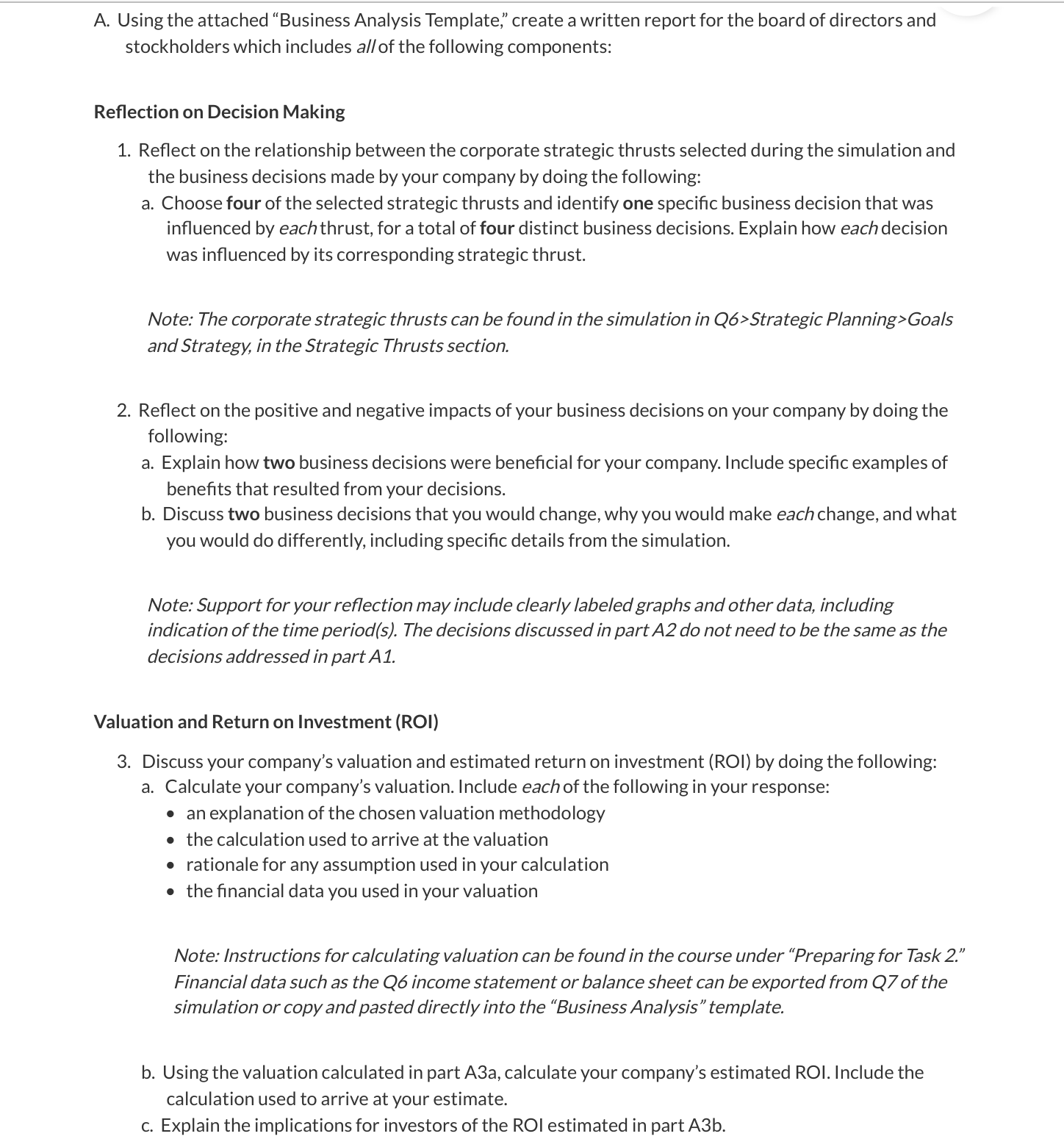
After you complete the C219 business simulation at a competent level (a cumulative total performance score above 0.000 at the end of Q6), C219 Task 2 asks you to turn that simulation history into a written Business Analysis Report for the board of directors and stockholders. You’ll use the “Business Analysis Template” to analyze the decisions you made throughout the simulation and evaluate where the company stands financially right now.
This isn’t a reflection paper you can write from memory. Every section needs evidence pulled directly from your simulation: strategic thrusts, financial reports, Q6 ratios, cash flow totals, and your conscious scorecard.
C219 Task 2 Perfect Score Guide
What Is C219 Task 2?
In plain terms: you’re looking back at the decisions you made in the simulation, figuring out what those decisions actually did to the company, calculating the company’s valuation and estimated ROI, and evaluating its overall financial health.
The assignment breaks into four major areas:
- Reflection on decision making (A1 and A2): connecting strategic thrusts to decisions, then evaluating which decisions helped and which you’d change.
- Valuation and ROI (A3): calculating the company’s valuation, estimating ROI from that valuation, and explaining what it means for investors.
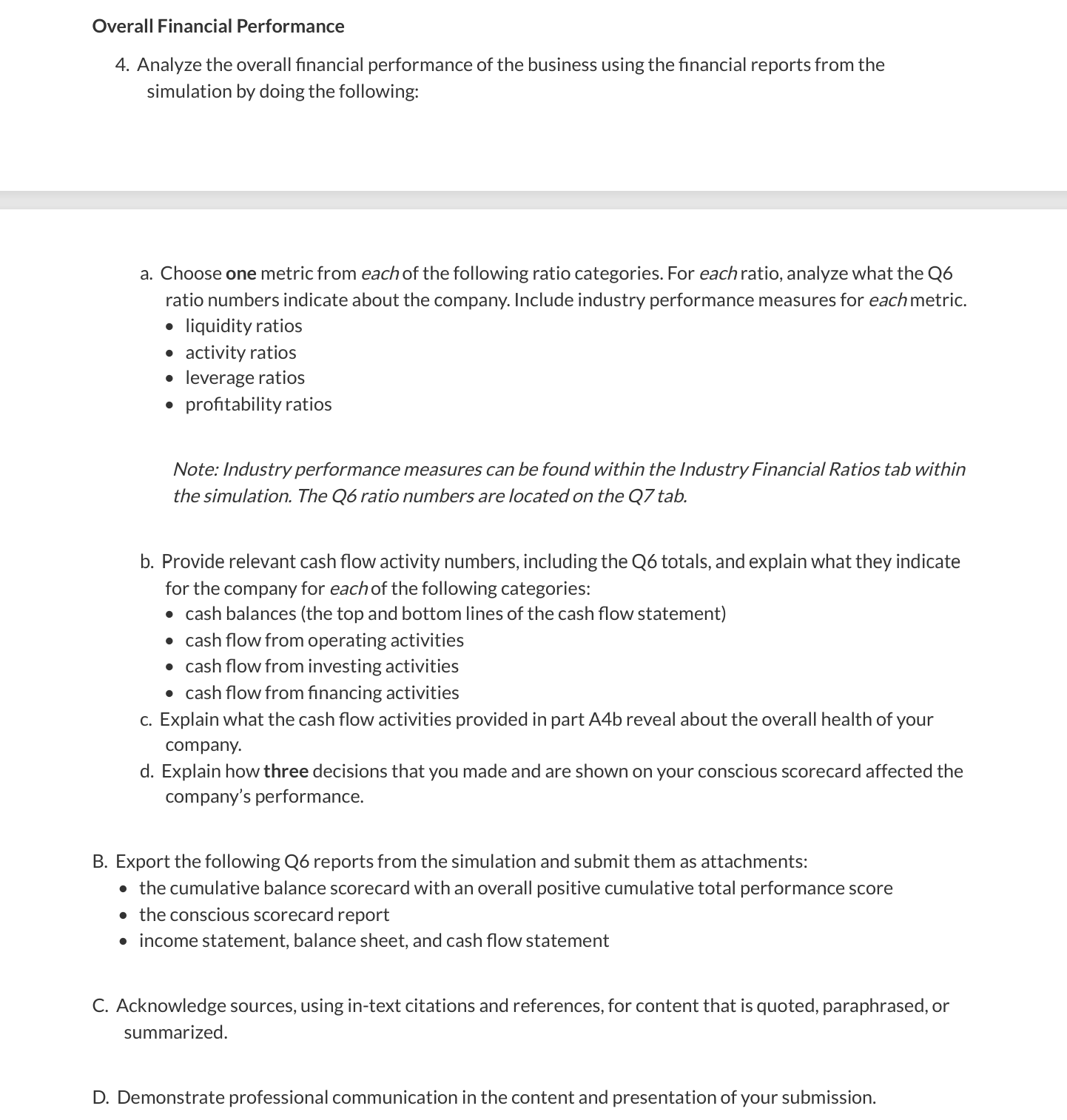
- Overall financial performance (A4): analyzing financial ratios, cash flow, and conscious-scorecard decisions.
- Required reports and submission requirements (B, C, D): the Q6 attachments, sources, and professional communication.
C219 Task 2 at a Glance
| Part | What You Need to Do |
|---|---|
| A1 | Connect 4 strategic thrusts to 4 distinct business decisions |
| A2a | Explain 2 beneficial decisions |
| A2b | Identify 2 decisions you would change |
| A3a | Calculate company valuation |
| A3b | Calculate estimated ROI |
| A3c | Explain ROI implications for investors |
| A4a | Analyze 4 financial ratios |
| A4b | Analyze Q6 cash flow activity |
| A4c | Explain overall financial health |
| A4d | Explain 3 conscious-scorecard decisions |
| B | Attach required Q6 reports |
| C | Cite sources |
| D | Demonstrate professional communication |

C219 Task 2 A1: Connect Strategic Thrusts to Business Decisions
You’ll find the corporate strategic thrusts inside the simulation at Q6 > Strategic Planning > Goals and Strategy > Strategic Thrusts.
The requirement: choose four of the selected strategic thrusts, and for each one, identify one specific business decision it influenced, for a total of four distinct decisions. Then explain how each thrust actually influenced its corresponding decision.
Use this structure for each pair:
Strategic Thrust → Decision → Explanation
Naming a thrust and a decision side by side isn’t enough. The explanation is where the credit lives: why did that thrust push you toward that specific decision? What would have been different if the thrust weren’t part of your strategy?
One detail that trips people up: the four decisions must be distinct from each other. Reusing the same decision under two different thrusts is one of the fastest ways to fall short here.
C219 Task 2 A2: Evaluate Your Business Decisions
This section splits into two opposite reflections, and the decisions you use don’t need to overlap with the ones you picked for A1.
A2a: Two Decisions That Benefited the Company
Pick two decisions that produced a measurable or clearly observable benefit. For each one, use:
Decision → Evidence → Benefit
The rubric specifically wants “relevant specific examples of the benefits resulting from both decisions,” not a general claim that the decision “worked out well.” Point to what actually happened in your simulation data.
A2b: Two Decisions You Would Change
Pick two different decisions you’d handle differently if you could redo the simulation. For each one:
Decision → Problem → Why You’d Change It → What You’d Do Differently
Both halves matter here. Saying you’d change a decision without explaining why, or explaining why without saying what you’d actually do instead, leaves this half-finished. The task explicitly asks for specific details from the simulation, so ground both decisions in your actual results, not general business logic.
C219 Task 2 A3: Valuation and ROI
This is the section where the article needs to slow down, because it’s easy to guess at a formula that isn’t actually the one your course expects.
A3a: Calculate Company Valuation
Your response needs four components:
- The valuation methodology you chose
- The calculation used to arrive at the valuation
- Rationale for any assumptions you made
- The financial data you used
Here’s the important part: the assignment directs you to the course’s “Preparing for Task 2” materials for the valuation methodology. It doesn’t specify a single universal formula in the task instructions themselves. If you’re not sure which method to use, that’s where to look, not a generic online guide to business valuation. Financial data like your Q6 income statement or balance sheet can be exported from Q7 of the simulation, or copied directly into the Business Analysis template.
A3b: Calculate Estimated ROI
Your ROI has to be calculated using the valuation you produced in A3a, and you need to show the calculation, not just the final number. If your ROI figure isn’t traceable back to your A3a valuation, this section won’t hold up under the rubric.
Valuation (A3a) → ROI Calculation → Estimated ROI
A3c: Explain the ROI for Investors
Don’t stop at reporting the percentage. The task wants you to interpret it:
- What does this estimated return suggest about the company?
- Is this an attractive or a weaker investment position?
- What from your simulation results supports that read?
The explanation has to logically follow from your actual A3b number, not a generic statement about what good ROI looks like in general.

C219 Task 2 A4: Overall Financial Performance
This is the largest analytical section, and it has four parts of its own.
A4a: Four Financial Ratios
Choose one metric from each of these categories:
- Liquidity
- Activity
- Leverage
- Profitability
For each one, use:
Q6 Ratio → Industry Measure → Comparison → What It Indicates
Industry performance measures are in the Industry Financial Ratios tab within the simulation. Your Q6 ratio numbers are on the Q7 tab. The rubric specifically requires industry comparison data for every metric, not just your own number in isolation. Pull your actual figures; don’t estimate or approximate them.
A4b: Cash Flow Activities
Cover all four required categories, and include the Q6 totals for each:
- Cash balances: the top and bottom lines of the cash flow statement
- Operating activities: what it says about the company’s core business
- Investing activities: what the cash used or generated through investing indicates
- Financing activities: what financing cash flows indicate
A list of numbers without explanation doesn’t meet the requirement. Each category needs its Q6 total and an explanation of what it signals about the company.
A4c: Overall Financial Health
Bring A4a and A4b together into one conclusion, without just repeating every ratio and cash flow number you already covered.
Ratios + Industry Comparison + Cash Flow → Overall Financial Health
The question to answer directly: based on everything above, how financially healthy is this company right now?
A4d: Three Conscious Scorecard Decisions
Select three decisions that are actually shown on your conscious scorecard, and explain how each one affected the company’s performance.
Decision → Performance Effect → Explanation
The rubric is specific that these three decisions need to be accurately identified from the conscious scorecard itself. Discussing a decision that isn’t shown there, even if it was a real decision you made, doesn’t meet this requirement.
Required Q6 Reports for C219 Task 2
Part B requires you to export these from the simulation and submit them as attachments, not just reference them inside your report text:
- Cumulative balance scorecard, with an overall positive cumulative total performance score
- Conscious scorecard report
- Income statement
- Balance sheet
- Cash flow statement
Missing even one of these attachments is enough to fall short on Part B, regardless of how strong the written analysis is.
Sources and Professional Communication
Sources (Part C): any content that’s quoted, paraphrased, or summarized needs both in-text citations and a matching reference list that accurately identifies the author, date, title, and source location where available.
Professional communication (Part D): clear sentences, correct grammar, contextual spelling, and punctuation that support accurate interpretation of your analysis. The assignment notes that Professional Communication is automatically assessed through Grammarly for Education in most performance assessments, and the overall submission won’t pass without this aspect passing. Review that feedback before you submit, not after.
How to Organize C219 Task 2 If You Work Full Time
- Confirm the simulation is completed at a competent level.
- Export the required Q6 reports.
- Record your four strategic thrusts.
- Match each thrust to a distinct decision.
- Identify two beneficial decisions.
- Identify two decisions you’d change.
- Gather your valuation information.
- Calculate valuation and ROI.
- Record one ratio from each category with the matching industry measure.
- Record your Q6 cash-flow totals.
- Select three conscious-scorecard decisions.
- Draft the report using the Business Analysis Template.
- Review your draft against the rubric line by line.
- Run your Grammarly and similarity checks.
- Submit.
Working through it in this order keeps you from writing the valuation section before you’ve actually confirmed which methodology your course wants, or writing your financial health conclusion before you’ve pulled the ratios that conclusion needs to rest on.
C219 Task 2 Common Mistakes
- Listing thrusts without explaining their influence. Naming a strategic thrust next to a decision isn’t the same as explaining how the thrust shaped that decision.
- Reusing the same decision. The four A1 decisions need to be distinct from each other.
- Giving unsupported claims about benefits. “This decision helped” needs a specific example behind it.
- Saying what should change without explaining what you’d do instead. Both halves of A2b are required.
- Using an incorrect or unsupported valuation calculation. If your course’s “Preparing for Task 2” materials specify a methodology, use it rather than a generic formula you found elsewhere.
- Calculating ROI independently of valuation. Your A3b number has to trace back to your A3a valuation.
- Giving ratios without industry comparison. Every one of the four ratios needs its industry measure alongside it.
- Listing cash-flow figures without analysis. Each category needs both its Q6 total and an explanation.
- Discussing decisions not shown on the conscious scorecard. A4d decisions must be ones the scorecard actually reflects.
- Forgetting required Q6 attachments. All five reports need to be attached, not referenced.
- Ignoring professional communication. Run Grammarly for Education before you submit, not as an afterthought.
C219 Task 2 Final Checklist
- 4 strategic thrusts selected
- 4 distinct decisions connected to those thrusts
- 2 beneficial decisions explained with specific evidence
- 2 decisions identified for change
- Reasons for changing both decisions provided
- Alternative actions explained for both decisions
- Company valuation calculated
- Valuation methodology explained
- Assumptions and rationale explained
- Financial data used identified
- Estimated ROI calculated and traced back to the valuation
- Investor implications explained
- 4 financial ratios analyzed (one per category)
- Industry measures included for each ratio
- Q6 cash flow totals included for all four categories
- Overall financial health explained
- 3 conscious-scorecard decisions analyzed
- Required Q6 reports attached (cumulative balance scorecard, conscious scorecard, income statement, balance sheet, cash flow statement)
- Citations and reference list included where required
- Professional communication reviewed through Grammarly for Education
Not sure your analysis covers everything the rubric is looking for? Get a practical review before you submit, on your strategic thrust connections, your valuation logic, or how well your financial health conclusion actually follows from your ratios and cash flow.

Related Resources
C219 Task 1 Example and Guide: MBA Capstone Investor Presentation
WGU D361 Task 2 Example and Guide: Competitive Analysis (SWOT, Strategic Graphs, SMART Goals)
C207 QUM3 Task 1 Example and Guide: Regression Analysis – Data-Driven Decision Making C207 PRFA
EHM2 C206 Task 2 (Paradigm Toys): Competent Example and Guide
WGU D472 Task 1 Guide: Operations and Supply Chain Disruption Presentation