
C207 Task 2 Review: Rubric Check Before You Submit

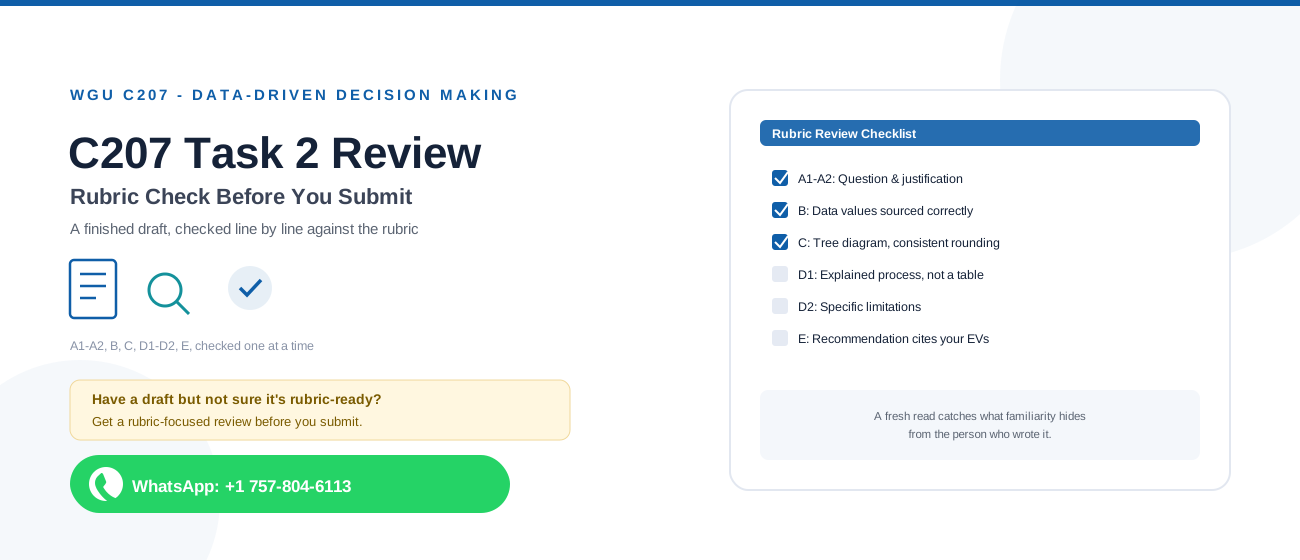
You’ve built your decision tree, calculated your expected values, and written your report. Before you upload it, the question that matters most isn’t “did I finish,” it’s “does this actually hold up against the rubric.” A C207 Task 2 review is a line-by-line check of a finished draft, catching the gap between a submission that looks complete and one that’s actually rubric-ready.
This page walks through how to self-review your draft before you submit, what a second reviewer typically catches that self-review misses, and where to get a rubric-focused review if you want one. If you haven’t built your draft yet and need to understand the method first, our C207 Task 2 Tutor page covers tutoring specifically; this page assumes you already have something written and want it checked.
What a C207 Task 2 Review Actually Checks
A rubric review isn’t a grammar pass, though professional communication matters too. It’s a check of whether each section of your report does what the rubric requires, not just whether it covers the topic in general terms.
| Section | What “Complete” Looks Like | What a Review Catches |
|---|---|---|
| A1: Business question | Names specific alternatives, framed as an expected-value comparison | A question too broad to actually test against your calculations |
| A2: Technique justification | Ties decision tree analysis to this scenario’s specific structure | A generic explanation of decision trees that could apply to any scenario |
| B: Data values | Probabilities, profits, and demand identified for every alternative | A missing value, or data assigned to the wrong branch |
| C: Decision tree diagram | State-of-nature nodes, payoffs, and expected values, consistently rounded | Payoffs and EVs rounded to different decimal places within the same tree |
| D1: Expected value explanation | Walks through the calculation process | A results table standing in for an explanation |
| D2: Limitations | One limitation tied to a specific value, one tied to the technique | A generic limitation with nothing specific behind it |
| E: Recommendation | References your calculated EVs directly, includes a backup option | A recommendation that doesn’t cite your numbers, or a missing backup |
How to Self-Review Your C207 Task 2 Draft
Before you ever send a draft to someone else, you can catch a lot on your own. Here’s a practical process:
Step 1: Read Only Your A1 and A2 Sections
Ask: could a stranger who’s never seen your dataset understand exactly what decision you’re evaluating and why decision tree analysis is the right tool for it? If your business question could apply to a different scenario with a find-and-replace, it’s too generic.
Step 2: Trace Every Number in Part B Back to Your Source Data
For every alternative, confirm you have a probability, a profit figure, and a demand value, and that each one is actually pulled from your assigned dataset rather than estimated from memory.
Step 3: Check Your Rounding Consistency
Pick one decimal standard (the task typically expects two decimal places) and scan your entire tree and report for anywhere that standard slips. This is one of the fastest wins in a self-review, since it’s purely mechanical.
Step 4: Read D1 Out Loud
If reading your D1 section out loud sounds like narrating a spreadsheet (“the EV for option A is X, the EV for option B is Y”), it’s a table wearing a paragraph’s clothing. A real explanation walks through how you multiplied payoffs by probabilities and summed the results, not just what the outputs were.
Step 5: Stress-Test Your D2 Limitations
For each limitation, ask “specific to what?” If you can’t answer that (a specific data value, a specific weakness of decision tree analysis as a technique), the limitation is too vague to hold up.
Step 6: Confirm E Actually Cites Your Numbers
Your recommendation should reference your calculated expected values directly, not just land on a conclusion that happens to match them. And check whether your version of the scenario expects a backup recommendation alongside the primary one.

What a Second Reviewer Catches That Self-Review Often Misses
Self-review closes a lot of gaps, but it has a blind spot: you already know what you meant to say, so it’s hard to notice when your writing doesn’t actually say it. A second reviewer, reading cold, tends to catch:
- Places where your explanation makes sense to you but not to someone without your context. You know why you rounded a certain way; the reader doesn’t, unless you’ve stated it.
- Small inconsistencies across sections. A number in your diagram that doesn’t quite match the same number referenced in your report text.
- Whether your recommendation genuinely follows from your analysis, or just happens to land in the right place.
- Professional communication issues that are easy to miss in your own writing after staring at it for hours.
- Whether you’ve actually addressed every rubric line, versus covered the general topic without hitting the specific requirement.
This is the value of an outside review: not new information about your scenario, but a fresh read that catches what familiarity hides from you.
C207 Task 2 Review vs. Tutoring vs. Help
These three services solve different problems, and it’s worth knowing which one fits where you are right now.
| Best For | When to Use It | |
|---|---|---|
| Tutoring | Learning the decision tree method itself | Before or during your work, when the concept isn’t clear yet |
| Review | Checking a finished draft against the rubric | After you’ve written something and want it verified before submitting |
| General help | Understanding requirements and getting unstuck at any point | Anywhere in the process, when you need a mix of guidance and direction |
If you’re not sure which you need, our C207 Task 2 Help page is the broader starting point; this page is specifically for readers who already have a draft in hand.
C207 Task 2 Pre-Submission Checklist
- A1 names specific alternatives and fits an expected-value comparison
- A2 ties decision tree analysis directly to this scenario, not decision trees in general
- Every alternative in part B has a probability, profit, and demand value sourced from your dataset
- Payoffs and expected values are rounded consistently throughout
- D1 explains the calculation process, not just the results
- D2 includes one limitation tied to a specific data value
- D2 includes one limitation tied to the technique itself
- E explicitly references your calculated expected values
- Backup recommendation included, if your scenario calls for one
- Numbers match across your diagram and your written report
- Submission cleared the similarity scan
- Submission cleared Grammarly for Education
C207 Task 2 Review: What Support Looks Like
A rubric-focused review of your C207 Task 2 draft checks each section against what’s actually required, not just whether it’s present. That means confirming your D1 reads as an explained process, your D2 limitations are specific rather than generic, your E recommendation cites your own expected values, and your numbers stay consistent from diagram to write-up.

C207 Task 2 Review FAQ
What does a C207 Task 2 review check?
Whether each rubric section (business question, technique justification, data values, decision tree diagram, expected value explanation, limitations, and recommendation) meets what’s actually required, not just whether the topic is covered.
Can I review my own C207 Task 2 draft before paying for a review?
Yes, and you should. Reading your A1/A2 for specificity, tracing your data values back to the source, checking rounding consistency, reading D1 out loud, and stress-testing your D2 limitations will catch a large share of common issues on your own.
What does a second reviewer catch that I might miss?
Places where your explanation is clear to you but not to a reader without your context, small inconsistencies between your diagram and your report text, and whether your recommendation genuinely follows from your analysis rather than just landing near it.
Is a C207 Task 2 review the same as tutoring?
No. Tutoring builds your understanding of the method before or during your work. A review checks a finished draft against the rubric. See our C207 Task 2 Tutor page if you need the method explained first.
Will a review guarantee my C207 Task 2 passes?
No service can ethically guarantee a grade. A review identifies gaps against the rubric so you can address them; the final submission and outcome are yours.
How do I get my C207 Task 2 draft reviewed?
WhatsApp +1 757-804-6113 with your draft and where you’re least confident, whether that’s the expected value explanation, the limitations, or the recommendation.
References
- Schuyler, J. R., “Analyze Project Decisions: Decision Trees for Complexity”, Project Management Institute. Background on decision tree structure and expected value calculation referenced throughout this review checklist.
- Hulett, D. T., “Decision Tree Analysis for the Risk Averse Organization”, Project Management Institute. Background on decision tree analysis’s conventional link to expected monetary value and its limitations as a technique.
Related Content
- C207 Task 2 Help, the broader starting point covering requirements and common mistakes.
- C207 Task 2 Tutor, for tutoring on the decision tree method itself.
- C207 Task 2 Guide, a full worked example of the method.