
EHM2 C206 Task 2 (Paradigm Toys): Competent Example and Guide


Updated on: Aug 6, 2026
EHM2 C206 Task 2: Developing Organizational Ethics And Socially Responsible Behavior
Introduction
As an organizational leader, one of your primary roles is establishing programs and policies that ensure the organization operates under ethical considerations and legal mandates. This responsibility includes informing employees of the organization’s code of ethics, communicating the code of ethics, providing training, and ensuring that operational aspects are administered in a legal and ethical manner.
You will assume the role of a leader and decide what strategies you will use to develop a strong organizational ethical climate. In your position as a leader, you will need to identify primary and secondary stakeholders and satisfy their concerns, understand the organization’s ethical standing, and develop an ethics training program.
Scenario
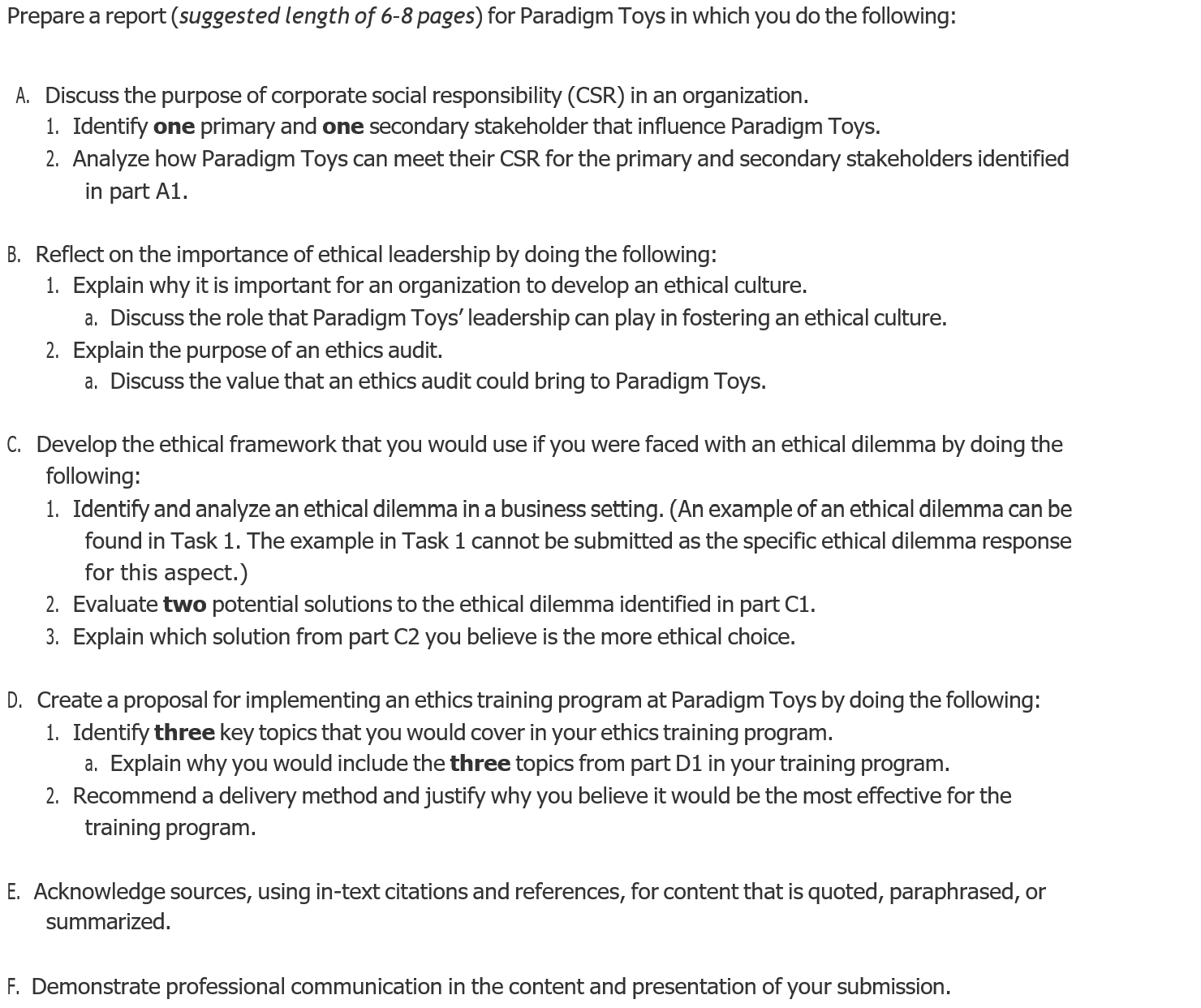
You are a business manager of Paradigm Toys, a fictional publicly held company that is a retailer and manufacturer of children’s toys. The board of directors has asked you to conduct an ethics audit of the company and report to the board if you find the need for ethics training.
Requirements
Your submission must represent your original work and understanding of the course material. Most performance assessment submissions are automatically scanned through the WGU similarity checker. Students are strongly encouraged to wait for the similarity report to generate after uploading their work and then review it to ensure Academic Authenticity guidelines are met before submitting the file for evaluation. See Understanding Similarity Reports for more information.
EHM2 C206 Task 2 Competent Example
Developing
Organizational Ethics and Socially Responsible Behavior
Student Name
Institutional Affiliation
Course
Name of Professor
Due Date
Developing
Organizational Ethics and Socially Responsible Behavior
A. Purpose of CSR
The commitment of an organization to conduct business in a way that maintains profitability while producing favorable social, economic, and environmental results is known as corporate social responsibility, or CSR (George, Kayal, & Maiti, 2023). CSR acknowledges that companies have an impact on a variety of groups outside of shareholders, such as workers, clients, suppliers, communities, and regulators. A company like Paradigm Toys, which produces and markets children's toys, can better balance its financial objectives with its ethical responsibilities and the expectations of the public by implementing a robust CSR strategy. CSR also strengthens reputation, trust, and long-term sustainability. Adopting CSR lowers the risk of legal or reputational damage, increases stakeholder confidence, and shows accountability (George, Kayal, & Maiti, 2023). CSR can become a competitive advantage in a market where customers are more inclined to support businesses that uphold moral principles.
A1. Primary and Secondary Stakeholders
Customers, especially parents, guardians, and families buying toys for kids, are one of Paradigm Toys' primary stakeholders. Customers directly affect revenue, brand loyalty, and market success. Their purchasing decisions determine whether the company grows or declines. Since customers expect safe and high-quality toys, their influence on business operations is immediate and significant (Cunha, Proen a, & Ferreira, 2022). Secondary stakeholder is the community, including schools, neighborhoods, and local organizations where Paradigm Toys operates. Although they may not directly purchase goods at the same rate as customers, community members have an impact on the company's reputation, labor availability, and social acceptability (Cunha, Proen a, & Ferreira, 2022). Community opinions can shape media coverage, partnerships, and regulatory attention.
A2. Responsibility for Stakeholders
Paradigm Toys can meet its CSR responsibilities to customers through product safety, transparency, and quality assurance. Toys should meet or exceed safety standards and undergo rigorous testing before release. Clear age labeling and accurate instructions would help customers make informed decisions. Complaints should be handled promptly and fairly by effective customer service mechanisms. These acts show that the business prioritizes child safety over immediate financial gain. Through ethical hiring procedures, charitable giving, and environmental stewardship, Paradigm Toys can fulfill its CSR obligations to the community. The business could sponsor community events, donate toys to underprivileged families, and collaborate with schools on literacy or play-based learning initiatives. Programs for waste reduction and sustainable packaging would lessen their negative effects on the environment. Additionally, local hiring practices and fair wages would improve ties within the community. These initiatives demonstrate that the company sees itself as a responsible corporate citizen as opposed to a profit-driven enterprise (Awa, Etim, & Ogbonda, 2024).
B. Importance of Ethical Leadership
Ethical leadership is essential because it shapes how employees make decisions, interact with others, and respond to pressure. An organization may have written policies, but culture is formed through leadership behavior. When leaders act honestly, employees are more likely to follow those standards. Ethical cultures promote accountability, boost morale, and reduce misconduct. Additionally, employees in ethical companies are more inclined to voice problems because they have faith that management would act justly. Given that Paradigm Toys caters to families and children, an ethical culture is very crucial. There are ethical ramifications to decisions about product materials, advertising claims, supplier standards, and recalls. Employees may disregard safety risks or misrepresent items if managers allow shortcuts. Employees are more inclined to defend clients and the company's reputation if executives place a strong emphasis on integrity (Azhar, Iqbal, & Imran, 2025).
B1A. Fostering Ethical Culture
The leadership of Paradigm Toys may promote an ethical culture by leading by example. When making judgments on a daily basis, managers and executives should provide an example of integrity, equity, and respect. Through a code of ethics, frequent meetings, and outward support for ethical conduct, leaders must convey clear expectations (Onyekwelu et al., 2024). Workers closely monitor whether leaders adhere to the same standards as others. Additionally, rather than focusing solely on financial performance, leadership should set up processes that promote ethical conduct. Metrics related to integrity, compliance, and teamwork can be included in performance reviews. Employees should be able to voice concerns through confidential reporting methods without worrying about reprisals (Onyekwelu et al., 2024). Managers are required to look into complaints in a timely and reliable manner. Leaders strengthen confidence and trust throughout the organization when they deal with misconduct in a fair manner, regardless of rank.
B2. Ethics Audit
The purpose of an ethics audit is to evaluate how well an organization s practices align with its ethical standards, policies, and legal obligations. An ethics audit examines culture, leadership behavior, and areas of risk (Onyekwelu et al., 2024). It helps identify gaps between stated values and actual operations. An ethics audit also serves as a preventative tool. Rather than waiting for scandals, lawsuits, or public criticism, organizations can detect weaknesses early and make corrections. The process encourages continuous improvement and demonstrates accountability to stakeholders.
B2A. Value of an Ethics Audit
An ethics audit would bring substantial value to Paradigm Toys. Since the company manufactures toys for children, product safety and supplier conduct are high-risk areas. The audit could evaluate whether suppliers adhere to labor and safety standards, if testing protocols are regularly followed, and whether marketing communications are truthful. Employee opinions of leadership integrity and their readiness to voice problems could potentially be gauged by the audit. If employees mistrust management or fear reprisals, issues could go unnoticed until they escalate into major emergencies. Early detection of such problems would enable Paradigm Toys to improve compliance, build confidence, and safeguard the company's reputation. Additionally, board members and investors would be reassured that ethical concerns are being actively controlled (Onyekwelu et al., 2024).
C. Ethical Framework
An effective ethical framework should include the following steps. One would be to properly and effectively identify the issue. This would then be followed by gathering facts, determine affected stakeholders, review legal and policy requirements. At this point, it would then be prudent to evaluate available options, consider long-term consequences, choose the most ethical action, and review results afterward. This framework promotes thoughtful decisions rather than emotional or rushed responses (Onyekwelu et al., 2024).
C1. Ethical Dilemma
A realistic ethical dilemma for Paradigm Toys involves discovering that a popular toy contains a small detachable part that could create a choking hazard for young children. Internal testing shows the risk is real, but the product is a top seller during the holiday season. Recalling the toy immediately would create major financial losses. Delaying action until after the holiday season would preserve revenue but expose children to possible harm. This dilemma involves conflicting pressures between profit and safety. Shareholders may focus on earnings, while customers expect child protection. Employees may fear job losses if sales decline. Leadership must decide whether to prioritize immediate business performance or consumer welfare (Onyekwelu et al., 2024).
C2. Potential Solutions
Solution One: Immediate Voluntary Recall
Paradigm Toys could stop sales immediately, issue a public recall, notify retailers, and provide refunds or replacements. This option protects children quickly and demonstrates accountability. It may create short-term financial losses, negative publicity, and operational disruption. However, transparent action can preserve long-term trust and reduce legal liability.
Solution Two: Quiet Internal Review with Delayed Action
The company could continue selling the toy while conducting further testing and planning corrective changes for a future production cycle. This option avoids immediate losses and reduces public attention in the short term. Yet it leaves children exposed to known risk and creates severe reputational danger if incidents occur or internal knowledge becomes public.
C3. Explanation of Choice
The more ethical solution is the immediate voluntary recall. Child safety should outweigh short-term profits, especially for a toy company whose core customers are families. Once leadership becomes aware of a credible hazard, continuing sales would place revenue above human welfare. That decision would violate trust and likely cause greater damage later through lawsuits, regulatory penalties, and public outrage. A recall demonstrates responsibility, honesty, and courage. Customers are often willing to forgive mistakes when organizations respond transparently and quickly. Ethical leadership requires acting correctly even when the decision is costly. Protecting children aligns with the company s mission and long-term success.
D. Proposal for an Ethics Training
Program
Paradigm Toys should implement a company-wide ethics training program for all employees, managers, and executives. Training should occur during onboarding and annually thereafter, with additional sessions for high-risk departments such as manufacturing, purchasing, and marketing.
D1. Key Topics
- Product Safety and Quality Standards
- Conflicts of Interest and Fair Decision-Making
- Reporting Misconduct and Non-Retaliation Procedures
D1A. Explanation of Key Topics
To begin with, product Safety and Quality Standards should be included because toy manufacturers must prioritize child welfare. Employees need to understand testing expectations, defect reporting, and recall procedures. Mistakes in this area can harm children and destroy trust. On the other hand, Conflicts of Interest and Fair Decision-Making should be included because purchasing, hiring, promotions, and vendor selection can be influenced by personal relationships or gifts. Training helps employees recognize bias and make objective choices that protect company integrity. Similarly, Reporting Misconduct and Non-Retaliation Procedures should be included because employees are often the first to notice unethical conduct. Workers need clear guidance on how to report concerns confidentially. A speak-up culture allows problems to be corrected early (Bran et al., 2022).
D2. Delivery Method
A blended training model that incorporates instructor-led workshops, scenario-based discussions, and online learning modules would be the most efficient delivery method. Online modules offer uniformity, ease of use, and effective cross-location tracking of completion rates. Every year, employees can do refresher training and examine regulations at their own speed. Workshops guided by instructors are beneficial because ethical issues frequently need judgment rather than memory. Employees would be better able to apply policies to actual circumstances like supplier pressure, safety concerns, or requests for deceptive advertising if talks were facilitated using genuine Paradigm Toys scenarios. Compared to using either strategy alone, this mixed approach produces better learning outcomes by striking a compromise between efficiency and engagement (Bran et al., 2022).
Conclusion
Paradigm Toys has a responsibility to operate ethically and socially responsibly because it serves children, families, employees, and communities. Strong CSR procedures, frequent ethics audits, and organized frameworks for decision-making all contribute to lower risk and more trust. Leaders must put safety and integrity ahead of immediate profits when faced with moral conundrums. A well-thought-out ethics training program will empower staff, uphold standards, and foster an environment where success is determined by doing the right thing.
References
Awa, H. O., Etim, W., & Ogbonda, E. (2024). Stakeholders, stakeholder theory and corporate social responsibility (CSR). International Journal of Corporate Social Responsibility, 9(1), 11. https://doi.org/10.1186/s40991-024-00094-y
Azhar, Z., Iqbal, T., & Imran, M. (2025). The role of ethical leadership in HRM-driven corporate social responsibility (CSR). Journal of Management & Social Science, 2(1), 158-176. https://doi.org/10.63075/jmss.v2i1.66
Bran, F., Chiotan, R. A., Jaradat, M., & Gutu, C. (2022). Analysis of the Concept of Social Responsibility at the Level of Corporations. In Proceedings of Administration and Public Management International Conference (Vol. 18, No. 1, pp. 64-71). Research Centre in Public Administration and Public Services, Bucharest, Romania. https://ideas.repec.org/a/rom/compca/v18y2022i1p64-71.html
Cunha, S., Proen a, T., & Ferreira, M. R. (2022). Employees perceptions about corporate social responsibility Understanding CSR and job engagement through meaningfulness, bottom-up approach and calling orientation. Sustainability, 14(21), 14606. https://doi.org/10.3390/su142114606
George, A. K., Kayal, P., & Maiti, M. (2023). Nexus of corporate social responsibility expenditure (CSR) and financial performance: Indian banks. The Quarterly Review of Economics and Finance, 90, 190-200. https://doi.org/10.1016/j.qref.2023.06.004
Onyekwelu, N. P., Ezeafulukwe, C., Owolabi, O. R., Asuzu, O. F., Bello, B. G., & Onyekwelu, S. C. (2024). Ethics and corporate social responsibility in HR: A comprehensive review of policies and practices. International Journal of Science and Research Archive, 11(1), 1294-1303. https://doi.org/10.30574/ijsra.2024.11.1.0216

C206 Task 2 Guide
Understanding the Assignment
You’re asked to conduct an ethics audit for a fictional company and report your findings to its board — specifically, whether the company needs ethics training. The report has four functional parts: a CSR analysis identifying who the company owes ethical responsibility to and how; a reflection on why ethical culture and ethics audits matter; a demonstration of your own ethical decision-making process applied to a real dilemma; and a concrete training program proposal.
Why WGU Uses This Assignment
Ethics failures at real companies rarely come from leaders who wake up intending to do harm. They come from leaders who never built the structures — audits, training, clear frameworks — that catch ethical drift before it becomes a scandal. This assessment tests whether you can build those structures, not just recognize unethical behavior after the fact.
Before You Begin
- Read the full scenario and identify the company’s industry and public status — both affect which stakeholders and risks are most relevant
- Note the specific instruction that your ethical dilemma for Part C cannot be the same dilemma used in Task 1 — pick something genuinely new
- Review all six rubric sections before writing, since several build on each other (your Part C dilemma should feel consistent with the CSR and culture points made in Parts A and B)
- Decide on your ethical decision-making framework (a specific ethical theory) before drafting Part C, not while you’re in the middle of it
Key Business Concepts
What Is Corporate Social Responsibility (CSR)?
CSR is an organization’s responsibility to operate in a way that accounts for its impact on the people and groups affected by it, not just its shareholders. For a deeper breakdown of the CSR framework this task draws on, see our Understanding Corporate Social Responsibility explainer.
Primary vs. Secondary Stakeholders
Primary stakeholders are directly and significantly affected by the organization’s decisions and are essential to its ongoing operation — employees, customers, shareholders. Secondary stakeholders are affected by or interested in the organization’s actions but aren’t essential to its direct operation — the local community, advocacy groups, media, regulators. Both matter; the distinction is about directness of impact and operational necessity, not about which one is “more important.”
Ethical Culture
An ethical culture is the set of shared norms, expectations, and unspoken rules that shape how people in an organization actually behave when no one’s watching closely — distinct from the values stated in an official code of ethics, which can exist on paper without being reflected in daily practice.
Ethics Audits
An ethics audit is a systematic review of an organization’s practices, policies, and culture against its stated ethical standards — designed to surface gaps between what the organization says it values and what it actually does, before those gaps become public failures.
Ethical Decision-Making Frameworks
Applying a named ethical theory — rather than just personal instinct — to a dilemma makes your reasoning traceable and defensible. If you haven’t already, our Virtue Ethics vs. Utilitarianism vs. Principle-Based Ethics explainer breaks down the three most commonly used frameworks and when each applies.

Breaking Down Every Requirement
Part A — CSR and Stakeholders
A: Purpose of CSR. State what CSR is for in general, then ground it in why it matters for a publicly held, consumer-facing company specifically — public companies face reputational and shareholder scrutiny that private companies don’t.
A1: Identify one primary and one secondary stakeholder. Pick stakeholders whose interests could plausibly create tension with each other or with the company — that tension is what makes A2 easy to write well. A stakeholder pair with no real tension between them produces a thin analysis.
A2: Analyze how the company can meet CSR for both. This needs to be genuinely distinct for each stakeholder, not one generic CSR statement applied twice. Name a specific action tied to each stakeholder’s specific interest.
Part B — Ethical Culture and Ethics Audits
B1: Why ethical culture matters. Connect this to real organizational outcomes — trust, risk reduction, employee retention — not just “it’s the right thing to do,” which won’t satisfy the rubric’s request for well-supported reasoning.
B1a: Leadership’s role in fostering it. Be specific about what leaders actually do — modeling behavior, setting policy, responding to violations consistently — not a vague “leaders should be ethical” statement.
B2: Purpose of an ethics audit. Define it functionally: what does an audit actually check, and why does that checking matter.
B2a: Value an audit brings to this specific company. Tie the value explicitly to the company’s specific situation (public status, consumer-facing, manufacturing operations) rather than a generic “audits are valuable” statement.
Part C — Ethical Dilemma and Framework
C1: Identify and analyze a dilemma — a new one, not Task 1’s. A strong dilemma has genuine competing interests where reasonable people could disagree, not an obvious right-and-wrong scenario.
C2: Evaluate two potential solutions. Both solutions need real evaluation — strengths and weaknesses — not one obviously-better option and one strawman.
C3: Explain which is more ethical, and why. This is where naming your ethical framework explicitly (utilitarian, principle-based, virtue-based) makes your reasoning traceable rather than just asserted.
Part D — Training Program Proposal
D1: Three key topics. Pick topics that connect back to gaps your audit or dilemma analysis actually surfaced — a training program that seems disconnected from the rest of your report reads as an afterthought.
D1a: Why each topic. Tie each one to a specific, named risk or gap, not a generic “this is important for all employees” statement.
D2: Delivery method, justified. Common options include in-person workshops, e-learning modules, blended approaches, or scenario-based simulations — the justification should reference this specific company’s size, structure, or workforce, not just assert that one method is “most effective” in general.
Parts E & F — Sources and Professional Communication
Same mechanics as every WGU performance assessment: complete in-text citations and a matching reference list for E, and a clean pass through Grammarly for Education for F — don’t submit before reviewing that feedback.

C206 Common Mistakes
- Picking two stakeholders with no real tension between their interests, making Part A2 thin
- Writing about ethical culture in the abstract without connecting it to this company’s specific situation
- Choosing an ethical dilemma with an obvious right answer, which makes Part C2’s two-solution evaluation weak
- Reusing Task 1’s dilemma, which the rubric explicitly disallows
- A training program that doesn’t connect back to anything the audit actually found
- Justifying a delivery method with “it’s effective” instead of a reason tied to this company
C206 Task 1 Self-Assessment Checklist
- Do my primary and secondary stakeholders have genuinely different interests?
- Is my CSR response for each stakeholder specific, not a repeated generic statement?
- Have I named a specific ethical framework in Part C3, not just an unlabeled opinion?
- Is my Part C dilemma different from my Task 1 dilemma?
- Do my three training topics each trace back to something my audit actually surfaced?
- Have I justified my delivery method with a reason specific to this company?
References & Further Reading
- Hu, Y., Yang, Y., & Lee, P. K. C. (2022). Effective Practices for Improving Service Professionals’ Ethical Behaviors: A Multiple Method Study. Frontiers in Psychology, 13. — A peer-reviewed study identifying practical, effective approaches to improving ethical behavior in service organizations, informing this guide’s emphasis on tying training topics to specific, identified gaps rather than generic content.
Frequently Asked Questions
Can my ethical dilemma be related to my Task 1 dilemma, just not identical? The rubric specifically disallows submitting Task 1’s example as your Part C response — choose a genuinely different dilemma to be safe, even if it’s thematically related.
How do I pick which ethical framework to use in Part C3? Choose whichever framework gives you the clearest, most defensible argument for the specific dilemma — a broken promise or public claim often fits principle-based reasoning well; a resource tradeoff often fits utilitarian reasoning better.
Does my ethics training program need a budget or timeline? The rubric doesn’t require one, but naming a realistic scope (who attends, roughly how long) often strengthens D2’s justification even without being explicitly required.
Is Paradigm Toys a real company? No — it’s WGU’s fictional teaching scenario for this course, and it’s shared across every student completing this task.
Is getting help with this task against WGU’s academic integrity policy? Tutoring, coaching, and editing support are a normal, accepted part of studying — most university policies explicitly support students getting this kind of help.
Related Learning Resources
- WGU C206 Task 1 Guide: Communication Portfolio
- WGU C205 Task 1 Guide: Leading Teams — Team Dynamics and Group Development (KUM1)
- WGU C203 Task 1 Guide: Personal Leadership Assessment and Profile
- WGU D361 Task 2 Guide: Competitive Analysis (SWOT, Strategic Graphs, SMART Goals)
- WGU C210 Task 2 Guide: Management and Leadership Development Program (MKM1)